

A response to Christopher Flannery.
How the Declaration Can Unite a Divided Nation
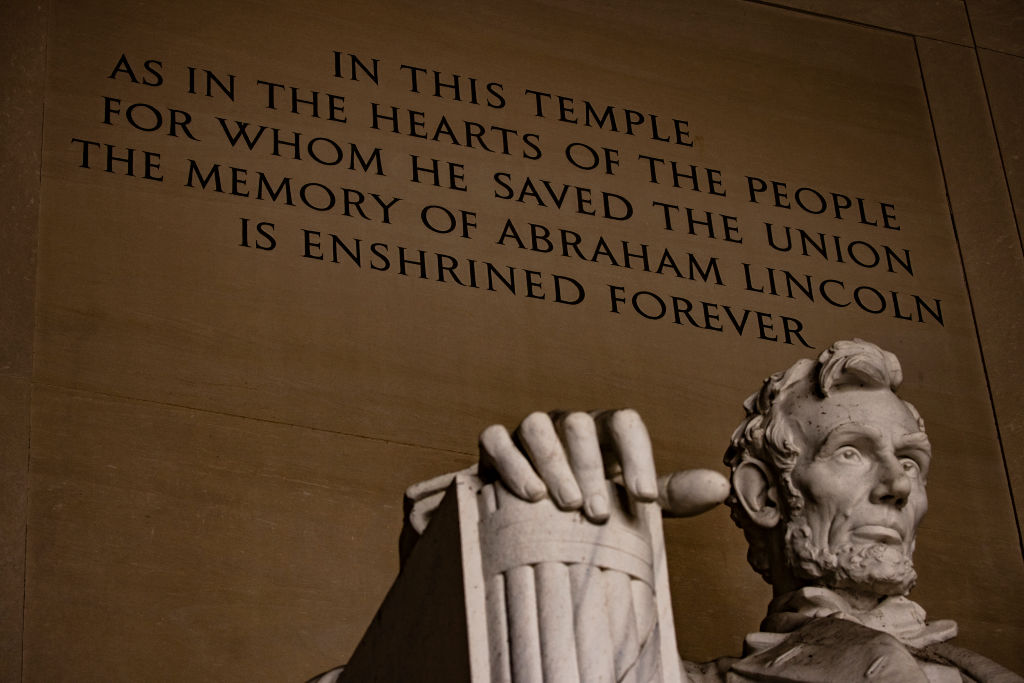
Lincoln looked back to the Founders—and so should we.
Editors’ Note
This is a lightly edited version of a speech that was given at Rededicate 250: A National Jubilee of Prayer, Praise & Thanksgiving on Sunday, May 17. As we continue to celebrate the 250th anniversary of the American Founding, we will keep publishing reflections on the meaning of the Declaration of Independence, some by Claremont scholars and others by learned friends. In this speech, Hillsdale College President Larry Arnn points Americans to the Declaration and Lincoln’s Second Inaugural Address as the path toward national reconciliation. Read all the entries in our “Declaration at 250” series here.
We know we live in serious times because the Declaration of Independence itself is controversial. Its meaning is contested or repudiated, and its authors are condemned. This very meeting is criticized as an attempt to turn America into a Christian nation. The Declaration says that under the laws of nature and nature’s God, no human being may rule another without his consent. In this respect, it is just like the New Testament, which makes each of us responsible for his own salvation.
Most people long for our divisions to be healed. How can that happen? The answer is found in the unsurpassed Second Inaugural Address of Abraham Lincoln. You should go tonight if you can, at night when it’s quiet, to the Lincoln Memorial. Stand facing Lincoln. Very beautiful. Look to your left: the Gettysburg Address, the full text. Look to your right: this Second Inaugural about which I’m speaking. It is a poem and a prayer. It says that the story of America is unique and beautiful. The beauty is offset by tragedy, and we see the beauty next to the tragedy—and see that the beauty is higher.
No speech in American history, nay in any history, better captures this beauty and tragedy. The contrast between them is the human condition, and that condition requires suffering. We can bear suffering if it has meaning. We have to share the meaning and the suffering. How did Lincoln do it? He said that the Civil War was a penance given both to the North and the South, our most costly war by far. He says in the sort of order of justice in God’s nature that if every drop of blood drawn by the lash by 250 years of the bondsman’s unrequited toil must now be repaid by another drawn by the sword, still it will be said that the ways of the Lord “are true and righteous altogether.”
We will know that our divisions are healing when we remember our purpose and take responsibility together. The solution is not to shout at each other. It is to forget about ourselves and study again the things that can guide us—the speeches of Lincoln, the mighty Declaration of Independence itself. Everyone should memorize it. Lincoln called it “the father of all moral principle” in us. He said, “Fondly do we hope, fervently do we pray, that this mighty scourge of war may speedily pass away.” Let us pray about our divisions today. Let us remember our suffering, remember its meaning, and rekindle our friendship.
The American Mind presents a range of perspectives. Views are writers’ own and do not necessarily represent those of The Claremont Institute.
The American Mind is a publication of the Claremont Institute, a non-profit 501(c)(3) organization, dedicated to restoring the principles of the American Founding to their rightful, preeminent authority in our national life. Interested in supporting our work? Gifts to the Claremont Institute are tax-deductible.
Suggested reading
Thomas Jefferson and John Adams celebrate their last Fourth of July.
Misuse is no reason to reject the Declaration’s principles altogether.

A new political vocabulary is needed for a world itself quite new.
Feel-good platitudes aren’t enough to sustain a healthy society.
Higher education has always been a religious quest.

