

With an irked chaser.
Films That Celebrate the Founding
What to watch in preparation for July 4th.
The American Founding was an epic, earthshaking, history-making event that still reverberates through the ages. For close to half of our history, America has had a filmmaking industry—Hollywood—one that has often been the envy of the world, although its global prestige has faded in recent years.
Despite the historic weight of the American Revolution, it has been mostly a spectral presence in the cinema. Even if we expand our focus to include the period from the war’s conclusion to shortly before the Civil War, Hollywood’s filmed history of early America is rather thin.
That is not to say that American history was not present on the silver screen from the medium’s earliest days. James Fenimore Cooper’s The Last of the Mohicans, based on events during the French and Indian War, was portrayed as early as 1909. In fact, there were three different films based on that book, and another film based on Cooper’s novel The Spy by 1920. Betsy Ross (1917), about the famous flag maker, still survives.
Perhaps the most ambitious film about the Founding in the silent era was D.W. Griffith’s 1924 America (also known as Love and Sacrifice), a sweeping tale running two hours and 19 minutes. With America, Griffith intended to tell a kind of American Revolution Romeo and Juliet, featuring Massachusetts patriot Nathan Holden, a minuteman, Son of Liberty, and comrade of Paul Revere, and Nancy Montague, who comes from a Loyalist, pro-British family.
America survives on YouTube, but it is a rather stodgy affair. The film emphasizes America’s deep ties with Great Britain. “Remember, America is the son—not the bastard—of England,” declares a member of Parliament. In a production supported by the Daughters of the American Revolution, all the elements of our history are there: Paul Revere’s ride, Lexington and Concord, the Declaration of Independence, Valley Forge, and Yorktown. George Washington is first seen seated and from behind, portrayed almost as a demigod. The best acting in the film is by Lionel Barrymore in an early role as the villain, the sleazy “renegade American” Captain Walter Butler, who dreams of setting up his own empire in the New World.
The film did poorly at the box office, and Griffith would make only a few more films. One of them was a talkie about Abraham Lincoln. The 16th president has been the subject of three legendary American directors—Griffith, John Ford, and Steven Spielberg. Neither George Washington nor any other historic figure of the American Revolution has had the good fortune of being the main subject of a first-rate feature film.
The ’30s continued to be slim pickings for films on the Founding, with one exception. There is Daniel Boone (1936), essentially a Western, and another version of The Last of the Mohicans (also 1936). But the star of the decade, and a personal favorite, is John Ford’s beautiful Drums Along the Mohawk (1939) with Henry Fonda. In my opinion, this classic film takes place during the American Revolution, with Utah subbing for Upstate New York circa 1776. Any red-blooded American will tear up during the last scene, as Fonda and the settlers raise the American flag at their fort.
I like three other American Founding films from the following decade of the Golden Age of Hollywood. The Howards of Virginia (1940) was poorly received at the time (except by Bosley Crowther of the New York Times, who called it “among the best historical pictures yet made”), and its star Cary Grant hated it, but I think it is very underrated. Directed by Frank Lloyd, who made the 1935 version of Mutiny on the Bounty, it is essentially a family drama set in Revolutionary War Virginia featuring the struggle between the old Tidewater elite and the rude folk of the frontier. John D. Rockefeller Jr. gave Columbia Pictures the right to film much of the movie at the recently restored Colonial Williamsburg.
It is a touching story, well-acted (except for Grant, according to the critics), and deeply grounded in the American experience. Rough frontiersman Matt Howard (Grant) looks to the West—to Ohio—but settles in the Shenandoah Valley with his new bride. Here, he and his genteel wife (Martha Scott) hew a plantation from the wilderness; “nothing matters in this world, here will be order and dignity.” A sympathetic Thomas Jefferson is a key supporting figure in the film.
While The Howards of Virginia is mostly forgotten, All That Money Can Buy (1941), directed by the great German exile William Dieterle, is a deservedly revered film classic based on the Stephen Vincent Benét short story “The Devil and Daniel Webster.” Beautifully made and deeply evocative of small-town, rural America and the ways of the old republic. When “Black” Daniel Webster speaks, “they say the Stars and Stripes come right out of the sky.” While not properly a War of Independence subject—it takes place in the 1840s—it very much fits into the spirit of the American Founding, a powerful, deeply patriotic film even though it is essentially a homespun fantasy comedy.
My third American Founding favorite from the ’40s is Cecil B. DeMille’s frontier spectacular Unconquered (1947) with Gary Cooper. DeMille was popular with audiences and mostly disliked by the critics, and this film is very much typical of DeMille’s work—lavish, entertaining, somewhat vulgar, and colorful. It takes place on the old American frontier, which in 1763 was essentially Western Pennsylvania. If one can stomach the hokum—Boris Karloff as an Indian chief, Italian American Iron Eyes Cody is listed as an advisor for Indian languages—you certainly won’t be bored. There seem to be more big-budget Hollywood spectaculars about the period of the French and Indian War/Pontiac’s Rebellion (Last of the Mohicans/Allegheny Uprising/Northwest Passage/Unconquered) than about the American War of Independence that followed it. Young Washington, a film released that same year, also focused on the French and Indian War.
I don’t much care for the 1955 The Scarlet Coat, which is a good-looking but dull spy adventure about the Benedict Arnold affair. But 1959’s The Devil’s Disciple, a witty comedy adventure based on the George Bernard Shaw play, is very entertaining. The only problem with it is that Laurence Olivier as British General Burgoyne steals the film from the patriot heroes Kirk Douglas and Burt Lancaster.
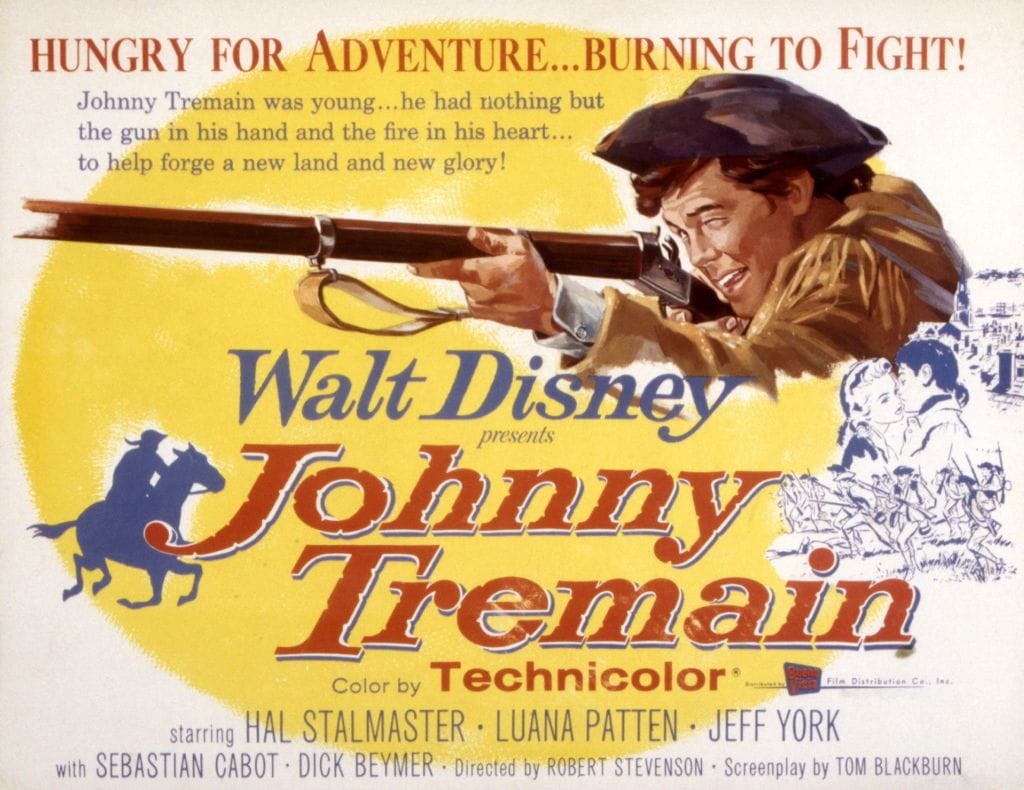
For aficionados of movies on the American Founding, the popular 1972 musical comedy 1776 is an obvious choice which I endorse. I first saw it in public school, where we also saw Disney’s Johnny Tremain and read Howard Fast’s April Morning. It has great songs and silly bits, but it tells a serious story, mostly accurately, and tells it well. I first learned of that great patriot from Delaware, Caesar Rodney, by watching it. Interestingly, actor Howard da Silva, who plays Ben Franklin in 1776, was the villain in 1947’s Unconquered.
The following decades would see a profusion of American Founding content coming out not in feature films but on television, either as television movies, series television (Turn: Washington’s Spies), or miniseries (John Adams, Franklin) shown on broadcast, cable, or streaming services. Though the results were mixed, even when good, they were often constrained by the limits of television in comparison to feature films, with smaller budgets and poorer production values. Despite that, the made-for-television movies of April Morning (1988), on Lexington and Concord, and The Crossing (2000), on the battle of Trenton, are quite good. Both are based on the work of the former Communist (and 1953 Stalin Prize winner) Howard Fast, a former Red but a man who could write.
My last two choices are obvious ones, both very well-known, popular feature films: the 1992 version of The Last of the Mohicans, directed by Michael Mann, and Mel Gibson’s fine 2000 film The Patriot, a highly fictionalized telling of Southern patriot partisans like Francis Marion and Thomas Sumter. Both are expansive, epic films that echo the titanic continent-wide scope of the American struggle for freedom, a war for the New World. There is nothing narrow or pinched in them.
That is only eight recommended feature films (maybe ten if you throw in a couple of television movies), a very modest haul indeed for over a century of American movie-making. I wish there were more.
It is easy to decry the anti-American nature of Hollywood, yet patriotic movies have always been part of its output—especially war and Western films—even if the American Founding itself has been largely neglected. So it isn’t that Hollywood is completely incapable of making such films. Perhaps part of the problem is that the stirring events of the American Revolution were too well known for American filmgoers. Now it seems that they are too little known.
Part of the challenge is inherent in making historical films about real-life historical figures. It is not easy to do without coming across as hackneyed or trite, especially in our cynical age. Some filmmakers seemed to have had a knack for history—the great John Ford, who wanted to make April Morning with John Wayne, and John Milius, who once wrote a treatment for a Daniel Boone movie, come to mind. We need to identify more rare talents for our time.
There are certainly many unexplored topics suitable for the wide screen if someone has the vision and the funding. Serious treatments of the likes of Daniel Boone, Daniel Morgan, Casimir Pulaski, and Peter Francisco need to be made. John Paul Jones, the “Father of the American Navy,” was the subject of one bad movie in 1959. He deserves better.
There is cinematic gold to be mined in the plots to overthrow General Washington, such as the Conway Cabal. Cooper’s Last of the Mohicans has been remade 11 times, from 1909 to 1992. But the same author’s The Spy, which actually takes place during the War of Independence and features George Washington in a key role, was last brought to the screen in 1914! There are the once highly regarded Revolutionary War novels of South Carolinian William Gilmore Simms. Screenwriter William Monahan produced a supposedly great script for Ridley Scott titled Tripoli, covering the early American Barbary Wars. But the film was never made.
What seems lacking is that fleeting combination of a sincere patriotic and historic vision, real talent, and the means to implement a project. But that has always been the struggle, not just in Hollywood, but for all types of art.
The American Mind presents a range of perspectives. Views are writers’ own and do not necessarily represent those of The Claremont Institute.
The American Mind is a publication of the Claremont Institute, a non-profit 501(c)(3) organization, dedicated to restoring the principles of the American Founding to their rightful, preeminent authority in our national life. Interested in supporting our work? Gifts to the Claremont Institute are tax-deductible.
Suggested reading
Wokeism is the essence of anarchy.

American exceptionalism is at the source.
We will no longer go abroad in search of monsters to destroy.
Feel-good platitudes aren’t enough to sustain a healthy society.
What should bind Americans together?

