

If they can’t have their way, they want to burn it down.
Birthright Citizenship and the Catholic Bishops
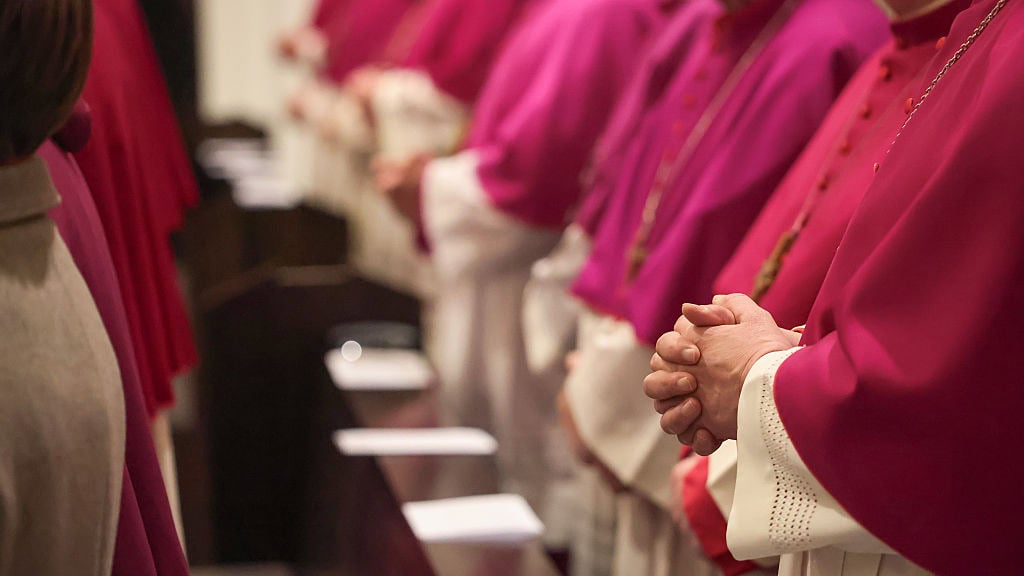
The curious case of an incoherent amicus brief.
While many of us are currently monitoring the situation in the Iranian fog of war, other pressing questions at home remain. What sort of victory against foreign enemies will we have if we end up losing our country to internal threats?
I am speaking, of course, of the migration crisis, which has thrown the very concept of American citizenship itself into doubt. After decades of treating citizenship like some ethereal idea, theoretically extendable to anyone who wants it, Americans have finally woken up to the fact that citizenship must be more than a piece of paper. New questions, as well as new battle lines, have emerged not only around illegal and legal immigration—but even the idea of birthright citizenship is now up for legal reexamination.
It’s against this larger background, then, that we should view Trump v. Barbara, a case the U.S. Supreme Court will begin hearing on April 1. At stake is whether our laws permit Americans to have a country or not. The Court will hear the government defend the proposition that birthright citizenship does not include children born to parents who are “unlawfully present,” or who have only “temporary” status. Such conditions on citizenship are very common among many nations, including numerous historically Christian nations.
Enter the curious case of a 29-page amicus curiae—a strange train wreck of a legal brief in support of birthright citizenship filed last week with the Court. It produced an immediate firestorm of controversy, which far exceeded the attention usually given to the dozens of briefs filed in cases of this magnitude. Why does it matter? It was filed in the name of the United States Conference of Catholic Bishops (USCCB) and its immigration legal services arm, CLINIC.
Weak Tea
The amicus brief asserts that anything short of an unconditional and unrestricted understanding of birthright citizenship is not just unconstitutional—something the Court must consider—but also immoral. According to the brief, if a criminal enters our country illegally and has a child, that child has a natural right to American citizenship.
Such an argument, if we were to accept it, would logically require that most of the nations of the world are immoral because they set similar conditions on citizenship. The logical fallacy extends further in the confusion of conventional rights—how a nation determines who is and is not eligible for citizenship—with natural rights, which come from God and which inhere in human beings as such. The bishops’ brief implies that birthright citizenship is the same as the right to life. In other words, the president’s proposed conditions on birthright citizenship are morally equivalent to the evil of abortion. Strong stuff, if it weren’t so embarrassingly weak.
It was for this reason that the brief was immediately attacked by every quarter, slammed by Southern Baptists, Presbyterians, and Catholics, as well as think tank presidents and law professors. But to understand fully why it generated so much heat (and no light), we need to find out who wrote it and the political aims of both lawyer and clients. Once we’ve understood these things, we’ll have a better idea not only about this tempest, but also a better grasp of what we’re really fighting about.
The Real Culprit
The principal author of the USCCB’s amicus brief is Matthew Martens, a D.C.-based partner at WilmerHale, a large, prestigious law firm known for supporting same-sex marriage in Obergefell and defending a right to abortion in Dobbs-related cases. Martens has regularly drafted religious liberty-oriented briefs for a variety of clients, from the Little Sisters of the Poor to the American Hindu Alliance.
He is also a vocal Christian critic of President Trump, which is evidenced in the brief itself. So we have to ask whether those antipathies also belong to his clients, the USCCB and CLINIC, a USCCB-founded immigration legal advocacy group that provides legal services, training, and advocacy for about half a million immigrants in the United States. It is a notable fact that the USCCB spent most of last year suing the government for reimbursements after $100 million in funding for its Migration and Refugee Services was cut, ending a half-century-long partnership with the government. So was the brief filed in revenge for the funding cuts?
One clue in answering this question was not immediately apparent to me. But an attorney friend pointed out that the USCCB’s general counsel, William Quinn, did not sign the amicus brief as is customary. He told me, “It can only mean one thing”: William Quinn didn’t sign the brief “because he didn’t agree with it.” I expect he didn’t agree because he’s a reasonable person and a good lawyer, and whatever his own views, he didn’t want to sign something so poorly argued. I am only speculating, of course, but it’s reasonable to infer that if he didn’t sign it, he would’ve counseled conference leadership against advancing the brief. It seems he was overruled since the brief was filed. But equally unusual is that not a single representative from CLINIC or the USCCB signed the brief either.
A quick glance at the brief demonstrates why. It doesn’t attempt to sway the Court’s opinion on anything other than affirming the basic pieties of liberal orthodoxy on birthright citizenship. Despite a few non-sequitur invocations of the Catholic Catechism, the brief makes no serious attempt to teach anything about what the Catholic Church means by inherent human dignity, natural rights, morality, or the relative autonomy of states to make prudential decisions about citizenship. One could argue that it was only signed by Matthew Martens and his WilmerHale colleagues because it didn’t speak for the Church at all.
The immediate backlash from organizations like Catholic Vote and The Heritage Foundation, along with a wide range of public commentators, was proof enough that this brief was not a “friend of the court” or the Church.
I am certain that a great many good and holy bishops regret the brief being put forward in their name. I am also certain that some are very satisfied with the virtue signals it sends to the cosmopolitan liberal class. But perhaps there is a silver lining—perhaps this curiously unsigned amicus brief is really a felix culpa (happy fault) in disguise.
Seen from an entirely different angle, the brief unintentionally proves the opposite of its two central claims:
- It seeks to show that restricting birthright citizenship would be “unconstitutional,” yet by making such a logical mess of that argument, it shows that the government’s textualist interpretation of the 14th Amendment should be considered within constitutional bounds.
- Similarly, by making such a moral muddle of the claim that any restriction or denial of birthright citizenship is “immoral,” constituting an affront to human dignity, Matthew Martens ironically and unintentionally proves that there is no natural right to birthright citizenship at all.
Sometimes God writes straight in crooked lines.
Determining Citizenship
American Christians, Protestant and Catholic alike, have been so captivated and captured by the implicit open borders theology of liberalism that too many have forgotten how to think like Christians—and like Americans.
Unrestricted and unconditional birthright citizenship might have been a prudential win when America was drawing on the deposit of Christian Europe in the early 20th century. But today we must rethink all those assumptions anew. Citizenship is not directly a question of natural rights, and so birthright citizenship cannot be treated as something that is owed to all by dint of being human.
Yet citizenship is not simply a legal question either. We are, after all, “one nation under God.” Why shouldn’t citizenship have something to do with the moral and religious particularities of our country? After all, citizenship has always been tied to questions of family, heritage, history, and faith. If being an American means belonging to a “particular common good,” as Aquinas would teach us, what are the moral particulars of being American—and what is the good peculiar to us? If families are the fundamental unit of political society, as Aristotle and the Catholic Church alike teach, doesn’t family matter when considering birthright citizenship? Is breaking our immigration laws a fitting foundation for sharing in the American way of life? And who is morally bound to safeguard these goods? None of these are neutral questions, but they are the better ones to ask.
The Supreme Court will likely stick to the broadest definition of the 14th Amendment in its ruling this summer, which is unfortunate since we need a much more refined debate. But I think that this little tempest in a teapot reveals that we are hungry for far better answers to these questions of what makes us American. I suspect that the battle over birthright citizenship has only just begun.
The American Mind presents a range of perspectives. Views are writers’ own and do not necessarily represent those of The Claremont Institute.
The American Mind is a publication of the Claremont Institute, a non-profit 501(c)(3) organization, dedicated to restoring the principles of the American Founding to their rightful, preeminent authority in our national life. Interested in supporting our work? Gifts to the Claremont Institute are tax-deductible.
Suggested reading


Officer selection and training cannot be placed at the service of the diversity regime.

This Supreme Court term could be consequential.

The Editor-in-Chief of the viral satire website tells his story, addresses factchecking controversies, and explores the philosophy of the Bee.
“Pride Month” and the cardinal sin.
Old-time liberals would not recognize the doctrine that speaks in their name.

