

Why African Americans should be very, very mad at the Democratic Party
Barack of Ages
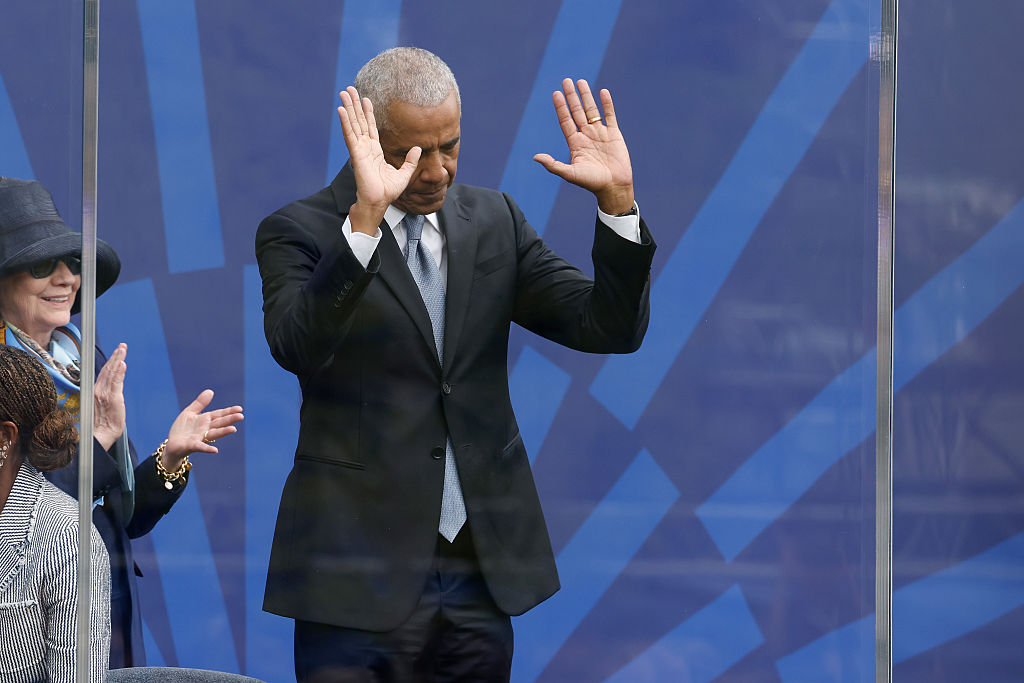
What, if anything, Obama meant.
Editors’ Note
What follows is an excerpt from William Voegeli’s essay, “Barack of Ages,” from the Fall 2026 issue of the Claremont Review of Books.
The Obama Presidential Center, located on Chicago’s South Side, opened in June 2026, nine years and five months after Barack Obama’s term in office concluded. The politicians who build these centers force themselves to run one final fundraising gauntlet, not to finance an election campaign but to leave behind an edifice that makes an enduring case for their probity, sagacity, and historical importance.
What sets Obama apart is that he began publicly discussing the greatness he hoped for prior to occupying, winning, or seeking the nation’s highest office. “My attitude about something like the presidency is that you don’t want to just be the president,” Barack Obama told journalist Jacob Weisberg in 2006. “You want to change the country. You want to make a unique contribution. You want to be a great president.” Later in the interview he said, “There are, what, maybe 10 presidents in our history out of 40-something who you can truly say led the country? And then there are 30 who just kind of did their best.”
At the time, having been elected to the U.S. Senate in 2004 after serving eight years in the Illinois state legislature, Obama was still a Washington, D.C. newcomer. The author of The Audacity of Hope (2006) lived up to his book’s title in October 2006, during an appearance on NBC’s Meet the Press. “When I think about great presidents, I think about those who transform how we think about ourselves as a country in fundamental ways,” Obama said. Specifically, “they transformed the culture” rather than “simply promoted one or two particular issues.”
After Obama announced his candidacy in February 2007, he continued to dilate on history’s judgment. “Ronald Reagan changed the trajectory of America in a way that Richard Nixon did not and in a way that Bill Clinton did not,” Obama told the Reno Gazette-Journal in January 2008. “He put us on a fundamentally different path because the country was ready for it.”
In June 2008, when the South Dakota and Montana primary results clinched the Democratic presidential nomination for Obama, his victory speech was astonishingly grandiose:
I am absolutely certain that generations from now, we will be able to look back and tell our children that this was the moment when we began to provide care for the sick and good jobs to the jobless; this was the moment when the rise of the oceans began to slow and our planet began to heal; this was the moment when we ended a war and secured our nation and restored our image as the last, best hope on Earth. This was the moment—this was the time—when we came together to remake this great nation so that it may always reflect our very best selves, and our highest ideals.
The Obama Presidential Center’s opening elicited many assessments of the 44th president’s legacy, but few reassessments. Politicians and writers who criticized Obama in the decade between the beginning of his candidacy and the end of his presidency reaffirmed their critiques, and those who supported him reiterated their high regard.
Notably absent from the latter takes, however, were claims that Obama had fulfilled the lofty expectations he had set before being elected. His admirers, rather, had long since concluded that he was a capable leader but not a world-historical figure. Jacob Weisberg, reflecting in 2017 for Slate on the career of the young politician he had interviewed eleven years before, wrote that Obama’s “legacy of integrity, eloquence, and patient commitment” qualified him as an “inspirational” president. But not a “transformational” one.
Obama himself appears to have moved on from the question of presidential greatness. His speech at his Center’s opening ceremonies touched on his administration’s achievements obliquely, while conceding that it “did not accomplish everything we set out to do,” in part because “hard things are hard,” as a sign he kept on his desk in the Oval Office affirmed. Even before leaving the White House, Obama addressed his legacy in a lower register, having apparently concluded that being president was tougher than becoming president. “At the end of the day we’re part of a long-running story. We just try to get our paragraph right,” Obama told The New Yorker in January 2014. “The President of the United States cannot remake our society, and that’s probably a good thing.”
Read the rest here.
The American Mind presents a range of perspectives. Views are writers’ own and do not necessarily represent those of The Claremont Institute.
The American Mind is a publication of the Claremont Institute, a non-profit 501(c)(3) organization, dedicated to restoring the principles of the American Founding to their rightful, preeminent authority in our national life. Interested in supporting our work? Gifts to the Claremont Institute are tax-deductible.
Suggested reading
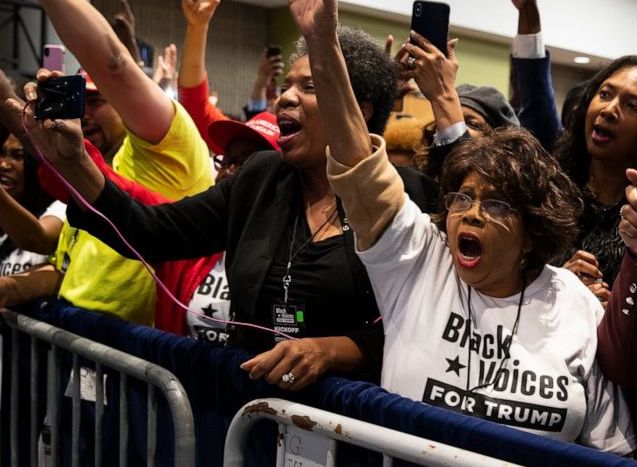
The California Reparations Task Force is trying its best to skirt a landmark Supreme Court ruling.
It sacrifices readiness and cohesion for leftist goals.
Evan Barker’s tell-all reveals a party in turmoil.
Will they continue to demonize voters or learn an important political lesson?
Or die waiting for a narrative to save you.

