

The choice of what to let go is no longer yours.
A Turn Toward Great Party Politics?
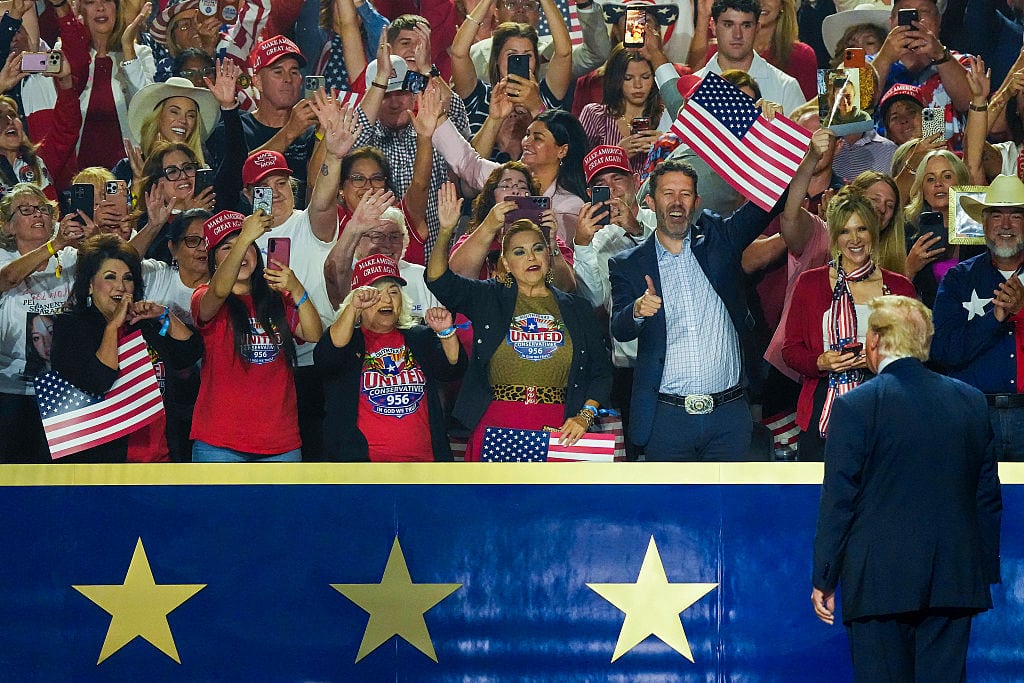
What Tocqueville can teach us about the Trump era.
In Democracy in America, Alexis de Tocqueville describes two kinds of political parties: great ones and small ones. The former are those “attached more to principles…to generalities and not to particular[s],” to statesmen and not to politicians. They are the parties of founders. The latter are just the opposite: “generally without political faith,” these are the parties of disinterested politics, of policy more than of direction.
“America has had great parties,” he writes, though “today they no longer exist.” But much has changed since the early 1830s, when Tocqueville visited the United States. He did not live to see the Civil War, a conflict so well-suited to his description of great parties that the war itself reads like his definition made literal. Neither did he live to see the small parties that followed in its wake.
From the North’s victory over the South, which vindicated the founding’s anti-slavery political principles, to the reorientation of American politics with the New Deal coalition under Franklin Delano Roosevelt and the rise of Ronald Reagan and the conservative movement, America has seen its share of great parties. They shared a common thread: each won a decisive victory that set the terms of political debate for a generation.
Small parties have then emerged in their wake. When Tocqueville tells us of those times “when societies rest and when the human race seems to catch its breath,” he is referring to the calm that follows the storm. As much as he admits to hating the lowness, blatant corruption, and political opportunism of small parties, Tocqueville contends that America “gained much in happiness” with their emergence. The patriots of 1776 paid in blood to establish a new status quo along republican lines, to create the conditions in which the small parties Tocqueville describes could ask small questions because the big ones had already been answered.
When Reagan won decisive victories in 1981 and ’84, he established a new paradigm that compelled subsequent Republican and Democratic administrations alike to operate within its terms. George H.W. Bush, Bill Clinton, and George W. Bush safely worked within the Reaganite consensus because its opponents had been decisively defeated.
But norms inevitably disintegrate. Just as a cliff exposed to wind and rain will erode over time, a political order governed by men will likewise erode. In democracies, that process happens twice as fast.
The realignment of the Republican Party along populist lines under Donald Trump was a telltale sign, but the rise of democratic socialism is an even clearer signal that the old consensus has collapsed. The appeal to return to the Reagan era falls mostly on deaf ears, especially for younger generations. The parties are asking big questions again. “There come periods,” Tocqueville says, “in which nations feel tormented by such great evils that the idea of a total change in their political constitution presents itself.” He might as well have been talking about 2026.
Democrats and Republicans have not only drifted apart on policy, but they fundamentally diverge on the level of principle. The central debate is no longer about healthcare or the environment. As Jason Killmeyer put it recently, “American politics is no longer a contest over how we govern, but over who decides.” Our politics has reached a point where distinct communities hold irreconcilable views about what America is. Tocqueville warned us about this: in “countries so vast that the different populations that inhabit them…have contradictory interests,” what results is not politics but “a conflict between rival peoples.”
If Republicans want to win in 2028, they must recognize that the Reagan-era status quo is gone for good. Those calling for moderation misunderstand the severity of our situation. Retreating from this fight will not persuade the Left to moderate.
The desire to make politics small is a healthy one. The “time[s] of great revolutions and great parties” Tocqueville describes are violent and destructive, and we should seek to avoid them if possible. But we must remember that peace does not come naturally. It comes only after a new status quo is forged, built on sound principles and defended by a party that knows what is at stake.
The American Mind presents a range of perspectives. Views are writers’ own and do not necessarily represent those of The Claremont Institute.
The American Mind is a publication of the Claremont Institute, a non-profit 501(c)(3) organization, dedicated to restoring the principles of the American Founding to their rightful, preeminent authority in our national life. Interested in supporting our work? Gifts to the Claremont Institute are tax-deductible.
Suggested reading


Gavin Newsom seems to have been created in the same lab that made his hair gel.

If California’s conservative vote went elsewhere, it could make a real difference.
Reject the National Governors Association’s advice.
Nationalist localism—unlike globalism—survives the virus.

RFK Jr. is making all the right people furious.

