

How to make Beijing pay
Our Trash Could Help Us Defeat China
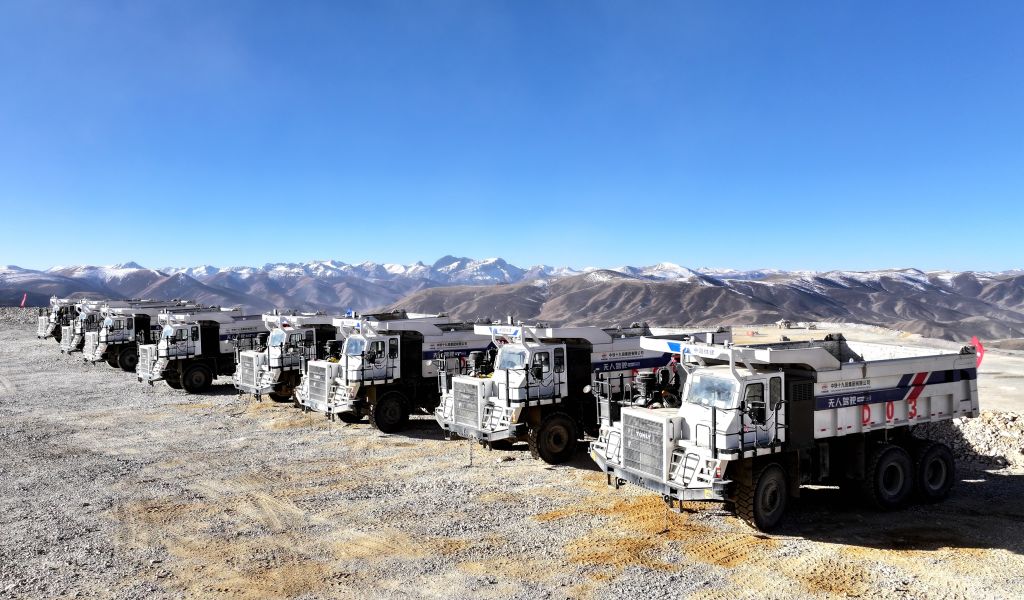
An economic weapon to best its magnet monopoly.
In his escalating attempts to cut ties with China, President Trump has aggressively employed tariffs, threats, and embargoes. But there’s one potentially powerful tool the Trump Administration has yet to leverage fully: trash.
Hidden among America’s trash heaps and mining waste are potentially rich accumulations of critical materials that China currently monopolizes—and that the United States desperately needs. Capitalizing on those materials will remove one of China’s greatest sources of leverage over American national and economic security.
After decades of allowing domestic production of critical minerals to flatline, policymakers and industrial partners have finally woken up to the dangers of the Chinese critical mineral monopoly. The country controls 60% of critical mineral production and 85% of the world’s processing capacity. Yet these often-cited numbers can obscure even more frightening vulnerabilities.
Take rare earth permanent magnets. (Full disclosure: I am the director of a company that develops commercial magnetic and superconducting solutions.) China produces about 90% of rare earth permanent magnets, while the U.S. has historically had virtually no manufacturing capabilities for specific types of high-value magnets. Very recently the U.S. has significantly ramped up rare earth permanent magnet manufacturing, spurred by federal and private investments, but these factories still need critical mineral feedstocks.
We desperately need permanent magnets, not only for high-power defense systems like the F-35 fighter, but also for electric vehicles, smartphones, computers, and most anything that uses an electric motor. Any significant disruption or restriction on magnet imports would figuratively send America back to the Stone Age.
The Trump Administration has adopted a two-pronged strategy to counter this vulnerability and establish alternative feedstocks for producing rare earth magnets. First, it has attempted to access alternative foreign markets by working with allies to exploit new sources, including reaching a major agreement to access Australian rare earths.
Second, the administration has devoted massive sums to increase domestic production, including by resurrecting the Mountain Pass Rare Earth Mine through a multi-billion-dollar deal with MP Materials, imposing a minimum price floor on Mountain Pass products, and inking a 10-year purchasing agreement for MP Materials’ products. These are bold and potentially transformational moves. But America has a third source of critical minerals in our waste products that policymakers and industry have largely not tapped.
The truth is, “rare earth minerals” is a misnomer. Some of the materials on the official list of critical minerals aren’t rare—they’re just difficult to extract and found in relatively low and highly dispersed natural concentrations compared to minerals that produce metals like gold and copper. These include the materials used in permanent magnets, like dysprosium, samarium, praseodymium, and neodymium.
Operations around the world that mine everything from silver and gold to coal and phosphates pull these critical minerals out of the ground, which are most often left in mining waste. For example, a top researcher at the Florida Industrial and Phosphate Research Institute found that Florida’s phosphate deposits alone could satisfy nearly half of the U.S. demand for many critical minerals.
Yet we do not sufficiently extract those minerals from mining waste because of restrictive government regulations, challenges associated with accessing resources locked in stable phases, and environmental concerns about the byproducts of extraction.
Mining operations are highly regulated in America. Companies are required to dispose of waste according to stringent environmental guidelines, leaving little room for startups or entrepreneurial mining companies to leverage the waste for coproduct generation. Even if they were able to use the waste more effectively, it would be difficult to run a profit because China keeps prices artificially low.
China monopolized the critical mineral marketplace not because it was blessed with stores of minerals that other nations lack, but because it mines and processes these minerals at cut-rate prices by flagrantly ignoring environmental standards. The West was happy to power our EVs and wind turbines using Chinese-produced minerals as long as the toxic waste sites were kept out of view. Now, with China restricting the flow of critical minerals to the U.S., we don’t have the luxury of continuing this devil’s bargain.
To ensure a resilient critical mineral supply chain and the security of our nation, policymakers will have to respond. They can further support domestic industry through public-private partnerships modeled on the government’s deal with MP Materials. Or they can provide the development funding that early-stage startups need to commercialize promising waste extraction technologies originally developed at national labs and research institutions.
Successfully, efficiently, and cleanly extracting rare earth minerals from mining waste, coupled with thoroughly recycling electronic devices, will help maximize the American supply of critical minerals.
There is no reason we should be beholden to China for critical minerals. But it’s better late than never. Responsible deregulation and investments in mining waste processing can turn our trash into an economic weapon that defeats the Chinese magnet monopoly.
The American Mind presents a range of perspectives. Views are writers’ own and do not necessarily represent those of The Claremont Institute.
The American Mind is a publication of the Claremont Institute, a non-profit 501(c)(3) organization, dedicated to restoring the principles of the American Founding to their rightful, preeminent authority in our national life. Interested in supporting our work? Gifts to the Claremont Institute are tax-deductible.
Suggested reading

The Biden administration has adopted a posture of compliance and appeasement toward Beijing.

China is buying American farmland at a brisk pace.

Now is the time to strike a partnership.

Remarks before the Senate Judiciary Committee by Kyle Shideler.
What it will take to break the deep state.

