

We need to think big as Americans—and as heirs of our noble inheritance.
The Meaning of the American Creed
Equality and liberty rightly understood are bulwarks against despotism.
As the 250th anniversary of the Declaration of Independence approaches, Spencer Klavan invites us to reflect on the origins of that document and its fate. He asks us to consider an array of questions: Are the principles of the Declaration the final truth at the end of history? Is the end of history lamentable? Does the war in Iran refute the end of history? Is the Declaration informed by a rational view of the universe or by revealed religion?
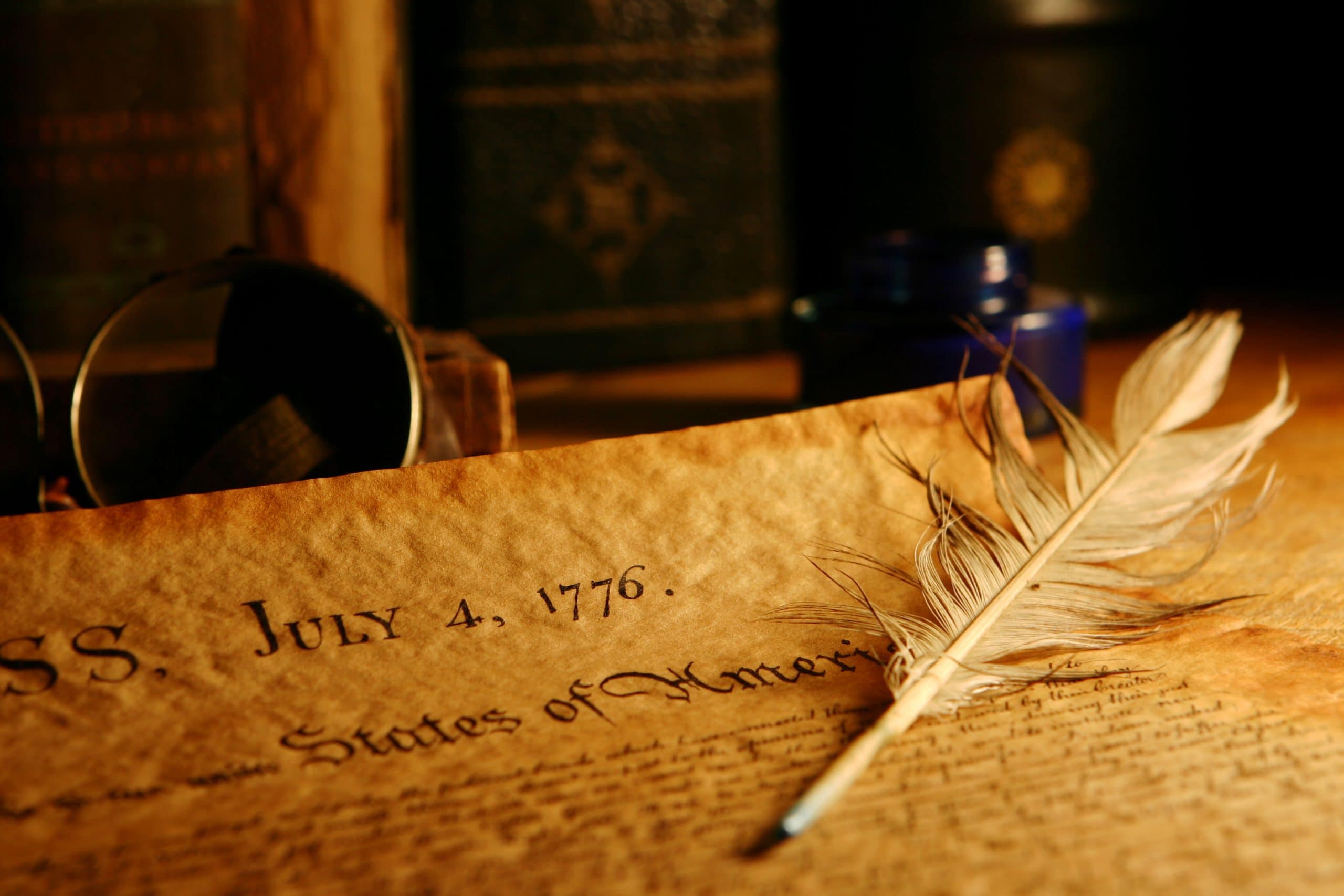
I have access neither to the world-historical spirit nor to prophetic signs, so I’ll begin with what has become a necessary task: to establish that the Declaration marks the founding of the American nation, to explain what it means, and to defend it against popular criticisms.
Some have tried to define America by the year 1619, because that is when slavery was established. Others opine that 1607 is the beginning of the United States, because that is when the English first settled in Jamestown. However, these are not true national origins, in part, because they do not recognize the independence of the United States from Great Britain. More importantly, they are wrong because neither of these events recognizes the fundamental principles of right that define the United States.
A nation is not just its land or its past—as Aristotle argued, it is a regime. A tragic chorus is not the same as a comic chorus, even if it is made up of the same people in the same place. Even if the effects of slavery linger, as well as certain Puritan effects from the original settlers, the country is defined by neither. The United States is a liberal democracy, because its fundamental principles are freedom and equality. Those principles were not fully declared as the foundation and unifying purpose of the nation until 1776. If those principles were not in full effect at the time of their declaration, they were nonetheless the declared goal to which we ought to aspire as a nation.
A New Beginning
Those who assert that 1619 is the definitive moment of national origin believe that the Declaration supports slavery, because freedom and equality were meant only for white, propertied males. To support this assertion, they invoke the fact that 13 years after the signing of the Declaration, the same nation ratified the Constitution even though it contained the Three-Fifths Clause and the Fugitive Slave Clause. While these facts are true, their interpretation is incorrect. These two clauses prove only that it took a civil war and almost 90 years to bring the country into accord with its founding principles. Abraham Lincoln put it nicely:
[The founders] did not mean to assert the obvious untruth, that all were then actually enjoying the equality…. They meant to set up a standard maxim for free society, which should be familiar to all, and received by all; constantly looked to, constantly labored for, and even though never perfectly attained, constantly approximated, and thereby constantly spreading and deepening its influence, and augmenting the happiness and value of life to all people of all colors everywhere.
Lincoln was responding to revisionist sophists like Supreme Court Chief Justice Roger Taney and Senator Stephen Douglas, who claimed that the principles of the Declaration were meant to be enjoyed only by the descendants of Englishmen. But before these kinds of sophistries were produced, even John C. Calhoun, an apologist for slavery, claimed that the Declaration applied to all mankind.
The founders themselves expressed their desire to end slavery, including Thomas Jefferson, who did not liberate his own slaves but recognized their right to be free. One can accuse him of hypocrisy, but not of having supported slavery in the Declaration. The Three-Fifths Clause and the Fugitive Slave Clause were compromises for the sake of maintaining the Union. Those compromises could not last—not for economic reasons, as Marxists assert, but for moral ones. The Declaration was so far from being an instrument in support of slavery that Lincoln appealed to its authority to justify its abolition.
The Declaration marks not only the origin of the United States, but also the beginning of a political experiment in liberty. Hamilton states the nature of the experiment in Federalist 1, asking, “[W]hether men are really capable or not of establishing good government from reflection and choice, or whether they are forever destined to depend for their political constitutions on accident and force.” This experiment in self-governance—the rule of reasoned choice—is already assumed to be possible in the Declaration.
Self-government does not mean mob rule or even majority rule, but governance in accord with the self-evident truths “that all men are created equal, that they are endowed by their Creator with certain unalienable Rights, that among these are Life, Liberty and the pursuit of Happiness.” These truths do not depend upon history or accident but upon the “Laws of Nature and of Nature’s God,” which are accessible to man as man regardless of time and place.
Nature and Ancestry
Prior to the Declaration, peoples were connected to their nations through passionate and sentimental attachments to their ancestry. In the medieval world, kings were either descended from family lines or thought to be chosen directly by God. They were born to command, and subjects were born to obey. There was a caste, and wills were directed toward one another in a divine order.
Even in ancient Athens, there was no freedom and equality as we understand it. The Metics could not become citizens (or if they could it was exceedingly rare), because they were not of Athenian blood. Jus sanguinis was the rule. Slavery was perfectly compatible with Athenian democracy, and the Metics were subject to special taxes and punishments. Athenian democracy consisted of 25,000 citizens ruling over 250,000 slaves.
In the United States, however, naturalization is part of the Constitution. The expectation that foreigners can become citizens follows directly from our creed. That creed is not “openness” or “inclusiveness,” but the belief in natural rights and the sovereignty of the people. Our heritage is this creed, and those who are willing and capable of living by it, in principle, can be assimilated into the American family.
Although our creed recognizes the universality of rights, it is not a cosmopolitan or globalist creed, for the simple reason that government gains its legitimacy from the consent of the governed. Other countries are free to establish their own governments on the principles of the Declaration, and for that reason, the Declaration combines patriotism with philanthropy, but there is no obligation to protect all peoples from their own governments.
Sovereignty and Self-Government
When comparing ancient Athens to the United States, it is sometimes said that Athens had a “direct democracy” while we have an “indirect democracy.” These are misnomers, which mistake different kinds of democracies for different procedures. Our entire understanding of sovereignty differs from that of the ancient polis, because we limit and divide sovereignty in order to distinguish civil society from the state.
Civil society is prior to the state both in time and in nature. Our natural rights do not depend on the state, which exists to protect them. When the state is no longer directed to that end and exhibits “a long train of abuses and usurpations, pursuing invariably the same Object evinces a design to reduce [the governed] under absolute Despotism, it is their right, it is their duty, to throw off such Government.”
Sovereignty belongs to the people, and consequently, they elect their representatives who make the laws, and they have recourse to the “Supreme Judge of the world” should despotism arise. Yet sovereignty also belongs to the government, which ought to be obeyed “while evils are sufferable.” The government checks the people from anarchy and mob rule, and the people check the government from tyranny.
This balance between civil society and the state works only as long as there is a common good that enlightens them and joins them together in a common purpose. In other words, the common good must reign supreme in the mind and spirit of both the people and the government. That supreme source of enlightenment is the Declaration. As Calvin Coolidge argued, it is the fountainhead of the nation, and without it, the experiment in self-government must fail.
Today, the belief in the Declaration and its creed among Americans has been severely weakened, culminating in the muddying of its spring into relativism.
The Declaration and Democratic Relativism
In his dying days, a week before the 50th anniversary of the Declaration, Jefferson wrote to Roger Weightman, stating that the Declaration opposed theocracy but not the rights of man, which includes the freedom of religion. He thought the freedom of religion accorded only with religions that are tolerant of other religions. Jefferson accepted religious pluralism, provided that no religion sought to violate the religious freedom of any citizen. He also believed that pluralism would purge religions of their ambitions to persecute and to rule, since being one of numerous religions, their weakness would purge their desire for empire over others.
But political belief is different from religious belief. In politics, there are self-evident truths, and the belief in rights is authoritative. This is where relativism has proven most inimical to the Declaration. Multiculturalism and group rights have replaced the idea of individual liberties. Unlike the freedom of religion, these beliefs accompany a philosophy of power founded on the idea that there are no rational or self-evident truths upon which to build a common good. All right is just a “narrative” for power. If life is simply a clash of wills, there are no civil rights to mediate between the races, but only a competition between black power and white supremacy, or girl power and patriarchy, or rootless cosmopolitanism and rooted, indigenous peoples.
The belief in will to power dominates democratic socialism, or the belief that freedom should be sacrificed for equality. Recently, it has allied with Hamas against Israel and with Iran against the United States for the simple-minded belief that Hamas and Iran are oppressed by Western capitalism.
To grasp the peculiar character of this democratic form of will to power, we should consider Tocqueville’s thoughts about how barbarism will come to America. It will arrive not as it did in Rome, but as it did in China, when the Chinese lost contact with theory and first principles. In the United States, loss of contact with first principles is loss of contact with the Declaration. Without this knowledge, practical implementation is impossible, and the country must necessarily stagnate and decay. Who cannot see that the democratic socialists do not understand that culture conflicts with universal rights, that racial power conflicts with civil rights, that rootedness conflicts with reason, and that Eastern despotism conflicts with self-government? These conflicts do not matter to them because they have a blind trust in the necessary progress toward the democratic-socialist future, one hostile to the Declaration and the freedoms it recognizes.
Self-government is ours to lose. It will not be lost to Russia, China, or any other adversarial foreign power, but to the ever-growing state, which is granted more and more power so long as it promises to create more and more equality. The democratic socialist state does not want a citizenry, but aspires to a homogeneous mass where no one falls beneath and nobody rises above. Crushed by the force of mass society and the omnipresent state, the individual will hand his freedom to think and act over to the state. In this manner, modern civilization will create a more complete despotism than any dictator could achieve through violence. This is the real threat to American self-government—that freedom will die not with a bang but with a whimper.
The American Mind presents a range of perspectives. Views are writers’ own and do not necessarily represent those of The Claremont Institute.
The American Mind is a publication of the Claremont Institute, a non-profit 501(c)(3) organization, dedicated to restoring the principles of the American Founding to their rightful, preeminent authority in our national life. Interested in supporting our work? Gifts to the Claremont Institute are tax-deductible.
Also in this feature
Americans must look to the principles of nature and eternal reason.
It was the cornerstone of the American founding.

Though our task is daunting, our moral duty remains.
American renewal requires going back to our foundations.
The bonding of religious and civil liberty we enjoy in America would have been impossible in the ancient world.

