

It’s in the hands of the judicial and legislative branches.
The Decline and Fall of Republican Government in America
Our problems are many, the solutions are few.
Ronald J. Pestritto has done a splendid job in supplying us with a succinct account of the ideological origins of the administrative state, its evolution, and the attempts by Donald Trump and some of his predecessors to rein it in. Essentially a fourth branch of government, the administrative state has taken over most of the functions of government, yet is not directly responsible to any elected official.
Its establishment and expansion presuppose the existence of what Hegel called “the universal class”—an impartial, benevolent, all-wise cohort of Platonic Guardians apt to take better care of us than we would be capable of doing ourselves, even if we were blessed with ample resources. Such an arrangement makes a mockery of our pretension that, as human beings, we have the capacity to govern ourselves, and that it is incumbent on us to do so. How can there be liberty and personal responsibility when our conduct is governed in nearly every particular by individuals over whom we exercise no leverage? And how can there be a redress of grievances when our true rulers are largely beyond our reach?
Something more can be said. To begin with, our administrators have never fully lived up to the standard set by Hegel. From the outset, for example, the Internal Revenue Service has used its power and access to information to blackmail members of Congress and persecute citizens whose views are out of favor with the presidential administration in power.
In this regard, things are now worse than ever. Professional ethics have gone by the board nationwide. Impartiality, benevolence, and wisdom are in short supply. Lawyers practice law as a species of warfare, and do so with impunity. The subject is even taught in law school. Prosecutors operate in a blatantly partisan fashion, and judges think they have a right to make public policy. To date, not one of these malefactors has been disbarred.
Moreover, as we learned during the coronavirus lockdowns, the same can be said for the medical profession. No one in their right mind would rely on the professionalism and integrity of those who work for the CIA, the FBI, the IRS, the CDC, USAID, FEMA, or any other federal agency. Impartial? Benevolent? All-wise? No one would attribute these qualities to our bureaucrats. They are all too often partisan, self-serving, vain, malicious, and foolish. To an ever-increasing degree, they have ceased to be the servants of the public and have instead become the tools of petty and not-so-petty tyranny.
I would like to think that Donald Trump will manage to put an end to this. Were he to succeed, the executive agencies would come under the control of an official who owes his authority to the electorate, and who would be held responsible by the general public—which would be highly advantageous. For what we would gain, however, we might well pay a heavy price. It would concentrate tremendous power in the hands of a single elected official. In all likelihood, it would not take long for a president to succumb to temptation and begin wielding that power for his own benefit, and for the benefit of his friends and fellow partisans. We got a bitter taste of this during the Obama and Biden administrations.
Of course, Congress might step in, which would be a boon. The members of the House of Representatives and the Senate are closer to the people than the president. They are more dependent on the people for their future well-being than he is, and they are far more apt to be responsive to public grumbling. If Congress were to review the legislation governing the operations of the various executive agencies, it could tighten up the language, make it more precise, and thereby rein in the bureaucrats. This would, however, be a mammoth task that would probably take a decade or more to complete, a task Congress would likely not take on.
Our congressmen and senators are, with exceedingly rare exceptions, professional politicians—and, to be frank, they are for the most part an ignorant and cowardly lot, far better at posturing in public than at devoting themselves to the public welfare. For them, reelection is not just a concern—it is their primary obsession. It suits their purpose to dodge responsibility by leaving policymaking to those who are fully sheltered from the public’s ire. If the wording in an executive agency’s enabling legislation is ordinarily vague, it is deliberate: this defect is a feature, not a bug.
Another option would be devolution. Local and state governments are far closer to the people than the leviathan based in Washington, D.C. Moreover, conditions vary considerably from one locality to another. Public policy ought to pay close attention to local circumstances; grievances are more easily adjudicated at the local level. Here, however, another obstacle presents itself.
Ronald Reagan’s call for a “new federalism” met with determined resistance from governors and state legislators (many of them Republicans). Local notables, like those at the national level, are frequently more focused on re-election than on governance, and, with rare exceptions, they are anything but eager to take responsibility. The administrative state would never have come into being, and it would never have greatly expanded, had it not been for the connivance of elected politicians—national, state, and local—who were eager to evade responsibility, pass the buck, and get re-elected.
Another alternative would be to scale back the scope of government and leave individuals more to their own devices. The welfare state stifles personal initiative. It inspires boredom and fosters laziness, irresponsibility, addiction, and crime. In its absence, necessity would force Americans to take more responsibility for their own welfare, and work harder and show more initiative. This would be good for our national character. It would enhance the importance of family, and it would encourage cooperation at the local level.
To such a reform, there would, however, be fierce opposition—and not only from its supposed beneficiaries and others who profit from the welfare state. There are officials at all levels who take pleasure in directing the lives of others. The nanny state rewards busybodies, and those in “the helping professions” are numerous, vocal, and well-organized. Politicians know better than to do anything that upsets expectations.
The situation might well seem hopeless, but it is not. What cannot go on forever won’t go on forever. Someday, the system supporting the administrative state will collapse, and the latter will dissolve. As Margaret Thatcher once observed, sooner or later you run out of other people’s money. That day is, I would submit, nigh. The Social Security system is very nearly bankrupt. It could no doubt be shored up for a while by way of increased taxes. But the right to tax is the right to destroy, and there comes a time when raising taxes dramatically reduces commercial activity and, with it, revenues.
Similarly, our national debt is unsustainable. We have already reached the moment when the interest on that debt is the largest item in the federal budget. It now exceeds what we pay for defense, and the gap between the two is widening. If the dollar were not the international reserve currency, its value would have already collapsed and the United States would resemble the Argentina of days gone by. It is hard to believe, in current circumstances, that the dollar will long retain its position within the international system. If our friends in Europe had not been more profligate than we have been, the euro would now be playing the role the dollar has long played.
There is another cataclysm on the horizon that might well bring the entire system down. For something like 35 years, we have suffered in the international arena from an improvident stewardship. Our leaders—both in the United States and in the countries allied to us—have lived in a dream: with the end of the Cold War, we thought in Kantian fashion that commercial wealth would guarantee peace. However, we ended up deliberately fostering Russia’s resurgence and China’s immense growth in wealth and power, while simultaneously denuding ourselves of heavy industry and manufacturing.
Now, at a time when we are very nearly bankrupt, we face the prospect of a war in Europe and of another in Asia. Our capacity to put up a real fight is in question. And if we had to do so, the expense would put an end to the nanny state—and, alas, to much else.
Neither prospect is in any way heartening. It is not clear that the American republic, damaged as it is already, would survive either catastrophe. As individuals, we must be prepared for the worst. For, as a self-governing people, we have very nearly committed suicide, and no nation on the horizon could rescue us as we rescued Britain and Europe in the 1940s and 1950s. Perhaps we will luck out and our rivals will end up, due to a folly dwarfing our own, in even worse shape. Perhaps we will actually tackle our most serious problems and reduce them to relative insignificance. I certainly hope so, but I do not believe there is any reason to be sanguine.
The American Mind presents a range of perspectives. Views are writers’ own and do not necessarily represent those of The Claremont Institute.
The American Mind is a publication of the Claremont Institute, a non-profit 501(c)(3) organization, dedicated to restoring the principles of the American Founding to their rightful, preeminent authority in our national life. Interested in supporting our work? Gifts to the Claremont Institute are tax-deductible.
Also in this feature
Recovering republican government in the 21st century.

Opponents of the administrative state shouldn’t give up on the Founders’ design.
It’ll take more than one administration to end the administrative state.
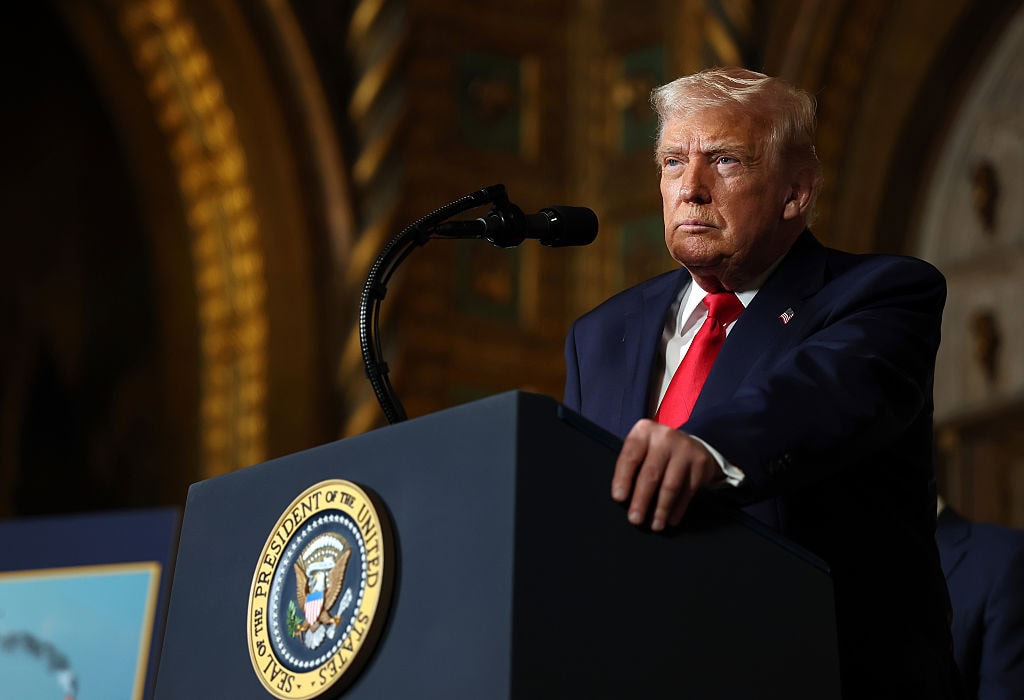
He’s taking on the modern administrative state.

