

Conservatives are attacking America by weaponizing our favorite things.
Europe’s War on the Remigration Debate
French authorities are increasingly willing to suppress views they disagree with.
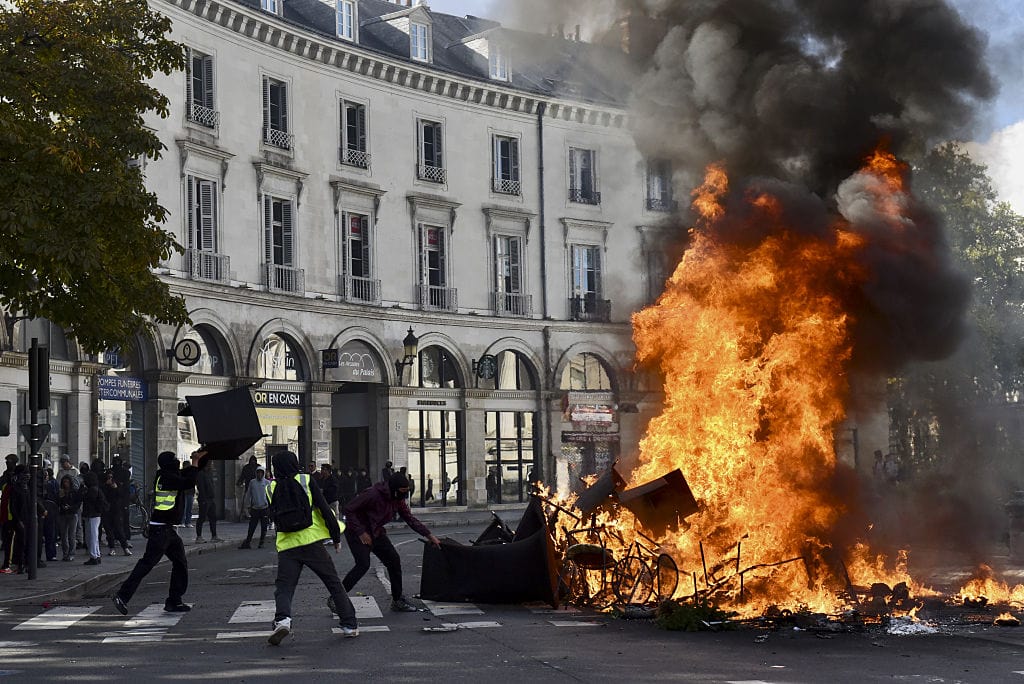
On October 31, as Paris was still dealing with violent demonstrations and unrest, the French government made an extraordinary decision: it prohibited a peaceful political conference on remigration. The contrast was difficult to miss. While protesters were throwing Molotov cocktails at police, an international gathering of politicians, writers, and activists seeking to debate European immigration policy was deemed too dangerous to take place. I was among those scheduled to speak at the conference, which was ironically titled “Remigration: Let’s Open the Debate!”
Organized by Polémia, the event was intended to bring together approximately 800 participants from Europe and the United States to discuss remigration—a term increasingly used to describe the return or deportation of foreign nationals, whether voluntary or compulsory.
Two days before the scheduled gathering, organizers received an official decree prohibiting it. French interior ministry authorities invoked the possibility of public disorder and characterized remigration as a xenophobic and racist ideology. An administrative court subsequently rejected an emergency appeal, forcing the organizers to move the conference online, where it was broadcast on X and YouTube.
Unfortunately, that particular prohibition was only the beginning. Austrian remigration activist Martin Sellner, scheduled to speak at the conference, was denied entry into France upon arriving at Paris–Beauvais Airport. He was detained, held in a cell all night without his phone, and subsequently deported to Austria. Sellner was also prevented from holding a book event and attending a rally in support of the Save Europe Act, a European citizens’ initiative advocating remigration. After French authorities prevented the rally from taking place, several hundred peaceful activists gathered at a restaurant outside central Paris. Within hours, police told everyone to leave the premises.
Three interventions in the space of a few days effectively dismantled an entire program of peaceful political activity.
The French authorities’ targeting of remigration could not be clearer. To European elites, it is an ideological and organizational threat to everything they love. Against the backdrop of the disorder that has unfolded across Paris over the past month, the censorship is even more egregious. The student protests, hijacked by leftists, immigrants, Islamists, and other bad actors, have featured attacks on police, vandalism of shops, and acts of arson. And yet none of this seems to warrant any serious consequences from the French state.
There are differences in both sentiment and law concerning the extent of freedom of speech in Europe and the United States. Free speech is not some alien American libertarian export, as German Chancellor Friedrich Merz claimed earlier this year. Although freedom of speech may be less absolute in Europe, both Europe and the U.S. recognize that no government can unilaterally determine the boundaries of legitimate speech and thought. The outcry from Europeans and Americans over this particular incident has been pronounced, as both accuse the Macron regime of censorship.
Last year, Vice President JD Vance warned about Europe’s retreat from fundamental freedoms shared with the United States and highlighted several examples of European restrictions on speech. The Trump Administration also imposed visa restrictions on five European figures who pressured U.S. technology companies to censor and suppress American viewpoints. During the State Department’s gathering on political terrorism, Secretary Marco Rubio recounted the history of 20th-century violent revolutionary movements, most of which emerged from the authoritarian Left. These movements promised equality and social emancipation but quickly began to concentrate political power and suppress dissent.
Commenting on this phenomenon, French philosopher Pierre Manent wrote, “The progress of freedom in the West once consisted of measuring speech by the standard of visible actions; political correctness consists of measuring speech by the standard of invisible intentions.” He further explained that the separation of speech from action had transformed how societies evaluate expression. Because speech was no longer measured against the possibility of an identifiable action, Manent contended that “many take speech as seriously as if it were itself an action and consider speech they do not like equivalent to the worst possible action.”
The traditional justification for restricting expression was tied to preventing a direct threat, incitement to imminent unlawful conduct, or another identifiable harm. The new justification rests on interpretations of a speaker’s intentions and character. For European elites, the perceived racism and hatred of the remigration advocates justifies suppression, because the question has become about what their words supposedly reveal about themselves.
In recent years, remigration has moved from the margins of European political discussion into mainstream, “polite” conversation. Average citizens, affected by crime, the presence of unassimilated communities, and the erosion of their way of life, are demanding an 180-degree reversal of immigration policy. Recent polling from France shows that 83% of French citizens support the expulsion of foreigners who are lawbreakers, criminals, or long-term unemployed. Suppression may restrict the remigration movement’s ability to get its message out, but it can neither eliminate the circumstances that produced it nor stop its momentum.
The United States has a direct interest in whether Europe remains faithful to the political principles and traditions we share. Our transatlantic alliance cannot rest indefinitely on a common history while Europe’s political trajectory moves in the opposite direction on fundamental freedoms. European leaders who use their power to silence political opponents risk undermining not only their own democratic legitimacy but also the foundations of their relationship with their closest ally. And they should be concerned about the future of their own civilization.
Americans should recognize that what is happening in Europe is not merely a European problem but a warning about how quickly the freedoms we take for granted can be lost.
The American Mind presents a range of perspectives. Views are writers’ own and do not necessarily represent those of The Claremont Institute.
The American Mind is a publication of the Claremont Institute, a non-profit 501(c)(3) organization, dedicated to restoring the principles of the American Founding to their rightful, preeminent authority in our national life. Interested in supporting our work? Gifts to the Claremont Institute are tax-deductible.
Suggested reading

Ireland’s leaders are inviting disaster.

We’ve reached a turning point in our nation’s “house divided” future.

How neocons locked the Right into a leftward drift.

The contemporary American mode of protest was made in China.
The struggle for the soul of America is here.

