

The latest atrocity in American public life could serve as a turning point.
Tom Wolfe, Money, and Me
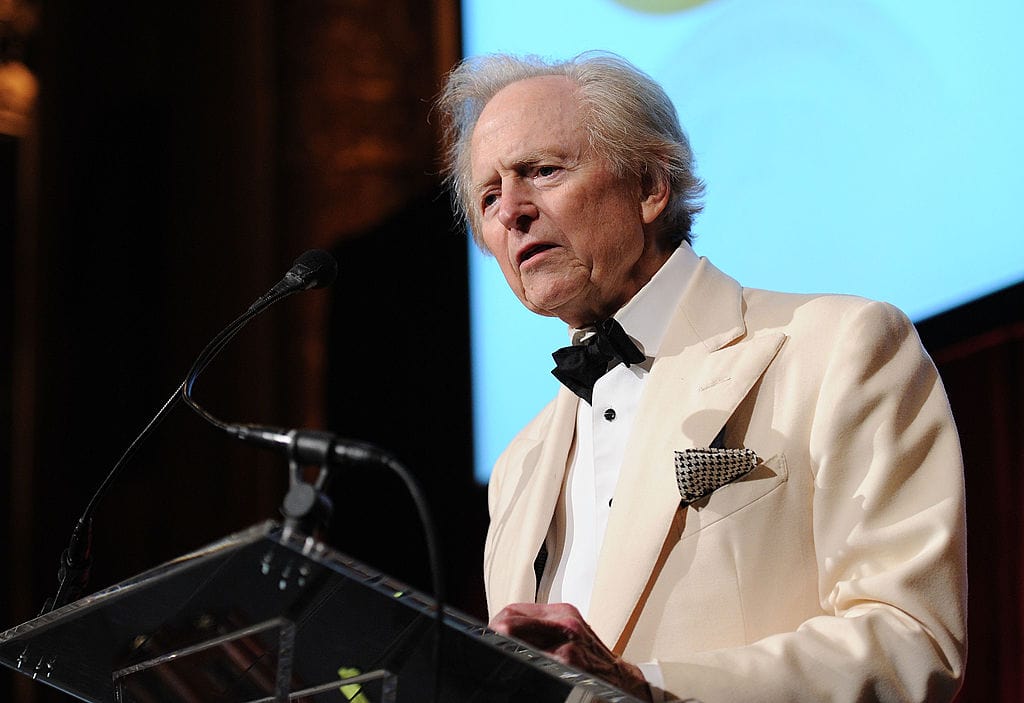
The price of literary perfection.
When I read James Rosen’s review of my Dispatches from the Late Republic, I panicked a little over the following:
Anton is way off base when he asserts that Wolfe’s creative decision-making was at any point driven by exigent financial needs…. For Wolfe—who never borrowed money—the 1990s were flush: The Bonfire of the Vanities (1987) had been a titanic success, and he had, as a matter of public record, sold a brownstone and bought a co-op. It was struggles with plot, not finance, that delayed the publication of A Man in Full (1998). (Emphasis added.)
Now, some of the above is not in doubt. Bonfire was indeed a huge success, selling 800,000 copies in hardcover alone, plus God knows how many in paperback (nearly 40 years later, the book is still in print), and netting Wolfe a $750,000 check for the movie rights. But does that necessarily mean that, for Wolfe, “the 1990s were flush”?
I have several distinct recollections of him saying otherwise. For instance, here he is, in his own words, in the very first sentence of “My Three Stooges,” published just two years after the rip-roaring success of A Man in Full (which sold 1.2 million in hardcover):
I can tell you, taking eleven years to write one book is a killer financially, a blow to the base of the skull mentally and physically, hell for your family, a slovenly imposition on all concerned—in short, an inexcusable performance verging on shameful. (Emphasis added.)
I also read every interview Wolfe gave at the time Man in Full came out (I have sought to read and collect every interview Wolfe ever gave, though no doubt have missed a few). And I distinctly recall him saying something along those lines at the time. Moreover, in the YouTube age, many of Wolfe’s lectures and speeches have been posted online. I’ve watched most of them. In several public appearances from that time, Wolfe speaks amusingly of the cult of “leverage,” i.e., borrowing money, that emerged during the go-go ’80s (of which Wolfe remains our best chronicler) and hints that he himself was not immune. Indeed, in both Bonfire and Man in Full “leverage” is a central plot device, and the psychological depth Wolfe displays in showing how the “levered” cower in their central nervous systems suggests that his knowledge arose from more than just interviews—the same way his depictions of depression in Man in Full and I Am Charlotte Simmons stem from personal experience, as Wolfe himself explicitly affirmed.
As I have mentioned elsewhere, I got to know Tom Wolfe a bit. I even at one point proposed writing his “official” biography, which is to say, writing a biography with his approval and cooperation. He agreed. That book is now not likely to happen, but that’s not the reason I bring this up here. At the time, having committed to the project, I realized I would have to ask him about things that might turn out to be…uncomfortable. Including this business about money. Because, say what one will, if it is true that a writer of Tom Wolfe’s stature—who, I must say, lived very high on the hog—occasionally got himself into financial distress, well, that’s…interesting, and not something a conscientious biographer could leave out. After all, the same thing had happened to Twain, Churchill, and lord knows who else, and their biographers had hardly skipped over it, because it’s interesting. (Nor, I hasten to add, do their money troubles in any way lessen their titanic achievements.)
So one day I asked Wolfe about it. He went on at some length about his financial travails in the 1960s (despite living in high style on Beekman Place), especially during New York’s two (1962-63, then again in 1965) newspaper strikes, when he basically didn’t have an income. He told of living paycheck-to-paycheck and later, after leaving salaried employment behind, advance-to-advance and royalty-check-to-royalty-check throughout most of the ’60s and ’70s. When I asked him, gingerly, about the public hints he’d dropped that he had dipped into the red in the 1990s, he seemed to confirm it had happened—and then changed the subject. OK, I thought; this process is just getting started. No need to be the pushy interviewer quite yet. There’s time. But as things turned out, we never talked about it again.
Anyway, none of this being definitive, as I read Rosen claiming that Wolfe “never borrowed money,” my heart sank. I know Rosen; he does not make things up. If he said it, he had good reason. So I asked him. Let me just say, without identifying his source, that the descriptor “unimpeachable” is not out of place here.
My heart sank further. I made a desultory (but not therefore disingenuous) defense about generally having a good memory, not prone to conjuring “facts” out of thin air. I offered to write a letter to Rosen’s editor apologizing for my mistake. But James himself suggested that, before I do that, I dig around a little and see what I could find. If I turned out to be right, he offered to correct his review.
So I dug (with help from the research assistants with whom think tank scholars and college lecturers are blessed). The first tranche revealed some information that was suggestive, but far from conclusive. Ditto the second. I was on the verge of giving up when—paydirt!
In November 1998, the very month of Man in Full’s release, the (London) Spectator published an interview (online, but available to subscribers only) with Wolfe by one William Cash. Which is ironic, because the subject of the piece is money, specifically, Tom Wolfe’s relationship thereto.
In it, Wolfe makes several interesting and meaningful observations. But the most important for our purposes is that he says—in his own name, on the record—that in the sprint to finish Bonfire, “I had borrowed obscene amounts of money,” and then again “had to borrow quite a bit of money” to finish Man in Full.
Well. That settles that. Not necessarily the question of whether Wolfe actually did borrow money; for perhaps he is stretching the meaning of “borrow” here or engaging in a little literary license. But it certainly settles the question of whether my recollection was fabricated from nothing; it wasn’t.
Now, on one point, Rosen is definitely wrong. For I do not assert, and have never believed, that “Wolfe’s creative decision-making was at any time driven by exigent financial needs.” Rosen goes on to say, correctly, that it was “struggles with plot, not finance, that delayed the publication of A Man in Full.”
Indeed, this has always been my understanding. The plot struggle created the financial struggle, not the reverse. Wolfe himself says—again, on the record—that he was paid a $7.5 million advance for A Man in Full, a sum he fully expected to carry him through its publication with ease. That is, had he not taken 11 years to write the damned thing.
Which was not simply owing to procrastination or “writer’s block.” As is well known to us Wolfeans, but perhaps not to everyone, the original draft of A Man in Full began in Atlanta but shifted to New York as the book progressed. More than halfway through the writing, Wolfe began to see this reliance on familiar ground as a lazy cop-out and so made the difficult, time-consuming—and potentially financially ruinous—decision to scrap New York and move nearly all the action to Atlanta. It cost him at least two years. Similarly, the…well, we can’t call Sherman McCoy a “hero,” can we? He’s not even really a protagonist, as he is more acted upon than actor. So let’s just call him Bonfire’s McGuffin. Sherman was originally a writer, but Wolfe eventually found that choice similarly lazy (and boring) and so changed him to a bond salesman, another decision that ate up some two years.
My point in belaboring all this is that I want no one to misunderstand why I cited Wolfe’s (alleged) financial troubles. It was not in any way to suggest that Wolfe was some kind of…what?…sellout? To the contrary, it was to show what an absolute—I can think of no other word that will do—baller he was. (I do not believe that Wolfe, a connoisseur of urban slang, would object to that term being applied to himself.) This is a man who, not once but twice, completely rewrote an all-but-finished manuscript, nearly from scratch, because the perfectionist-writer in him knew that if he did, the result would be a better book. And in so doing, put himself at real financial risk. Security-driven middle-class striver that I am, this is something I can scarcely imagine, but that I can look on in awe from afar.
Wolfe, as I said, was a baller. To mention only one detail, he lived in exactly one of those apartments that he describes in the opening pages of Bonfire, one where there are no exterior hallways and the elevator stop is just for you, 12-foot ceilings, two wings, one for the residents, one for the help, “the sort of apartment the mere thought of which ignites flames of greed and covetousness under people all over New York and, for that matter, all over the world.” Even by 1987, these apartments were almost exclusively the domain of Wolfe’s “masters of the universe,” highly paid, high-finance mavens. By the time of Wolfe’s passing in 2018, Sherman McCoy’s 1987 income—$980,000—was almost quaint; it took at least ten times that to buy into one of those buildings. The fact that Tom Wolfe managed to do it as a writer, in the late 20th and early 21st centuries no less, as scribbling became less and less remunerative, is simply astonishing. The fact (if it is a fact) that he had to stake it all on the table and then win the whole pot, more than once, to keep everything going—and that both times, he did it—is even more amazing and, in my opinion, only augments his already considerable legend.
The American Mind presents a range of perspectives. Views are writers’ own and do not necessarily represent those of The Claremont Institute.
The American Mind is a publication of the Claremont Institute, a non-profit 501(c)(3) organization, dedicated to restoring the principles of the American Founding to their rightful, preeminent authority in our national life. Interested in supporting our work? Gifts to the Claremont Institute are tax-deductible.
Suggested reading


But humility, courage, and loyalty might.

An English literature professor describes how he came to love teaching Freshman Comp.

The rise of centralized digital currency will be convenient—but at a cost.
Leave country music alone.

The reaction to Trump’s attempted assassination could rekindle the American Spirit.

