

How they kept our national memory alive.
How Americans Build
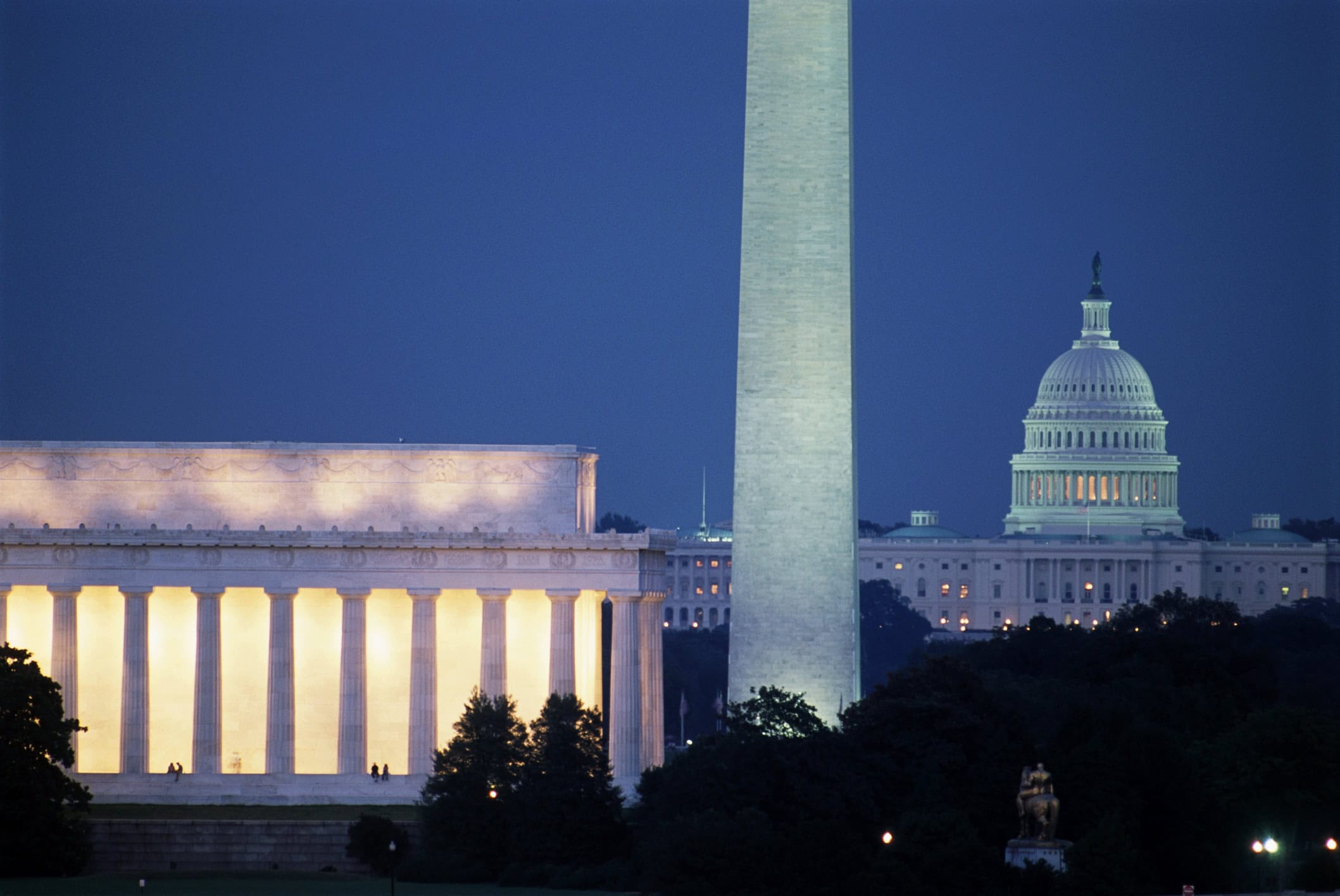
What is the right architecture for a republic?
“Like all fascists’ aesthetics,” declared a Guardian editorial, “Trump’s gaze is backward to an idealized ‘classical’ age and forward to a time when he, the Great Man, is immortalized in stone and gold.” The charge is familiar. President Trump is having a roughly 90,000-square-foot ballroom added to the White House and wants to erect a 250-foot-tall triumphal arch near Arlington National Cemetery; the article describes this as “trashing monumental public works while building cheesy monuments” and defiling the United States’ “collective heritage.”
The White House has also increased its efforts to beautify Washington, D.C. along classical lines, restoring Columbus Circle to its former glory, pumping water through the formerly long-dormant fountains at Meridian Hill Park, resurfacing the Reflecting Pool, and announcing plans to construct a pedestrian bridge behind the Lincoln Memorial in accordance with the original McMillan Plan. Critics of the president remain unimpressed. “This is just straight-up fascism,” remarked a guest on a recent episode of Runaway Country with Alex Wagner.
But that claim raises a question: What is the architecture of a republic?
To answer that, we must look to the founders. For Thomas Jefferson, it was to be found in the neoclassical style. Drawing on the architecture of Greek and Roman temples, neoclassicism is easily recognized by its symmetrical design and column-laden facades. Jefferson hoped that classical buildings could give the fledgling republic an environment that felt permanent. He reasoned that an idiom which had earned “the approbation of the ages” would inspire Americans to pursue the virtues embedded into the very form of their surroundings.
Jefferson put that conviction into practice when he drew up the Virginia State Capitol with Charles-Louis Clerisseau. Modeled on an ancient Roman temple, the Capitol represented a greatness the nation could then only aspire to. When William Thornton submitted his design for the U.S. Capitol in 1792, he drew upon that same classical tradition. So did the architects of nearly every major federal building in Washington. From the Supreme Court and the Treasury Building to the National Archives and the White House itself, each building reflects the founders’ belief that public architecture should embody a classically inspired brand of republican virtue.
Anti-traditional styles like brutalism only arrived in D.C. in the 1960s and ‘70s, making them a relatively recent addition. They are also widely disliked. The Robert C. Weaver Federal Building, which was until recently the home of the U.S. Department of Housing and Urban Development, has drawn criticism for decades. A Washington Times architecture critic called it one of the “ugliest buildings in town” in 2007. Housing Secretary Shaun Donovan placed it “among the most reviled [buildings] in all of Washington—and with good reason.” Polling confirms the pattern: Americans consistently prefer traditional architectural styles to contemporary ones.
Popularity alone should not settle the question, of course. But in this case, public opinion taps into something basic and real: human nature prefers the beautiful to the austere.
Not every American setting calls for a neoclassical approach. Contemporary styles define the skyline of New York, where steel and glass skyscrapers reflect the forward vision of a city addicted to progress. Trump himself deployed that vocabulary in Trump Tower. Even brutalism finds its proper context in the Washington, D.C. Metro, where converging rays of stark concrete evoke the ruthless forward drive of the trains and make you feel as if you are living in a ‘60s-inspired vision of the future. Throughout the country, regional differences have given us beautiful vernacular architecture in everything from the log cabins of Appalachia to the Pueblos of the Southwest. Those forms work in their natural environments.
Moreover, there is room for some critique of how the Trump Administration has gone about executing its vision. Perhaps the lions at the base of the proposed arch were a monarchically coded mismatch for an otherwise republican monument. Maybe the ballroom could have been smaller. But these isolated cavils are incidental to the wholesale objection being mounted by Trump’s most devoted opponents, who dislike the neoclassical revival per se because they recognize that it “projects strength…these big columns, all the flags.” On that point, they are correct. When they leap from this observation to condemning the style itself as suspect, however, they reveal that they implicitly equate strength of every kind with fascism.
Jefferson did not look to classical architecture because it domineered. He looked to it because it inspired. When visitors climb the steps to the Supreme Court, they ascend from the low to the high. The columns and pediments draw the eye upwards, forcing mortal men to look towards the heavens. That should be the aspiration of any genuine republican government: not to crush its citizens, but to elevate them.
As we approach the republic’s 250th birthday, we ought to recover some of Jefferson’s optimism. What a civilization builds is what it becomes.
The American Mind presents a range of perspectives. Views are writers’ own and do not necessarily represent those of The Claremont Institute.
The American Mind is a publication of the Claremont Institute, a non-profit 501(c)(3) organization, dedicated to restoring the principles of the American Founding to their rightful, preeminent authority in our national life. Interested in supporting our work? Gifts to the Claremont Institute are tax-deductible.
Suggested reading


Peer review funds derivative research at colossal expense.

The far-reaching strategy relies on a weak GOP.

An obituary for the greatest mass migration fiasco in American history.

Trump rebuilds the U.S.-Hungary relationship.

A century-old case law lurking in the disqualifications of Trump’s interim U.S. attorneys.

