

Gorbachev inherited an empire that was ready to dissolve.
Why Attack Iran Now?
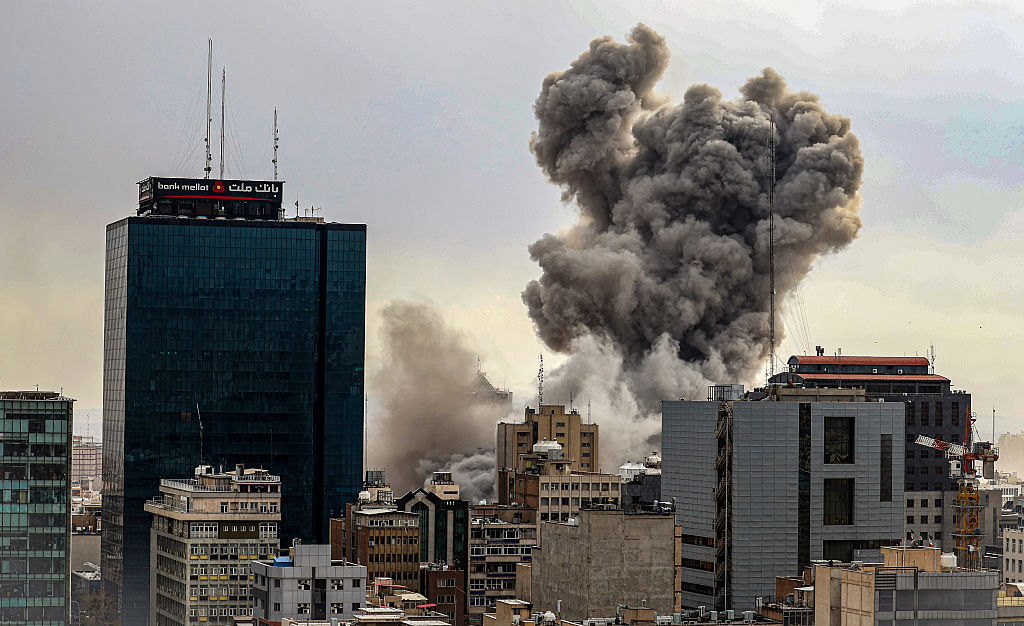
This war will end when Tehran scraps its nuclear program and stops attacking the U.S.
For almost half a century, American policymakers have been conditioned to look the other way when Iran has attacked America. The Iranian regime sees the United States as its main enemy—beneath contempt and worthy of death and destruction. President Trump views the threat of future Iranian attacks as existential, and believes that further delay is no longer acceptable. It is therefore a matter of life and death that he has taken military action in Iran.
President Trump has two objectives: to make sure Iran does not use nuclear ballistic missiles to attack the United States and to install a regime in Tehran favorable to U.S. interests. This will only happen when the current Iranian regime is defeated—and when they know they have been defeated.
Last summer’s Operation Desert Hammer did not change the Iranian regime’s mind that destroying America was their birthright. The Iranians must know that their policy of killing Americans has brought death and destruction, and that future killings will bring annihilation. Of this there can be no doubt.
The U.S. did not launch the airstrikes to liberate the Iranian people from the Islamic rule of the mullahs. Although President Trump is sympathetic to the Iranian people’s plight, the liberation of Iran is a job for the Iranian people. As it is, President Trump is trying to liberate the United States from the Deep State and its corrosive grip on our constitutional government.
Understanding why the U.S.’s attack on Iran had to happen now is essential, for the country is divided on the wisdom of the president’s course of action.
Why Do We Care if Iran Has Nuclear Weapons?
Twenty-five years ago, the Iranian military tested its ability to launch a Shahab-1 short-range ballistic missile from a freighter ship in the Caspian Sea. In two separate tests, they successfully launched a missile and exploded it in the high atmosphere to simulate an electromagnetic pulse attack. This is the kind of asymmetric attack that would be useful only against the United States. A nuclear warhead launched off the U.S. coast and detonated in the atmosphere would permanently destroy our electronic infrastructure and lead to the deaths of millions of Americans. This is what Iranian President Mahmoud Ahmadinejad had in mind when he announced in 2005 that he could envision a world without the United States.
Thus was Iran’s strategic nuclear doctrine established: they would strike the U.S. not with an intercontinental ballistic missile, which they have yet to develop, but with a short-range ballistic missile such as the Dezful, which has a range of 1,000 kilometers, or potentially a medium-range ballistic missile such as the Sejjil, which has a range of 2,000 kilometers. Iran tested the Dezful missile in 2024 in a launch from the IRIS Shahid Mahdavi, a container ship the Islamic Revolutionary Guard Corps (IRGC) Navy has used to test sea-based missile launch capabilities. In this scenario, an attack on the U.S. homeland by a ship-launched nuclear missile would also include the sinking of that ship so that there would be no trace, save the nuclear signature of the explosion. This would make retaliation difficult, if not impossible. Absent Iran’s ability to launch a nuclear ballistic missile from a submarine, this is the next best possibility.
In the years before the joint U.S.-Israeli airstrikes, the Iranians had done two demonstrable things: they worked continuously to modernize their ballistic missiles, and they developed their nuclear enrichment program to the point where they can produce a nuclear weapon. In what might be described as not ideal diplomatic negotiation tactics, the Iranians bragged to American envoy Steve Witkoff that they already had enough nuclear materials to produce 11 warheads.
If the United States were attacked by a ship-launched nuclear missile, we would be at the tender mercies of Communist China, Russia, or any other nation that seeks our destruction. Such an electromagnetic pulse attack is not something to be dismissed as a relic of Cold War thinking. It is today the operational doctrine of our enemies.
These hard facts are not easily explained to the American people. They are unpleasant to say the least. But at some point very soon, they need to be. The American people need to understand that Iran presents an existential threat to the United States.
At War for 47 Years?
Many of the anti-war detractors seem to have little appreciation for what has transpired since the Iranian Revolution. In 1979, a group of militant students seized the American embassy in Tehran—in effect, the sovereign territory of the United States. They held the embassy staff hostage for over a year to demonstrate their hatred of the United States. In the hours before Ronald Reagan was sworn in as president in January 1981, the hostages were released. History records that President Reagan had sent emissaries to Iran who spelled out the violent repercussions that would await Iran, and specifically its leaders, if the hostages were not released.
These were textbook acts of war against the United States. But they were never treated as such.
Having failed to respond adequately, in 1983 Iran used the terrorist group Hezbollah—which was created by the IRGC—as a proxy to bomb the U.S. Marine barracks in Beirut, Lebanon, killing 241 American servicemen. Believing somehow that not punishing Iran would lead to better relations, American lives were lost, and Iran’s contempt for the United States grew stronger. Even President Reagan believed he could defer a day of reckoning.
Likewise, in America’s misguided wars in Iraq and Afghanistan, Iranian-provided IEDs killed and maimed American soldiers. Again, these were textbook acts of war that Iran believed would go unpunished. For Iran, the United States is the Great Satan, and they believe we do not have the courage or moral conviction to defend ourselves against the morally superior mullahs in Iran. Every time we did not respond, their hatred and contempt only increased. Common sense would dictate that the Iranian nuclear program should be seen in light of their hatred and contempt. Just as Iranian-supplied IEDs have been used to kill American soldiers, Iran’s nuclear ambitions pose an existential threat to the American homeland and our way of life.
What Are Iran’s Intentions?
Iran sits on the second-largest deposit of natural gas in the world. The regime can sell natural gas abroad and provide energy to its people with gas-fired electric plants for several hundred years. The production of nuclear power could be done only at five times the cost, making little economic sense. Iran’s sole purpose in enriching uranium is to build nuclear weapons that can be used against the United States and the West.
To this day, the Iranians have their children go to school each morning and recite, “Death to America and Death to Israel.” The Iranian Revolution in 1979 may have concluded half a century ago, but it is alive in the hearts and minds of the mullahs and members of the IRGC who run Iran. At every turn of their public and private diplomacy, they invited the enmity of the United States, which they view as morally corrupt.
Iran could have negotiated an agreement with President Trump to eliminate their nuclear weapons and ballistic missile programs. That would have avoided war and led to the potential of greater prosperity for the Iranian nation. But they rejected such an agreement.
Don’t We Have a Missile Defense System?
The Iranian nuclear scenario described above is but one reason President Trump takes missile defense so seriously. But it should be noted that the president’s Golden Dome missile defense system is still in its infancy. Were it fully operational today, Operation Epic Fury would have been largely unnecessary. President Trump’s primary purpose, after all, is the defense of the U.S. homeland.
Throughout the nuclear age, America’s primary adversaries, the Soviet Union and Communist China, built both nuclear weapons and ballistic missile defenses. They are not perfect, but they are effective. Although the American people very much believe they should be defended from a nuclear ballistic missile attack, American political elites have failed them miserably.
Right now, we cannot stop a single Russian or Chinese intercontinental ballistic missile. We have limited defense from our Ground-Based Midcourse Defense system bases in Fort Greely, Alaska, and Vandenberg Space Force Base in California. Their primary purpose is to stop a North Korean ballistic missile launch. We have not yet built a missile defense system that can prevent the Iranian scenario described above, nor have we adequately hardened our electric grid from the threat of an electromagnetic pulse attack. Until President Trump, Americans had operated on the unfounded belief that we were immune from the hatred of our enemies and that nuclear war was somehow inconceivable.
What’s China’s Role?
Iran is a strategic ally of Communist China and Russia. Both nations, along with North Korea, support Iran’s nuclear ballistic missile research and development, much of which takes place in North Korea. It is a matter of high government policy that China and Russia desire an Iran armed with nuclear weapons, which creates a deadly proxy for use in any future conflict. This is one reason we must not discount the possibility that Iran already possesses a nuclear weapon.
Furthermore, China obtains significant amounts of oil from Iran as part of their strategic partnership. Iran is a valued supplier of this key commodity. But China is also a valued trading partner of the United States, given our economy’s dependency on rare earth minerals. This is one reason why economic warfare alone will not bring down the Iranian regime. A true sanctions regime against Iran would require robust secondary sanctions, including broad enforcement against Communist China’s purchases of Iranian oil—effectively severing U.S. trade with China. But this is not currently a realistic option. Indeed, we have imposed only limited penalties on Communist China for buying Iranian oil, which is being sold today using foreign-flagged ships. We are not, therefore, in a complete economic war with Iran, nor did we plan to be.
What we have done with our current use of military force is remove Iran as an effective proxy of Communist China. If the Chinese ever tried a sneak nuclear attack on the United States, what better way than to use the Iranian ship-launched ballistic missile scenario? Why run the risk of the U.S. retaliating against China directly when your Iranian proxy could do it for you? If we are indeed in World War III, it will now be clear that a nuclear attack is coming from one of three sources: China, Russia, or North Korea. If we are attacked now, those three nations will suffer the consequences. Such is the calculus of nuclear warfighting.
One additional and immediate concern of the United States should be the 200,000 Chinese men of military age who appear to be special forces who came illegally to the United States during the Biden Administration. They, along with Iranian sleeper cells in the U.S., may well use terrorism as a response to America’s use of military force in Iran. There needs to be a robust effort to root out these Chinese special forces, along with the 25 million other illegal invaders. A robust counterintelligence effort is also needed to defend against internal Iranian threats. Such is the consequence of the immigrant invasion that the Biden Administration aided and abetted.
How Does This End?
President Trump has said that the war in Iran will end with the “unconditional surrender” of Iran and the leadership in Tehran on terms that are favorable to the United States. As a matter of statecraft, one has to admire President Trump’s absolute clarity. Presidents before him deferred payment on a debt they knew had to be paid one day. The U.S. attack on Iran is payment with interest. President Trump’s resolve to see this through to the end cannot be doubted.
Put simply, this war ends when the nuclear threat from Iran ends, and the regime in Tehran believes it is suicidal to attack the United States ever again. Nothing less will suffice.
The American Mind presents a range of perspectives. Views are writers’ own and do not necessarily represent those of The Claremont Institute.
The American Mind is a publication of the Claremont Institute, a non-profit 501(c)(3) organization, dedicated to restoring the principles of the American Founding to their rightful, preeminent authority in our national life. Interested in supporting our work? Gifts to the Claremont Institute are tax-deductible.
Suggested reading


Tucker Carlson should have known better than to be seduced by Stalin’s majestic subway stations.

Progressive opposition to Israel’s military operation is rooted in racism and antisemitism.

To spot a would-be autocrat, look for someone who undermines language.

Biden’s dreams of American semiconductor dominance are futile.

How Trump can retaliate against the Honduran president’s threats.

