
Don't bend the knee to wokeism.
Who Owns American History?
The battle over slavery intensifies as we approach America’s 250th birthday.
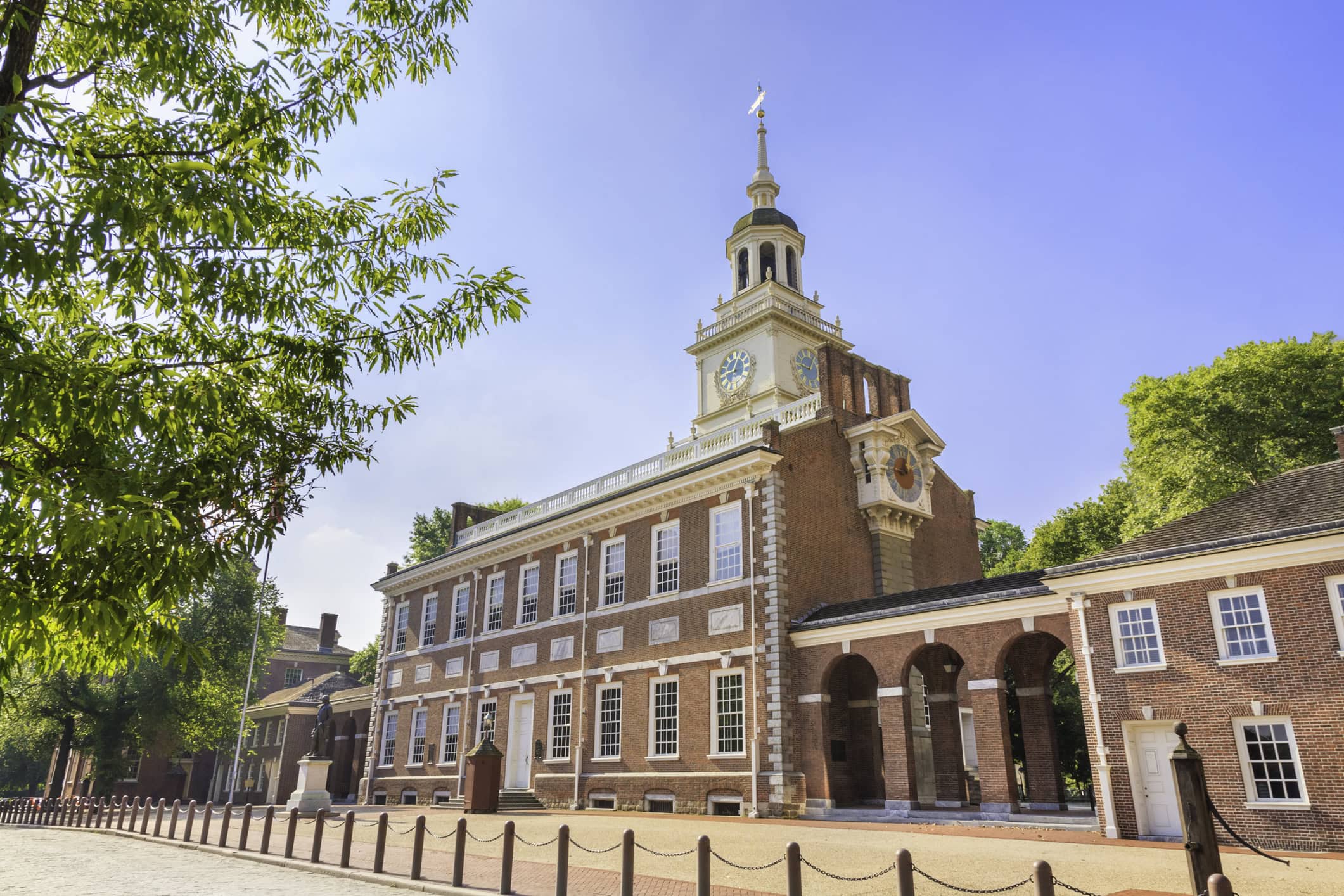
Why did the National Park Service regularly denigrate the events of 1776 prior to the Trump Administration? In the Claremont Review of Books’ 25th anniversary issue, Jeffrey Anderson describes a visit to Independence National Historical Park, situated in the heart of old Philadelphia and run by the National Park Service. Congress created Independence Park for the purpose of “preserving” historic sites associated with “the American Revolution and the founding and growth of the United States,” as Anderson notes.
Anderson found an overwhelming emphasis on slavery and race—25 of 30 signs at the park’s President’s House, where George Washington and John Adams lived during part of their presidencies, “focus on slavery or race relations.” He writes that Washington and other founders “stand accused” of “‘injustice’” and “‘immorality.’” The first U.S. president’s “actions [are] characterized as ‘deplorable,’ ‘profoundly disturbing,’ and as having ‘mocked the nation’s pretense to be a beacon of liberty.’”
How did this situation come to pass?
We must go back 24 years to the formation of the Avenging The Ancestors Coalition (ATAC). A lawyer, community activist, and founding member of ATAC, Michael Coard, expressed the mindset of the group in a July 4, 2021, essay in the Philadelphia Tribune:
July Fourth is a celebration of kidnapping, transporting/buying/selling human beings, separating families, torture, whippings, rapes, castrations, lynchings and enslavement…. So why do many Black folks continue to do their flag-waving, fireworks-blasting, and swine-barbecuing thing on July Fourth? The answer is obvious. They’re ignorant or they’re traitors or they’re both.
Incidentally, ATAC sponsors “Anti-Fourth of July Day” events annually—and its mailing address happens to be Coard’s law office. To describe the group as anti-American and particularly hostile to patriotic African Americans is an understatement.
The Philadelphia Inquirer reported that beginning in 2002, ATAC “worked with local scholars, lobbied elected officials, and negotiated directly with Independence Park to ensure the history of slavery was centered at” the President’s House. The Inquirer noted that “It wasn’t until roughly six years after their advocacy began, when [ATAC] felt like focusing the site on slavery was a done deal.” Michael Coard stated, “We all agreed that slavery was going to be prominent.” “The question was how prominent?” Coard credited the late Mary A. Bomar, the former National Park Service director under President George W. Bush, as being cooperative with ATAC.
The President’s House, with an overwhelming emphasis on slavery, opened in December 2010. It was immediately attacked by cultural critic Edward Rothstein, then with the New York Times. Rothstein rejected the argument of the site’s adherents that the new interpretation was based on history previously not examined. In a rebuttal, the Times writer argued it was far more beholden to identity politics advocacy than nuanced historical analysis: “It is not really a reinterpretation of history; it overturns the idea of history, making it subservient to the claims of contemporary identity politics.”
He continued:
After $10.5 million and more than eight years; after tugs of war between the city and the National Park Service and black community organizations; after the establishment of a contentious oversight committee and street demonstrations, overturned concepts and racial debates, it bears all the scars of its creation, lacking both intellectual coherence and emotional power.
Most importantly, Rothstein contended in a follow-up piece that the new ideological interpretation ignored what was significant for American history in the President’s House: the fact that the Washington and Adams administrations were influential in creating a new nation, a constitutional republic. Rothstein writes, “In the upstairs world of Washington and Adams, so blatantly ignored in the Philadelphia site, was the beginning of a national experiment: the faltering and difficult task of shaping a new society in which equality and liberty would indeed be governing principles, ultimately weakening the institution of slavery.”
Criticism also came from Williams College Professor Michael J. Lewis in Commentary Magazine in April 2011. In an essay entitled “Trashing the President’s House,” Lewis writes that its exhibition is akin to “making a national monument to the sins and failings of the Founding Fathers.”
Restoring History
Fortunately, on March 27, 2025, President Trump issued an executive order, “Restoring Truth and Sanity to American History,” declaring that there has been a “widespread effort to rewrite our Nation’s history” and to promote a “distorted narrative driven by ideology rather than truth.” This “revisionist movement” casts American “founding principles and historic milestones in a negative light.” The executive order called for “revitalizing key cultural institutions and reversing the spread of divisive ideology.”
In January 2026, in keeping with the implementation of Trump’s executive order, the National Park Service NPS began removing the current signage from the President’s House, replacing the ideologically driven interpretation with a more comprehensive and nuanced one for America’s 250th anniversary celebration. However, the City of Philadelphia, strongly allied with activist-advocacy groups, sued to block the removal of the signage. District Court Judge Cynthia Rufe agreed with the city and ordered the NPS to put the signs disparaging Washington and his presidency back up. She maintained that the NPS could not act unilaterally because it had entered into a series of cooperative agreements with the City of Philadelphia.
Judge Rufe declared that by removing signage developed by activists, including the anti-July 4th Avenging The Ancestors Coalition, revisionist historians, and the Democratic political leadership of the City of Philadelphia, the Trump Administration’s Department of the Interior (DOI) was involved in “dismantling objective historical truth.” Ruge continued, noting the “government claims it alone has the power to erase, alter, remove, and hide historical accounts…. Its claims in this regard echo Big Brother’s domain in Orwell’s 1984.” Rufe contended the removal of the signage “undermines public trust, and compromises the integrity of public memory.” Further, she maintained that it has harmed “the City’s tourism” and the “promotion of its history in advance of the founding of the United States of America.”
An appeals court temporarily stayed Judge Rufe’s order until further proceedings can determine the status of the President’s House. Meanwhile, Trump’s DOI posted on its website alternative signage to replace the City of Philadelphia’s activist narrative.
Patriotism Versus Anti-Americanism
The crucial question for any honest proponent of an objective, fact-based American history is which framework—the city’s or the Interior Department’s—best presents to millions of visitors (citizens and foreigners alike) a comprehensive overview of both freedom and slavery in America’s past?
As noted earlier, the Philadelphia-activist version overwhelmingly references slavery and race. George Washington is discussed mostly in negative terms. His actions are “deplorable” and “mocked the nation’s pretense to be a beacon of liberty.” Rather than seriously examining the administrations of the two men who lived in the President’s House, the activist signage dismisses their accomplishments, stating that as “Washington and Adams governed the new nation, slavery continued to grow.”
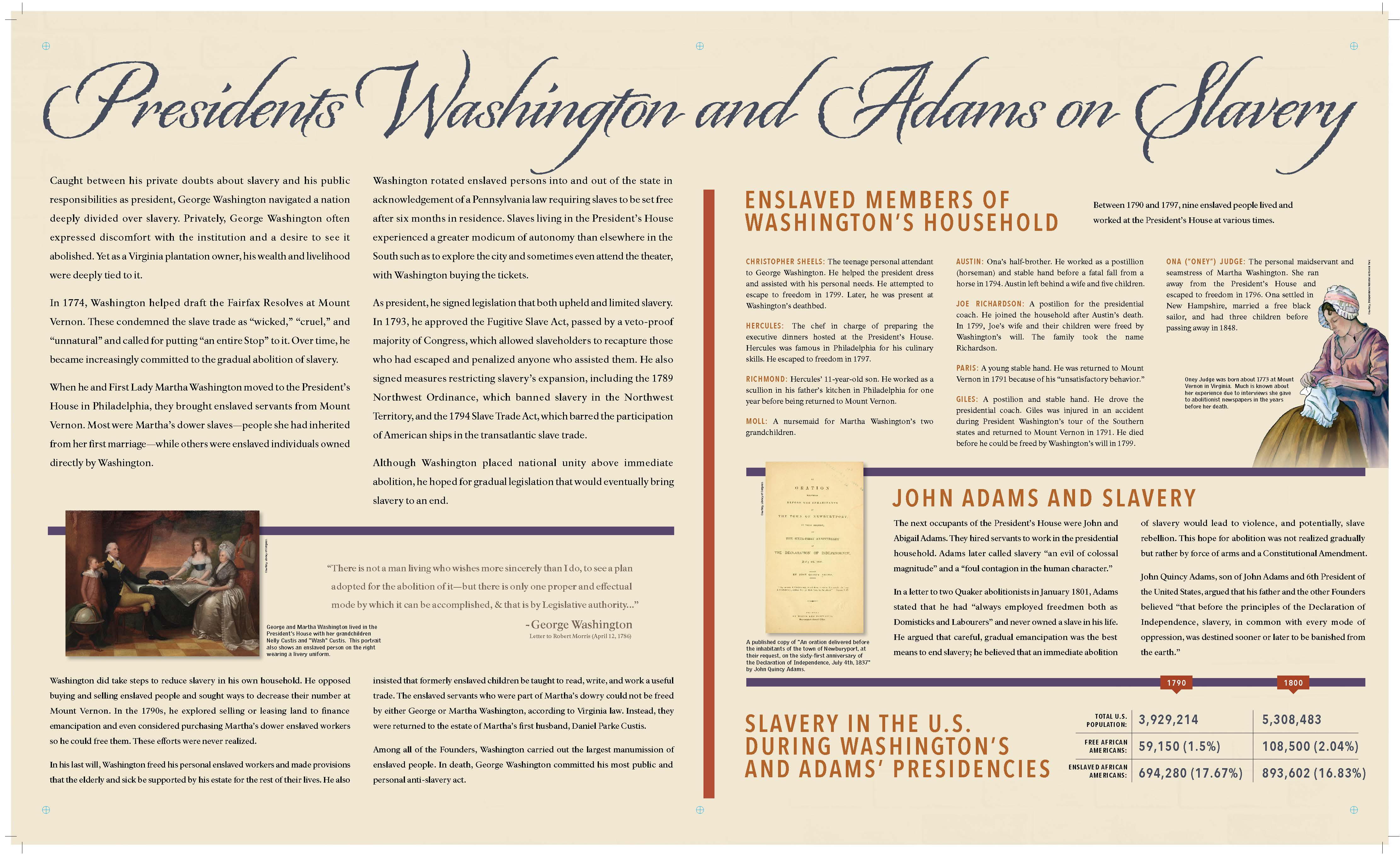
In contrast to the tendentious Philadelphia-activist interpretation of slavery, the proposed Trump DOI signage provides a complex discussion of the tension between slavery and freedom in the founding period in a section entitled “Presidents Washington and Adams on Slavery.”
It tells us that two years before the Declaration of Independence, “Washington helped draft the Fairfax Resolves at Mount Vernon. These condemned the slave trade as ‘wicked,’ cruel,’ and ‘unnatural’ and called for putting ‘an entire Stop’ to it.” The proposed signage also acknowledges that as president, Washington “signed legislation that both upheld and limited slavery.” He “approved the Fugitive Slave Act” but “also signed measures restricting slavery’s expansion, including the 1789 Northwest Ordinance, which banned slavery in the Northwest Territory, and the 1794 Slave Trade Act, which barred the participation of American ships in the transatlantic slave trade.”
The Interior Department signage also notes that Washington freed his slaves in his will and “made provisions that the elderly and sick be supported by his estate for the rest of their lives.” The Trump DOI’s interpretation concludes: “Although Washington placed national unity above immediate abolition, he hoped for gradual legislation that would eventually bring slavery to an end.”
Since John Adams was a lifelong opponent of slavery and never owned any slaves, he could not serve as a useful foil to promote the Philadelphia activist’s claim that “the American founding is all about slavery.” Therefore, Adams is barely mentioned in their signage, although he, like Washington, lived in the President’s House throughout his administration. The Interior Department interpretation reminds us that “During the Adams administration the United States supported” Toussaint Louverture’s slave rebellion in Haiti “economically with trade and supplies and militarily with arms and U.S. Navy ships.”
Besides providing a much more thorough analysis of the slavery issue during the Washington and Adams administrations, the DOI’s signage includes a much richer presentation of the history of the anti-slavery and abolitionist movements. Unlike the Philadelphia activist interpretation, the Interior Department version examines the history of the Underground Railroad, the careers of Harriet Tubman and Frederick Douglass, and Lincoln’s role in achieving the final abolition of slavery.
The interpretation of the history of slavery and the founding offered by the Trump Administration’s DOI is not “erasing history” in “Orwellian” fashion as Judge Rufe and advocates for the Philadelphia activists’ signage contend. Instead, it is comprehensively expanding our historical understanding of the detailed and nuanced history of the tension between slavery and freedom in our constitutional republic. If anyone is substituting propaganda for history, it is the Philadelphia-activist narrative, as New York Times critic Edward Rothstein pointed out 16 years ago.
The American Mind presents a range of perspectives. Views are writers’ own and do not necessarily represent those of The Claremont Institute.
The American Mind is a publication of the Claremont Institute, a non-profit 501(c)(3) organization, dedicated to restoring the principles of the American Founding to their rightful, preeminent authority in our national life. Interested in supporting our work? Gifts to the Claremont Institute are tax-deductible.
Suggested reading

Free expression is so central to liberty that its restriction by private megapolies is intolerable.
The cure for what ails America.
The greatest American film reminds us to give thanks that the cause of freedom remains there, waiting to be joined.

The Trump Administration has a big opportunity to curtail racism.

Weaponizing American privileges to own America.