

The divide between church and state doesn’t separate religion from public education.
The Tariff Wears Two Hats: What the SCOTUS Majority Overlooked
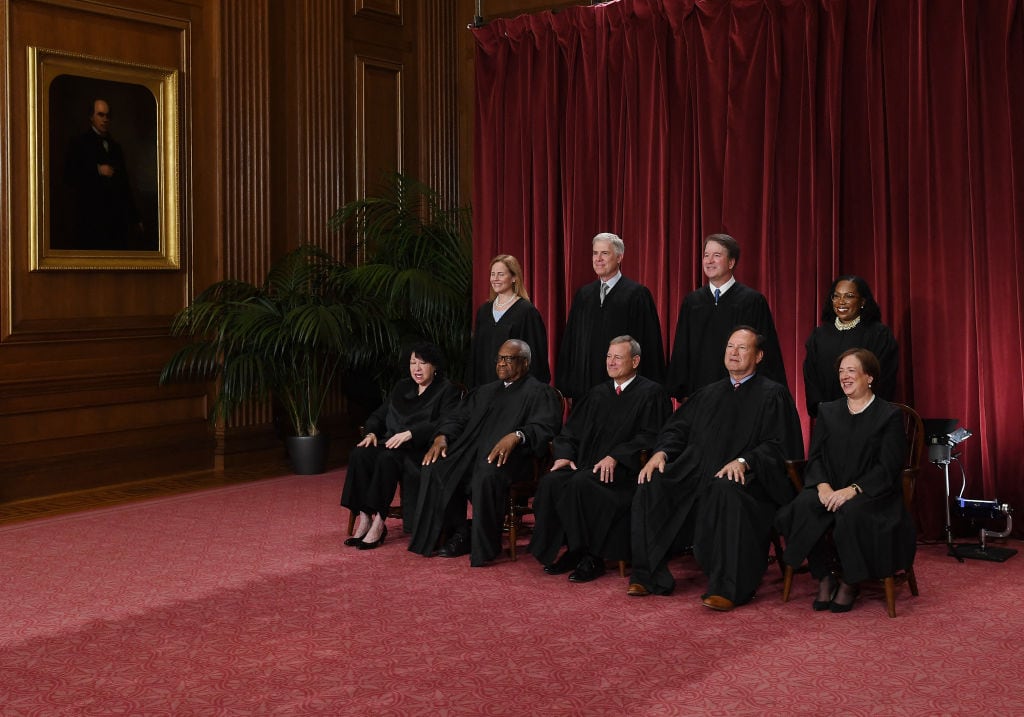
The president is the sole organ of foreign policy.
On the question of President Trump’s emergency tariffs, the Supreme Court has spoken. In the Court’s view, the International Emergency Economic Powers Act (IEEPA) does not authorize the president to impose tariffs during a declared emergency, namely, the massive trade deficits that threaten our economic security.
But the Court’s decision in Learning Resources, Inc. v. Trump was highly fractured. Only three justices—Kagan, Sotomayor, and Jackson—held that the law, under normal principles of statutory construction, does not give the president authority to impose tariffs. Justice Kavanaugh’s dissent, joined by Justices Thomas and Alito, quite persuasively demonstrates why that is not the case. As Justice Thomas noted in his separate dissent, the power to “regulate…importation” has throughout American history “been understood to include the authority to impose duties on imports.”
The other three justices who formed the majority holding—Chief Justice Roberts and Justices Gorsuch and Barrett—resorted to the major questions doctrine. This principle of statutory interpretation holds that Congress must speak with super clarity on issues of “economic and political significance” for the Court to approve a delegation to the executive. The turn to the major questions doctrine implies that the statute, under normal principles of statutory construction, authorizes the president’s action, a point that Justice Gorsuch explicitly conceded in his concurring opinion.
But here’s the rub. The Court has never previously applied the major questions doctrine in the foreign policy arena—and for good reason. Under Article II of the Constitution, the president has the core responsibility for foreign policy. Chief Justice Roberts acknowledged as much, stating in the part of his opinion that garnered only three votes that “as a general matter, the President of course enjoys some ‘independent constitutional power[s]’ over foreign affairs ‘even without congressional authorization.’” That’s quite an understatement. The failure to recognize the full measure of that fundamentally important piece of constitutional law is the first fatal flaw in the chief justice’s opinion.
The key Supreme Court case on this point is United States v. Curtiss-Wright Export Corp. (1936), which Chief Justice Roberts does not mention. In that case, Justice George Sutherland, writing for a near-unanimous Court, articulated the principled distinction between foreign and domestic powers: “In this vast external realm, with its important, complicated, delicate, and manifold problems, the President alone has the power to speak or listen as a representative of the nation.” Then, quoting John Marshall’s “great argument of March 7, 1800, in the House of Representatives,” he added, “The President is the sole organ of the nation in its external relations, and its sole representative with foreign nations.”
The main issue in the case was whether Congress could delegate to the president the authority to prohibit the sale of arms to either side in a war between Bolivia and Paraguay. But Justice Sutherland did not rely solely on the act of Congress. “It is important to bear in mind,” he wrote, “that we are here dealing not alone with an authority vested in the President by an exertion of legislative power, but with such an authority plus the very delicate, plenary and exclusive power of the president as the sole organ of the federal government in the field of international relations—a power which does not require as a basis for its exercise an act of Congress….” (Emphasis added.) In other words, President Roosevelt had the power to ban the sale of arms even without the act of Congress at issue.
The same should be true in Learning Resources, Inc. v. Trump. Justice Thomas’s dissenting opinion convincingly demonstrates why that is the case. While the chief justice claimed that Solicitor General Sauer conceded that “the President enjoys no inherent authority to impose tariffs during peacetime,” that’s not exactly what General Sauer said. Rather, he argued that the statute delegated such authority to the president. Under Curtiss-Wright, a claim of inherent authority over foreign policy should still be viable.
In the part of the Curtiss-Wright opinion I elided above, Justice Sutherland noted that the president’s power over foreign affairs, “like every other governmental power, must be exercised in subordination to the applicable provisions of the Constitution.” For Chief Justice Roberts, the fact that the power to tax is vested exclusively in Congress and, further, that any bill imposing taxes must originate in the House of Representatives—an odd acknowledgment given the chief’s prior decision to view Obamacare as a tax despite it having originated in the Senate!—was further confirmation that Congress had not delegated to the president any power to impose tariffs.
Therein lies the second fatal flaw in the Court’s decision, for a tariff wears two hats. It is both a tax and a tool of foreign policy. President Trump’s imposition of tariffs was clearly the latter (even though, incidentally, they also raised a lot of money). This “two-hat” phenomenon is not unique to tariffs imposed by the president. It is expressly recognized in another, somewhat related provision of the Constitution. Article I, Section 10, Clause 2 provides that “No State shall, without the Consent of the Congress, lay any Imposts or Duties on Imports or Exports, except what may be absolutely necessary for executing it’s inspection Laws.” This clause recognizes that an impost or duty (akin to tariffs) can be both a tax and an exercise of a state’s police power. The fact that the authority to impose such taxes is vested exclusively in Congress under Article I, Section 8 does not eliminate the states’ ability to use such a power for the different purpose of protecting health and safety through their inspection laws.
So, too, with tariffs. The fact that the power to impose duties and imposts is part of the taxing power vested exclusively in Congress does not undermine the president’s ability to use tariffs as a tool for foreign policy—a “plenary and exclusive power” vested, as Curtiss-Wright makes abundantly clear, in the president as the “sole” organ of foreign policy.
This distinction underlies Justice Thomas’s typically insightful dissent. He effectively indicated a path whereby the president can continue to use tariffs as he engages other nations in his capacity as the sole organ of American foreign policy. Time will tell whether the Court will adhere to its long-standing, landmark ruling in Curtiss-Wright if and when the president follows that path, but it certainly should.
The American Mind presents a range of perspectives. Views are writers’ own and do not necessarily represent those of The Claremont Institute.
The American Mind is a publication of the Claremont Institute, a non-profit 501(c)(3) organization, dedicated to restoring the principles of the American Founding to their rightful, preeminent authority in our national life. Interested in supporting our work? Gifts to the Claremont Institute are tax-deductible.
Suggested reading

We can’t count on the Supreme Court.
America’s unserious political class is totally unequipped to deal with the threat.
It’s keeping young families from owning homes.
When civility goes wrong.
Embracing Communist China was the U.S.’s greatest strategic failure.

