

Modern science can’t give an account of itself.
The Original Progressives Are No Guide for Today’s Conservatives
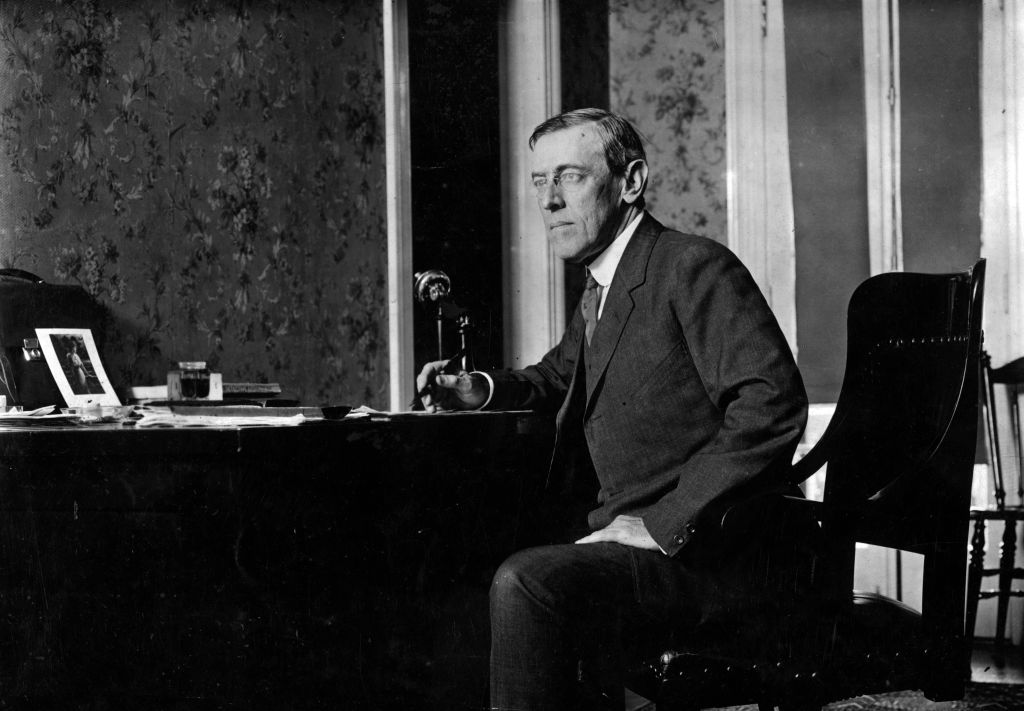
Woodrow Wilson and his ilk need to be left in the dustbin of history.
It has been a healthy development that parts of the conservative movement over the last decade or so have become increasingly skeptical of the Republican establishment’s slavish devotion to excessive individualism, indiscriminate immigration, and globalism.
In a recent First Things article, R.R. Reno pointed to America’s original Progressives—and to Woodrow Wilson in particular—as sources of inspiration for today’s conservative reassessment, because they too yearned for greater solidarity as they contended against the excesses of individualism. While I sympathize with Reno’s aims, Wilson and his fellow Progressive fathers of our modern state should not serve as guides to escaping our present mess—after all, they were the figures most responsible for bringing it upon us.
Conservatism is a divided movement today. But if we’re honest, it almost always has been, coming as it did out of the shotgun marriage of traditionalists and individualists. What united the diverse elements of the conservative movement, however, was their opposition to the collectivism and statism foisted on us by the likes of Wilson and Franklin Roosevelt. It is a sign of just how precarious our times have become—and of just how badly establishment conservatism has fallen short—that sensible conservatives should now turn for inspiration to those whose principal mission was to overturn the American political tradition and replace it with the modern state.
What the Progressives Wrought
Reno has a point when he says that the latter part of the 19th century featured plutocratic elements that were inimical to older American traditions. And of course he is right that the “energetic” responses of Wilson and his fellow Progressives were “illiberal.” But that doesn’t mean they were good for the country, nor does it suggest a parallel to our crisis today.
Contrary to what Reno suggests, the crisis we face today is actually an outgrowth of the Progressives’ original illiberalism. Zohran Mamdani’s progressive platform for New York City hews pretty closely to the socialistic economic program of his antecedents in the original Progressive Era. And it shouldn’t need pointing out that Mamdani and his allies call themselves Progressives for a reason.
Reno acknowledges the Progressives’ role in founding the administrative state, but misses the full picture when he says that conservatives oppose the administrative state because it betrays “the great American tradition of freedom.” The implication is that Reno wants us to be concerned with more than just freedom. Fair enough—and we are. The administrative state is a problem for an even deeper reason: it deprives the people of the ability to govern themselves. It replaces consent with alleged expertise as the principal claim to the right to govern. That the Trump Administration has made the deconstruction of the administrative state one of its main projects is thus greatly encouraging—precisely because it involves deconstructing the Progressives’ statist and anti-democratic program, not because it is somehow inspired by them, as Reno suggests.
The Progressives’ political economy that Reno appears to admire also seems ill-suited for Trump’s economic nationalism. Whereas Trump is making robust use of tariffs, Wilson did the opposite. His major economic initiative in 1913 was to replace the tariff with the income tax, which was to be used as the principal mechanism for funding the administrative state. Among other things, one effect of the income tax was to burden the middle class with the costs of the administrative state, and thus to increase their dependency on it; this is an aim made explicit by E.R.A. Seligman, the clearest Progressive writer on taxation, in his Essays in Taxation.
As another way of expressing the Progressive project, Reno uses the term “solidarity.” This helps to get to the heart of what he and some conservatives today find tempting about Wilson and other Progressives. They want a more robust version of the common good at the center of public life—one informed by religious faith and which can sometimes pull in the opposite direction of individualism. Wilson was indeed offering a kind of solidarity as a counterweight to the individualistic, capitalistic, and plutocratic excesses of the day. Many conservatives today—and I include myself in this group—seek “to renew American solidarity,” as Reno puts it, and move beyond the narrow obsessions of the Republican donor class.
But contrary to Reno’s contention at the end of his essay, Progressive solidarity is not a model for conservative solidarity today. The Progressives worshipped a very different god than the one that inspires Reno and readers of First Things. They were products of the Darwinian Revolution that defined the 19th century, and their god was science, which took the place of the traditional God. The Progressives believed that the state should employ a new conception of science in its supervision of individual development.
Modern Science’s god
To understand this fundamental shift, one must appreciate the sea change that had taken place in American higher education during the second half of the 19th century. The small, orthodox colleges that comprised almost all American higher education were increasingly replaced by, or transformed into, European-inspired universities; modern science came to replace traditional orthodoxy as the center of higher education. Institutions of higher education thus produced enthusiasts for scientific authority, increasingly armed with graduate degrees. These new graduates, inspired by their new scientific god, formed the professional academic associations that are still with us today (e.g., the American Political Science Association, the American Historical Association, the American Economic Association, etc.). They looked to staff the agencies of the emerging administrative state.
The Progressives are thus not the allies of, nor do they provide any grounds of inspiration for, those who today want to return traditional faith to an important place in public life.
Frank J. Goodnow, a leading Progressive intellectual and founding president of the American Political Science Association, explained that under the new Progressive vision the state replaces the Creator as the source of duties and rights. By contrast, the American Founders had posited that fundamental rights and duties transcend the conventions of human society and flow instead from the natural law authored by God. Goodnow countered that man’s rights and duties are “conferred upon him not by his Creator, but rather by the society to which he belongs. What they are is to be determined by the legislative authority.”
A central tenet of progressivism was the abandonment of natural law and nature’s God as the authoritative foundation for what Reno calls solidarity. One facet of this abandonment of our common human nature as the ground of solidarity was its replacement by race. For Progressives, who were inspired by German philosophers and largely educated at German universities, progress took place by the advance of certain races, or what the Germans called the “folk.” The phrase “progress of the race” is common in Progressive writings.
The Progressives’ rejection of the old American foundation in human nature clearly influenced a variety of their political positions and policies, including Wilson’s infamous re-segregation of the federal civil service. As odious as the Progressives’ pseudo-race science is, it has a growing appeal among fringe elements of the so-called “dissident right,” especially among the young. This is all the more reason for us to take care when suggesting that Progressive solidarity might be an inspiration for a renewed solidarity today.
One example of such Progressive solidarity was their immigration policy, which Reno mentions, and which has drawn praise from some elements of the New Right. Certainly, any sensible conservative today should recoil at the indiscriminate, open-borders policies of recent administrations. Conservatives should insist that nations have both the right and duty to control their borders and to be selective about whom they allow to immigrate—including their right to forbid immigration entirely if they so choose.
But what principle should form the basis of our selectivity in immigration? The Progressives’ answer relied largely upon race science. But the Founders and Americans throughout much of our history thought differently. Even the Naturalization Act of 1790 referenced color more as a cultural category than a racial one. And it did not employ the so-called “science” of race that first showed itself in the antebellum South and later came to be fundamental to the Progressives. The early American tradition looked instead to welcome those who embraced the kind of republican virtues that would contribute to, and sustain, the American way of life. Our more recent, self-destructive policies have done just the opposite: they have opened our borders to those openly hostile to our way of life and the principles of American government.
The remedy for this problem is not Progressive race science. It is instead to insist on solidarity with our republican principles and with the American way of life. This is a solidarity that is consistent with the best traditions of America. The Progressives’ new turn, by contrast, openly rejected both those principles and that way of life. Why would we look to it as a model?
Through a Glass Darkly
Ultimately, the main reason there is some sympathy for the Progressives on the New Right today is the overt Christianity of Wilson, and especially of Theodore Roosevelt. The latter was famously nominated at a Progressive Party convention in 1912, which was as much a religious revival as it was a political event, with the delegates marching around the convention hall waving Bibles and singing “Onward, Christian Soldiers.” Yet while their Christian faith was genuine, conservatives should also understand that Progressives embraced a peculiar kind of Christianity—one that ultimately led to the hollowing out of the denominations most influenced by it. Much of Progressivism was intertwined with the Social Gospel, a left-wing Protestant movement created in the 19th century on the momentum of the Darwinian revolution. It sought to merge Christian faith with the enterprise of an activist state.
My colleague Brad Watson has pointed out the odd and unfortunate parallels between the Social Gospel and the “conservative” integralists of our own day. Those with a knowledge of philosophy will also see the clear origins of Social Gospel progressivism in Georg Hegel’s fusion of the state and religion. Hegel described this fusion, which was massively influential on the Progressives, as one where “all the worth which the human being possesses, all spiritual reality, he possesses only through the State.” The state is “the Divine Idea as it exists on earth.” For the segment of Protestantism that embraced this fusion, the results were predictable: adherents eventually figured out that they could get the collectivism and the social justice activism without the personally inconvenient demands of Christian religious practice. This phenomenon explains in part the hollowing out of the mainline denominations that we have seen over the latter part of the 20th century, and now into our own time.
We conservatives can do better. We too want to remedy the hyper-individualism that has destroyed much of our culture and our politics. This is why we might be tempted to find common cause with the Progressives, who, as Reno observes, faced their own crisis of excessive individualism. But this common cause comes from a common error: both the original Progressives and those among today’s conservatives whom they inspire make the mistake of seeing the early American political tradition as a source of this excessive individualism. They want to reject our own tradition and go back to some other, better one, though it’s unclear what or where that is.
The problem here is a misunderstanding of the American Founding that mirrors the one made by the original Progressives. Their hyper-individualized version of the founding, which they saw as the origin of the plutocracy of their own day, was a distortion they accepted from the right-wing social Darwinists against whom they happened to be contending. For the most part, the Progressives didn’t access the Founders’ thought directly. Instead, they saw it through the lens of their radically individualistic opponents in the late 19th century, who distorted the principles of the founding for their own purposes. It is then somewhat understandable that the Progressives turned away from their opponents’ view of the “founding” to embrace a more collectivist vision.
Some of our conservative friends are making the same mistake today, though the lens through which they see the founding is that of our own contemporary liberals. With that distorted view of our genuine liberal tradition in America, it’s no wonder some are tempted by alternative, illiberal remedies. The real remedy, however, is a more accurate understanding of both Progressivism and the older tradition in America, and of why only the latter provides any genuine model for a conservative restoration.
The American Mind presents a range of perspectives. Views are writers’ own and do not necessarily represent those of The Claremont Institute.
The American Mind is a publication of the Claremont Institute, a non-profit 501(c)(3) organization, dedicated to restoring the principles of the American Founding to their rightful, preeminent authority in our national life. Interested in supporting our work? Gifts to the Claremont Institute are tax-deductible.
Suggested reading


It’s time to bet on humanity—before things get worse.
A little less conversation, a little more action.

Obsessive bodybuilding is a funhouse mirror image of obese trans Gatorade yoginis.

Why African Americans should be very, very mad at the Democratic Party

