
The Mount Rushmore of American Educators
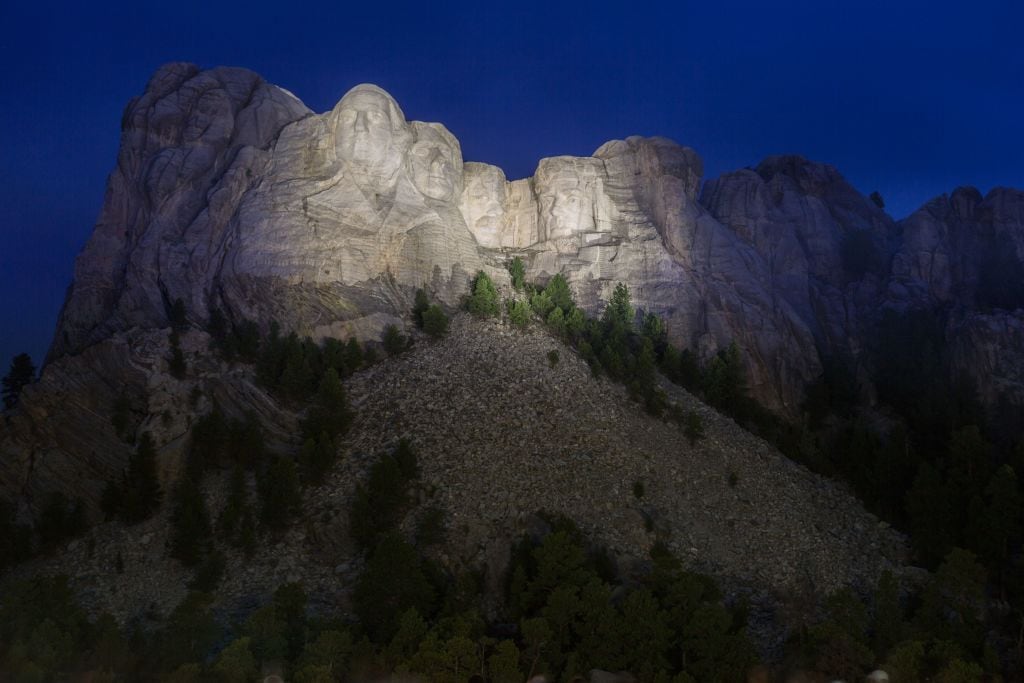
These four teachers faced incredible challenges but never gave in to despair.
As the United States celebrates the 250th anniversary of its founding this July, it seems fitting to reflect on our national heroes. This country has many monuments honoring important figures from our history, but none loom larger than Mount Rushmore, featuring the faces of four of our greatest American presidents: Washington, Jefferson, Lincoln, and Theodore Roosevelt. Each of these leaders was flawed in his own way, but we honor them together as heroes for the way they served their country.
As human beings, we need heroes. We need not only abstract descriptions of what is excellent, but also individuals we can strive to emulate. Reading the stories of those who pursued excellence in the face of adversity can train us to pursue that which is good in our own circumstances. Stories of human excellence show us that achieving the good is still possible in our time and should prompt us to be better than we would be on our own.
Heroes are not limited to national leaders. They can be found in almost every area of American life—even in classrooms. What if the field of education had its own Mount Rushmore? What four American teachers, out of the millions who have faithfully taught students, should be represented? We propose Booker T. Washington, Anne Sullivan, Jaime Escalante, and Marva Collins.
Cast Down Your Bucket
Booker T. Washington was a teacher and leader who overcame great adversity to get an education and championed the dignity of manual labor. Born into slavery on a Virginia plantation, Washington and his family moved to Malden, West Virginia, after their emancipation. There, he worked in a salt furnace and later a coal mine to help provide for his family. When a day school for African American children opened in his town, Washington attended night classes until he struck a deal with his stepfather: he would work before school and again after school each afternoon.
At the coal mine, Washington heard about Hampton Normal and Agricultural School in Virginia and immediately sought to attend the school to continue his education. When he was about 16, he left Malden for Hampton even though he did not have money to make the entire journey, let alone to cover tuition. By ingenuity and grit, Washington made it to Hampton and worked as a janitor to pay for his board at the school.
Upon graduating, Washington returned to Malden and taught at the same school where he had studied as a boy. He sent a respectable number of his own students to continue their studies at Hampton, where the school’s administration was impressed by how well-prepared they were. Eventually, Hampton’s administration asked Washington to teach for them. Later, they recommended him to be the founding principal of a new school for African Americans in Tuskegee, Alabama.
At Tuskegee, students received both academic instruction and training in manual skills. Washington had them construct the school buildings, grow the school’s food, and make everything else the community needed. This was an opportunity for the students to develop their skills and to experience the satisfaction of making something for themselves first-hand. Washington led by example, showing his students that he was not ashamed to work with his hands alongside them. He demonstrated to them that hard work—which many still associated with the cruelty and inhumanity of slavery—led to dignity, agency, and self-respect.
Through his success at Tuskegee, Washington became a well-known national speaker, traveling widely to lecture about the cause of his people and the work at the school. His speech at the 1895 International Exposition was particularly famous. He called for black and white men to learn to serve and appreciate one another for their skill, hard work, and ingenuity. Though Washington’s emphasis on manual education at Tuskegee was controversial, he was committed to doing what he thought was necessary to prepare his students to flourish as individuals and as a community.
A Helping Hand
The second face on our Mount Rushmore of great American teachers is that of Anne Sullivan. The daughter of Irish immigrants, Sullivan spent a significant portion of her childhood in the harsh conditions of an almshouse, eventually leaving to study at the Perkins Institution for the Blind. Despite multiple surgeries on her eyes, she struggled with poor vision throughout her entire life. After graduating, Sullivan was hired by a family in Tuscumbia, Alabama, to tutor a blind and deaf child named Helen Keller, whose ability to communicate was severely limited.
Sullivan quickly learned that Helen’s biggest problem was not her inability to communicate—it was her lack of self-control. Out of pity, the Keller family had spoiled Helen for years and imposed little to no discipline on her. As a result, Helen became a self-absorbed, unhappy, wild child lost in a world of ignorance.
But Sullivan believed that Helen could learn.
She taught Helen to communicate through a manual alphabet, a system of finger motions corresponding to the letters of the alphabet that could be made in the palm of another person’s hand. Patiently and methodically, Sullivan used this manual language to introduce Helen to the wider world.
Sullivan encouraged her to ask questions about anything that interested her and always tried to answer her truthfully. She eventually taught Helen how to read raised-letter books, and later, Helen would go on to author 12 books of her own. Helen traveled to 39 countries in her lifetime and met many well-known people from her day. Sullivan remained Helen’s teacher and companion for most of her life. Although Sullivan is known mainly for her tireless efforts with one famous student, she is an inspiration to educators everywhere to continue to do their noble work with compassion and tenacity.
Standing and Delivering
Next to Sullivan appears the face of another remarkable American teacher: Jaime Escalante. Escalante grew up in Bolivia, where he excelled at math, science, and sports. A friend convinced him to begin teaching even before he had completed his training. Escalante eventually taught at three different schools at once.
After a few years of teaching in Bolivia, Escalante and his wife moved their family to California, where he took a job at Garfield High School in Los Angeles, which served mostly poor Latino students. Although Escalante had been hired to teach computer classes, he quickly discovered he had been assigned only basic math courses.
Escalante believed his students could learn advanced mathematics, regardless of family income and social status. After teaching at Garfield for a few years, he started an AP Calculus class and helped many of his students do advanced high school mathematics. Believing that learning requires hard work, Escalante assigned large amounts of homework and arranged study sessions outside of school hours to immerse students in the math they were learning. He used toys and employed sports metaphors to make mathematical concepts more interesting and understandable for his students.
Escalante treated his students like members of an athletic team, and he acted as their coach. He consistently showed them that he cared for them, but he was no pushover. Escalante would often use edgy nicknames for his students, and he was not above using insults—and even threats—to motivate them to learn.
In 1982, several of Escalante’s students had their AP Calculus scores suspended for suspected cheating because their mistakes were unusually similar. Most of the class ended up retaking the test, and all those students passed it—again. This incident drew widespread media attention to Escalante’s teaching and his students’ remarkable success. In 1988, Warner Bros. Pictures released a feature film about Escalante and his students entitled Stand and Deliver.
Learning for All
The final figure to appear on the Mount Rushmore of great American teachers is Marva Collins. Collins grew up in Alabama and attended Clark College, where she studied secretarial science. She had not intended to become a teacher, but she found a teaching job after graduation, and it turned out she was well-suited to the work.
Collins moved to Garfield Park, a westside neighborhood of Chicago, where she got married and started having children. The neighborhood was deteriorating into a ghetto while the Collins family lived there, but Marva wanted to stay and help the children in her community. After taking a break from teaching to care for her own children, she returned to the classroom in 1963 at Delano Elementary School. Collins was incredibly successful, but some of her colleagues did not like being shown up. As a result, these educators made things difficult for her, and Collins left after only one year at the school. Soon after, Collins was asked to help found a private school in Garfield Park known as Westside Preparatory Academy.
Most of the students who transferred to Westside Prep had been thought to have a variety of learning difficulties and struggled academically. But Collins believed that all children could learn regardless of their challenges and labels. She told her students that they could succeed if they were willing to take responsibility for themselves and their work.
Collins firmly believed that reading was the key to future academic success, and she used a phonetic method to teach her students how to read. Phonics gave them the linguistic tools they needed to sound out any word, and even struggling students learned how to read under Collins’s tutelage.
She also believed in the power of great stories. Collins ignited a passion in her students to read by giving them interesting and worthwhile books, especially fairy tales, folk tales, and classic works of literature such as Shakespeare’s plays. She knew they needed good stories that would teach sound morals and show them a larger world beyond the ghetto. Collins intentionally gave each of her students plenty of encouragement, praise, and physical affection. She knew many of them had been convinced by prior failures that they were incapable of learning, but she strove to create an environment where every student could learn.
The Four
The four teachers discussed above should be heroes for American educators today. Their stories present powerful examples of how teachers, in the face of difficult circumstances, can give students excellent instruction and make direct, positive contributions to their lives.
Washington strove against all odds to pursue an education for himself and to educate black Americans in order to prepare them to live as free people. Anne Sullivan, despite her own struggles with blindness, sought to reveal the world to a deaf and blind girl by treating her as a human being capable of knowledge, understanding, and creativity. Jaime Escalante helped his often-overlooked students to learn and love mathematics, teaching them how to overcome challenges in the face of societal expectations. Marva Collins tenaciously worked with struggling students and enabled them to become competent and confident learners through being exposed to a rich tapestry of great literature.
These teachers faced incredible challenges in their classrooms but never gave in to despair. They left a rich legacy for all teachers who have come after them, which is why they have earned a place on the Mount Rushmore of American Educators.

The American Mind presents a range of perspectives. Views are writers’ own and do not necessarily represent those of The Claremont Institute.
The American Mind is a publication of the Claremont Institute, a non-profit 501(c)(3) organization, dedicated to restoring the principles of the American Founding to their rightful, preeminent authority in our national life. Interested in supporting our work? Gifts to the Claremont Institute are tax-deductible.

Trump is right: only patriotic American history can heal our deep wounds.

Government schools have become day camps for indoctrinating a woke cadre.

Texas voters punished Republican legislators who opposed school choice.

We must understand the political ideas, history, and culture of the Founders’ generation.

The California Reparations Task Force is trying its best to skirt a landmark Supreme Court ruling.

