

It’s a good time to remember that our Constitution is founded on the right of revolution.
The LGBTQ Tidal Wave Was Never About a Social Contagion
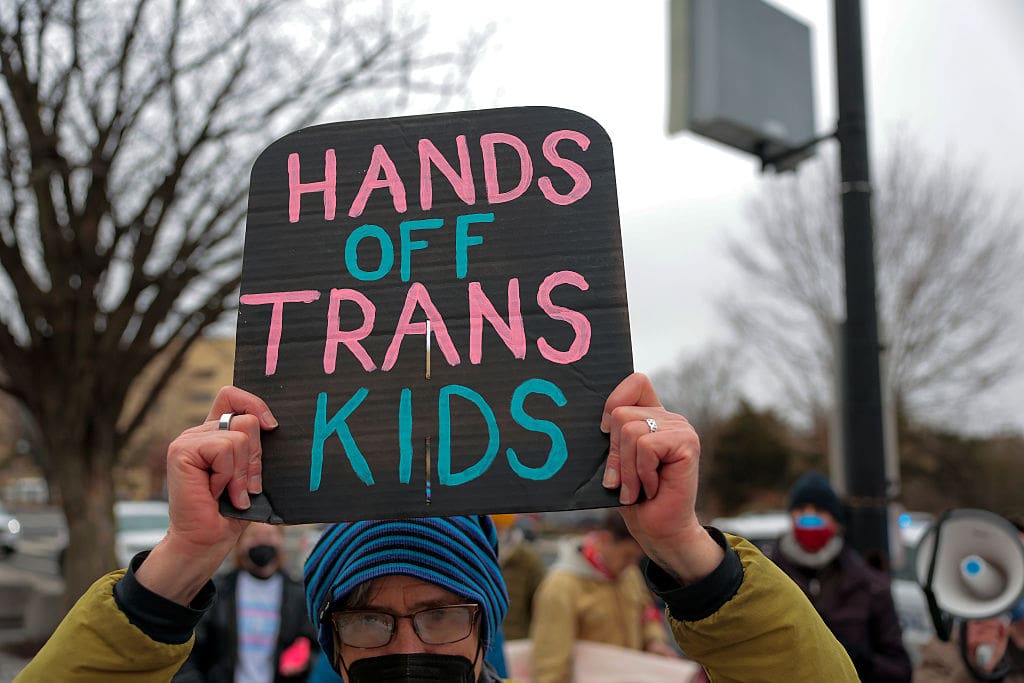
While a popular explanation, it doesn’t capture what really happened among the youth.
Opponents of surgically mutilating healthy adolescents are currently relishing a moment of vindication. This month, the Supreme Court delivered a blow to California laws that obligate schools to aid and abet minors’ “gender transitions,” keeping them secret from parents. Back east, a New York court awarded two million dollars in damages to a woman on whom doctors performed a double mastectomy at age 16. Given this turn in the cultural tide, it’s understandable why conservatives would be fighting the urge to spike the football and offer much-deserved “I told you sos.”
And there’s more good news. A few months ago, researcher Erik Kaufmann noted a precipitous decline in the number of young people who identify as “non-binary” after 2023. More recently, Jean Twenge, a scholar who charts generational divides and characteristics, confirmed that Kaufmann’s findings are likely true and can be extended to include transgender identity specifically and LGBTQ identity in general.
These results bolster the claim that the explosion of youth who belong to a sexual minority at the peak of the “Great Awokening” was the effect of a social contagion. Simply put, the social contagion argument holds that it was peer pressure, combined with cheerleading from mainstream media, that caused so many young people to announce that they were gay, transgender, or non-binary starting around 2020.
It may be true that there was a cultural moment in which it was broadly perceived as cool and edgy for youth to belong to a sexual minority. But the social contagion thesis ultimately fails to give a satisfying account of the phenomenon in question. Before offering an alternative explanation for the decline in youth LGBTQ identification, we must document the inherent weaknesses of the contagion theory.
Not Just a Fad
For one, the social contagion account implies that young people were not actively laying claim to these identities—that they simply caught them like a cold. However, there are strong indicators that they were doing so consciously.
More importantly, though, the social contagion theory is unnecessarily dismissive: it treats LGBTQ identity as just another fashion trend—here today, gone tomorrow. Youth fashion trends initially take hold because they serve as a means to signal belonging to an in-group. But a key factor in youth trends is that the fashionable thing has no meaning in and of itself—it’s merely a vehicle to show one’s membership in a particular group. Lava lamps weren’t good or bad, and they didn’t really mean anything. They were merely an indication of a particular cultural identity. Other fads work the same way, whether it’s nose rings or tattoos.
And that’s ultimately why the social contagion account is inadequate. Trans and non-binary identities mean something. We know this because of the fervor that results from even mild criticism of LGBTQ identity. Nobody ever got shot during an argument about lava lamps. No one elaborated a whole theory of rights for people with tattoos, as they did with so-called trans rights. In short, the spike in LGBTQ identification over the last ten years wasn’t just a fad.
Wrong Answers
Of course, the social contagion theory was always a non-starter for LGBTQ activists and sympathizers because of its decidedly negative connotation. The word “contagion” frames LGBTQ and associated identities as illnesses that must be avoided or contained. For many years, homosexuality was characterized as an illness. By the ‘90s, cultural elites had shifted to a position of neutrality. As the famous Seinfeld episode reminds us, they asserted that there’s nothing wrong with identifying as LGBTQ.
During the Obama Administration, however, progressives staked out a new position: being LGBTQ was an unequivocal good. It embodied authenticity, honesty, openness, dignity, and resilience in the face of unwarranted stigma. The idea of social contagion threatened a major step backward in the eyes of the political Left, and was never again taken seriously by the mainstream media.
So what is the Left’s preferred explanation for the phenomena in question? The line from the legacy media and LGBTQ advocates is predictable: the spike was a sign we had made enough moral progress that people finally felt they could be honest about “who they are.” Similarly, the decline in youth LGBTQ identification that researchers like Twenge and Kaufmann have documented can be only the result of increased anti-LGBTQ sentiment.
But that doesn’t hold water. The spike in LGBTQ identification was sudden and statistically astronomical, with about a quarter of all young Americans claiming to belong to a sexual minority in 2023. This provides strong evidence that it wasn’t the organic result of slowly diminishing stigma.
As for the cliff—well, the resurgence of anti-LGBTQ “bigotry” since 2023 doesn’t add up either. Can anyone really say that America in 2026 is significantly less tolerant of sexual minorities than it was, say, in 2015? I don’t think so. If the prevailing climate was less tolerant ten years ago, why were we seeing an increase in LGBTQ identification at that time? And why is there a decreasing rate of identification at present, which certainly isn’t less tolerant? Perhaps people today are more sensitive? That’s also improbable, given the present vigor and openness with which members of the LGBTQ community proudly express and defend their identities.
So much public discourse on sexual minorities insists upon the centrality and salience of LGBTQ identity as a core feature of one’s personhood. It’s framed as a distinct way of being in the world that is undeniable and valid. After all, these identities mean a great deal to those who identify as LGBTQ. But if it’s true that being LGBTQ correlates with a certain kind of existential, metaphysical experience, it’s unlikely that large segments of that group would so readily forsake their identity. Therefore, the cliff itself serves as evidence that the LGBTQ identities that so many young people claimed were not sincerely held.
The Real Story
To find a better explanation for the decline, we must first recognize that many young people’s alignment with LGBTQ ideology was a deliberate and strategic choice—quite unlike the passive transmission of a contagion. But why would someone choose to identify as a sexual minority? The answer is found in the dark calculus that defined leftist morality politics at the peak of woke culture.
It’s no coincidence that the spike in youth LGBTQ identification occurred at the peak of woke culture, from about 2020 to 2023. The two primary factors that fueled it were the leftist moral doctrine of intersectionality and the immense psychological pressure imposed by the Left’s attack on “normative” identities (for example, whiteness, heterosexuality, Christianity, middle-class status, and more). Both phenomena were characteristic of wokeness and reached critical mass around 2020. Let’s address them in turn.
The core premise of intersectionality is that the extent of “oppression” an individual experiences can be determined by evaluating his demographic characteristics and the degree to which they deviate from the “privileged” norm. Essentially, intersectionality establishes a moral hierarchy among people by associating individual differences with victimhood. Of course, “victims” are subjected to unjust hardship or injury—meaning they are due special consideration and redress by institutions, groups who enjoy greater privilege, and society at large.
One’s moral status increases as one moves up the intersectional hierarchy. At the bottom of the hierarchy is the American-born, able-bodied, Christian, middle-class, straight, white male—the person who checks all the privileged boxes, the one who is most responsible for oppression. The moral standing of a Hispanic person, for example, is greater than that of a white man. Blacks are probably situated above Hispanics due to their historical legacy of oppression. But not all blacks enjoy equal status when we run the intersectional math. A straight, black, Christian male would occupy a lower moral position than a lesbian, black, Muslim female. That is because in the Left’s worldview, the former’s masculinity, heterosexuality, and Christianity confer privileges that the latter is denied due to her femininity, homosexuality, and Islamic faith.
In short, the moral arithmetic of intersectionality fueled the rise in LGBTQ identity, because our culture began to reward those who inhabit non-normative identities. You may already check one or two of the victimhood boxes, but why not add a third and move a bit further up the ladder? This box-checking incentive gets much stronger when one doesn’t yet occupy any of the preferred intersectional categories. And that hints at the other way public discourse around 2020 incentivized LGBTQ identification among youth.
Young people are disproportionately progressive and in tune with trends. They are also more sensitive to social scorn and disapproval. In the early years of the Great Awokening, it became increasingly acceptable to disparage those who occupied the lower rungs of the intersectional moral hierarchy—that is, the oppressors.
In the racial panic that followed the death of George Floyd, this trend greatly intensified. The mass media, our universities, and the culture industry engaged in a campaign of opprobrium meant to humiliate the majority. Why? Again, two reasons: to signify institutional support for the Left’s unfolding cultural revolution and to guilt people who belong to cultural majorities into undertaking political action on behalf of oppressed minorities. Disdain was heaped upon the privileged identity categories. Whites were bad, Christians were bad, the wealthy were bad, Republicans were bad, men were bad, and straight people were bad. A trope of media discourse was that if you were fortunate enough to belong to one of these (dis)favored groups, you were obligated to perform some secular penance for your unearned privilege—whether that meant public groveling, monetary donations, political activity, or just a promise to “do better.”
This created enormous pressure upon normal, empathetic people who belonged to the cultural majority. The intended—and achieved—effect was to promote a sense of shame and indebtedness. For many young people, who are particularly susceptible to social pressure, the criticism was too much to bear. After all, as the advocates of social justice constantly reminded us, the privileged could never fully atone for the oppression they’ve inflicted upon their victims. The damage was simply too great. In the midst of that storm, it’s understandable that many looked for a way out.
But there was a problem. If you are white, there isn’t much you can do to change that. The same goes for other key markers of identity, including economic status, biological sex, nationality, and native language. But sexuality? That one’s a little more flexible. How can one tell definitively if you’re gay or straight? Or transgender? How can anyone truly know your internal perception of your gender identity? How can they prove that you don’t “feel like a woman on the inside”? For people looking to escape condemnation for their privilege, the answer was a welcome one: they can’t.
And if identifying as LGBTQ allowed you to check a box (just one!) on the tables of intersectionality, that might be enough to give you an out. It signified that you, too, had experienced at least some oppression—and gave you a credible claim to solidarity and community with other victims in the upper reaches of the moral hierarchy. You were designated an ally, which insulated you from the most forceful attacks. This allowed many young people a measure of relief from the psychic burden of their privilege, enabling them to dodge their fair share of public scorn for the oppressors.
Understood through the lens of “Peak Woke,” the decline in LGBTQ identification is readily explained. Ever since the 2024 election and Donald Trump’s return to the Oval Office, people have been talking about a “vibe shift,” a discernible transformation of public culture. Many commentators are now saying that we have moved beyond the 2020 moment. And while wokeness certainly isn’t dead, it’s indisputable that the mood of society has changed.
In other words, the pressure that had been inflicted upon those who inhabited “privileged” identities in the years immediately following 2020 has diminished considerably. Is it any surprise, then, that we are now seeing large numbers of young people disavow their previous claims to LGBTQ identities? It was the only major demographic category that one could plausibly opt into at will, when every other identity category seemed impossible to opt out of. That lifeline served its role in 2020—and now many are opting out again.
The dynamics underscore that the spike in youth LGBTQ identification during this period wasn’t simply a fad. And it wasn’t a social contagion. It was instead the predictable effect of an orchestrated campaign to disparage certain groups of Americans to advance an ideological agenda. Our institutions—and many of our fellow citizens—were willing to demonize people for arbitrary and immutable individual characteristics. The goal was to inflict enough internal shame, humiliation, and self-disdain that they were willing to co-sign on the contract to dismantle our society and rebuild it from the ground up. The goal of the revolutionaries was not to create a new order without privilege. Rather, it was to change the distribution of privilege from historically favored groups to historically disfavored ones.
Though wokeness has temporarily retreated, the revolution never dies.
The American Mind presents a range of perspectives. Views are writers’ own and do not necessarily represent those of The Claremont Institute.
The American Mind is a publication of the Claremont Institute, a non-profit 501(c)(3) organization, dedicated to restoring the principles of the American Founding to their rightful, preeminent authority in our national life. Interested in supporting our work? Gifts to the Claremont Institute are tax-deductible.
Suggested reading
How to think about Columbus Day.
Liberal critics of actual conservatism need to cool it.

How to restore America’s officer corps.

The best of the year in “show, don’t tell”

The gory details and irreversible horrors of "gender affirming" surgery laid bare.

