

Climate apocalypse porn is a lever to impose a radical economic agenda.
Rise of the Restrictionists
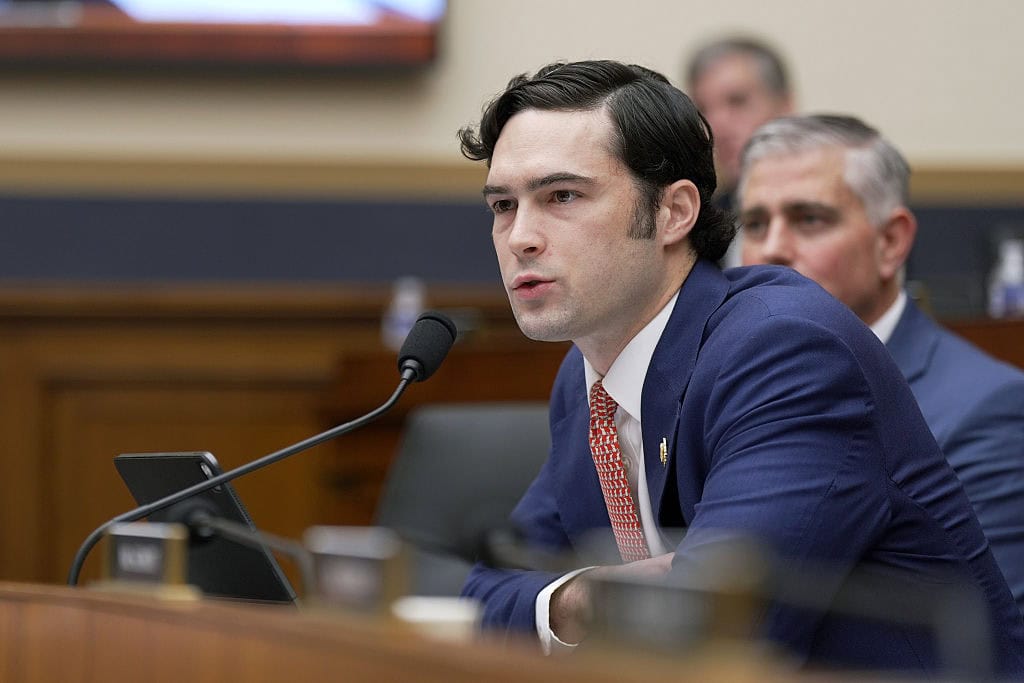
The future of the GOP is here.
Consider a simple question. The Biden Administration imported somewhere between six and ten million immigrants into the United States illegally. Do you think President AOC or President Newsom, if given the chance starting in January 2029, would let in fewer than Biden or more?
The American people don’t need a detailed policy briefing to answer that question. Amnesty and mass immigration are key features of expanding the Democratic Party coalition. Its ideology and electoral math, along with a vast government-contractor apparatus that supports the party, entrench a quasi-legal parallel rights regime.
Meanwhile, in the wake of Minneapolis, conventional GOP analysis holds that a combination of unsurvivable headlines and business interests demanding labor flexibility will pull the Republican Party back toward accommodation. That calculation may hold for another few months in Washington, or even survive until the midterms. It will not survive beyond then.
The accommodationist wing of the Republican Party sees immigration as the kind of disagreement that can be settled with a clever compromise, new labels, or a schedule of fines and penalties offered to voters who were promised the opposite in 2024, and who will bear the consequences of continued wage stagnation.
That wing is wrong, and much of the country has known it for years. That intuition powered a multigenerational, multiracial coalition that voted for Donald Trump in 2024, and it’s the only path toward creating a winning Republican coalition in 2028. Put simply, if 2028 is a contest between a Left and a Right populism, the one that doesn’t involve replacing American workers with millions of foreigners at the low end of the labor scale will win.
But the accommodationists are intent on reasserting their control over the party. Proof of that arrived on June 30. Glenn Thompson of Pennsylvania, the chairman of the House Agriculture Committee, introduced the Securing Agriculture’s Workforce Act with 51 cosponsors—all but four of them Republicans. Among them is Maria Elvira Salazar, sponsor of the DIGNIDAD Act, who has been peddling her immigration giveaway scheme for four years. The typical pattern emerges: invent a status. Attach a few terms and conditions. Deny that it’s amnesty.
In Thompson’s version of that gambit, he explains in a letter to colleagues that with the border now secure, it’s time to provide legal pathways for agricultural workers and to fill other jobs Americans supposedly will not do. We have run this experiment before. The 1986 amnesty required 90 days of self-attested farm work, was projected to cover 400,000 people, and drew 1.3 million applications. It produced what a New York Times investigation later called one of the most extensive frauds ever perpetrated against the federal government.
After an election in 2024 that was fought and won on mass deportation, the business interests still cling to the old path, aggressively trying to carve out their preferred exceptions.
Fortunately, this effort has gone nowhere so far. After Thompson introduced his bill, it was referred not to his own committee but to the House Judiciary Committee, where it remains pending nearly two months later.
Mass deportation will remain a foundational part of the Republican platform because mass importation will remain a foundational part of the Democratic Party.
This is why the rise of the restrictionists in the GOP was inevitable—and why their victory is all but assured. Brandon Gill, Chip Roy, Eli Crane, Keith Self, and a handful of others grasped that the immigration fight is no longer about caravans or crossings. It’s a fight about whether the American political community retains the right to define its own membership.
That diagnosis is evident in the bills they’ve introduced. Brandon Gill has moved to codify Remain in Mexico and impose a 25-year moratorium on Somali immigration. Andy Ogles introduced a sweeping rewrite of the 1965 Hart-Celler Act to end chain migration and the diversity lottery, replacing them with a merit-based system. Eli Crane’s End H-1B Visa Abuse Act, co-sponsored by Gill, Ogles, Hunt, and Self, would slash the annual cap from 65,000 to 25,000 and end Optional Practical Training, the now-infamous program that lets international students undercut American graduates in their own job market. Chip Roy’s PAUSE Act would freeze immigration entirely while the country takes stock.
These are not enforcement-metric arguments. They are policies based on reviving first principles regarding who comes in, who stays, and on what terms.
These legislators are right to think in first principles. While the federal debate continues, radicals in the states have been supplying their own answer to the immigration question.
California provides illegal aliens driver’s licenses, Medi-Cal, tax credits via ITIN, and food stamps for those 55 and older. Illinois offers driver’s licenses, state-funded health care, and in-state tuition with state financial aid. New York hands out driver’s licenses and state-funded health coverage, and tried to let non-citizens vote in municipal elections, a law its own highest court had to strike down.
Multiply that across the blue states and factor in the next Democratic president allowing another ten million people into the country. One flag, 50 different definitions of who sits under it.
That’s why the era of restrictionism is here. That’s why mass deportation will be the litmus test for the 2028 Republican primary. And if the GOP embraces restrictionism more broadly, it will be well-positioned to lead our great country at the presidential level for the foreseeable future. The America First movement has the opportunity to redefine our politics for a generation.
The restrictionists aren’t the radicals in this story. The radicals are the ones who decided, without asking, that the question of who becomes an American was no longer up to Americans to answer.
The American Mind presents a range of perspectives. Views are writers’ own and do not necessarily represent those of The Claremont Institute.
The American Mind is a publication of the Claremont Institute, a non-profit 501(c)(3) organization, dedicated to restoring the principles of the American Founding to their rightful, preeminent authority in our national life. Interested in supporting our work? Gifts to the Claremont Institute are tax-deductible.
Suggested reading


When a nation refuses to guarantee the personal safety of its legislators, its politics are a sham.

Escaping the long shadow of the civil rights revolution.
The speech heard ‘round the world.

Higher education now sells back what American society once provided for free.

Great social change takes time, courage, and charm—so get some.

