

An Age of Flux.
Retrieving America’s Natural Aristocracy
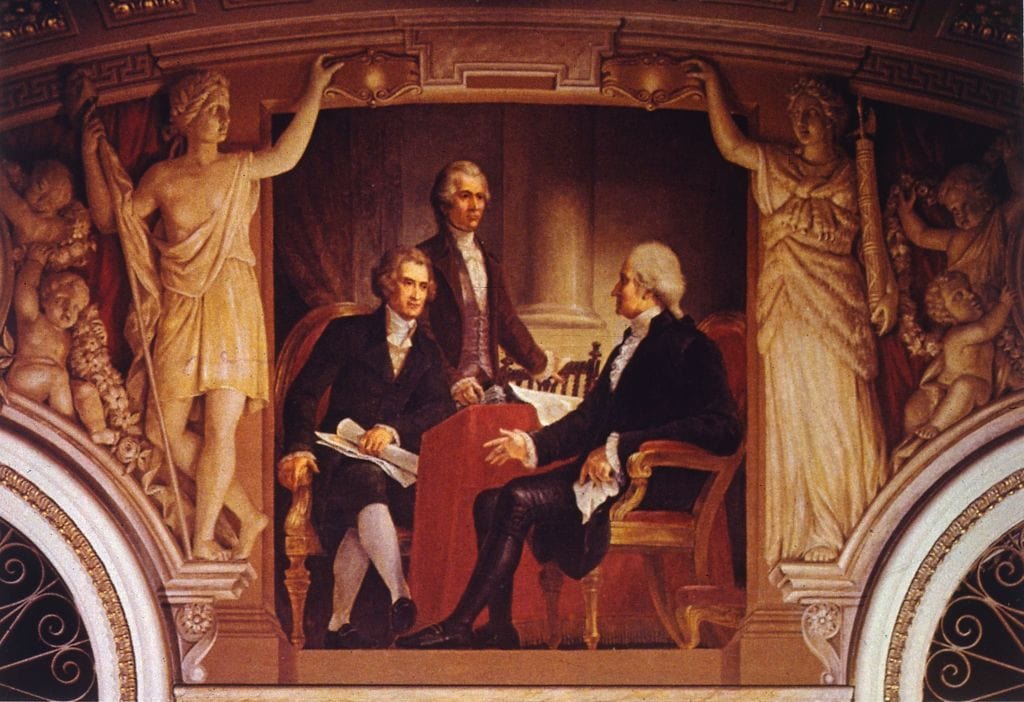
Elect those with merit and civic virtue.
With the celebration of America’s 250th birthday in July, it is an opportune moment to examine the traditions and culture of those who set the American experiment in motion. Any good American has a duty to consider the views and aims of the founding generation when contemplating the future direction of the United States. After all, a good employee pays deference to the founder of the company—an individual who took substantial risks to establish the firm—where he works. Citizens should do so to an even greater extent.
In this context, the pillars of American culture must be stressed. In pre-Revolutionary America, an immense web of patronage networks filled the role of the British aristocracy. Very few, if any, of the richest colonial gentry could hold their own against the colossal estates of British aristocrats, with their ornate country seats and vast fortunes. As Gordon Wood noted, the 13 colonies were instead “held together by intricate networks of personal loyalties, obligations, and quasi-dependencies.”
Naturally, the greatest patron of all was the Crown. While monarchical authority was never overbearing, it was still the dominant actor in regional and statewide appointments of governors, civil servants, and senior law enforcement officers. Otherwise, colonial politics orbited around a disproportionately small number of related families, usually the most prominent planters in a given territory. In many states, a few families might account for nearly half of the local political participation. The realm of public business reflected the same influence: royal and familial networks dominated.
The most important distinction in colonial society, however, lay between gentlemen and commoners. A gentleman was defined by his parentage, character, and manners—but, most of all, by his freedom from market forces. One could not style himself a colonial gentleman if he were not free from physical labor, from the profit incentive, and from any other material wantings of working commoners. While Max Weber shrewdly perceived an “impulse to acquisition,” driven by the Protestant “spirit of hard work” as a cultural sea change within the colonies, the transcendence of his “iron cage” was a prerequisite of gentlemanliness. Even Benjamin Franklin, whom Weber identified as a prime embodiment of the capitalist spirit, was regarded as a true gentleman only after he sold his business and freed himself from compulsory labor.
As the colonists began to find their political situation intolerable, the above paradigm was quickly upended and replaced by a principled republicanism.
Gentlemen Revolutionaries
Many are quick to point to the Founders’ rejection of monarchy, but they equally resented the mob-like elements of democracy. Be it from Crown or Commons, America’s founding credo rejected excessive power—a vice “not alluring to pure minds,” according to Jefferson—from all quarters. Most relevant to us is the extent to which the revolutionary spirit altered the Founders’ conception of gentlemanliness. Like their colonial predecessors, they sought a government run by cultivated gentlemen. Yet while colonial gentlemanliness required that one extricate himself from the commercial world, the republican gentleman did so in the service of the public good. There was now a civic aspect to being a gentleman, not merely a pecuniary one.
Any requirements of noble parentage were set aside in favor of an overarching emphasis on personal merit. The revolutionaries aimed to create a state in which “the door[s] of…the federal government [lie] open to merit of every description, whether native or adoptive, whether young or old, and without regard to poverty or wealth, or to any particular profession of religious faith,” as Federalist 52 states. “[E]ven the reins of state may be held by the son of the poorest man, if possessed of abilities equal to the important station,” wrote the politician and renowned historian David Ramsay.
Such a bold declaration ought not to detract from the highly aristocratic ethos of the revolutionary republicans. This element of the founding, more than any other, seems to be lost on my fellow Americans today.
Informed by Tacitean and Sallustian concepts of virtus, the Founders explicitly envisioned a nation not directly led by the people but by gentlemen rich enough to abandon the lure of profit to devote themselves to their country. Here we may invoke Jefferson’s distinction in a notable 1813 letter to John Adams between the “natural aristocracy among men,” defined by “virtue and talents…[and] an artificial aristocracy founded on wealth and birth, without either virtue or talents.” Jefferson continues:
The natural aristocracy I consider as the most precious gift of nature for the instruction, the trusts, and government of society…. May we not even say that that form of government is the best which provides the most effectually for a pure selection of these natural aristoi into the offices of government?
In essence, this precept encapsulates a primary aim of the American Revolution: to make it as easy as possible for potentially great men to access the reins of state. The Founders were dissatisfied with a government headed exclusively by those who could garner the most favor with the Crown or the mob. They instead envisioned an aristocratic society—but one in which anyone could join the aristoi if he earned his place.
America was to be an aristocracy of virtue, not of blood.
Accordingly, the United States was not, and ought never to become, a direct democracy. The Founders were in complete agreement on this issue. Democratic legitimacy is ensconced in our political process, but we unequivocally possess a government of individual decision-makers, propelled to the fore by the people. In the original republican paradigm, democracy was emphasized to cultivate prudent and capable individuals who could then be elected to office. Democratic choice was a means of putting the best men into public service—it was never the end of politics itself. Accordingly, if we ever become an entirely popular democracy, as the Democrats are wont to attempt, the U.S. as we know it would be destroyed. As it is, we have already departed far enough from the Founders’ vision in this direction.
Aristocracy and Democracy
The final vestige of that founding generation, John Quincy Adams, witnessed the democratic “downfall” of his father’s lofty system in 1828 with the rise of another great man of American history, Andrew Jackson. Adams lamented the ascent of “a barbarian, who could not write a sentence of grammar” to the highest office; America had crossed a definitive threshold into the domain of popular politics.
By the 1828 election, male suffrage had been largely established throughout the young republic. The elevated New England class of Federalist politicians—trafficking in the jargon of “arbitrary power”—rapidly became anachronistic in this newly leveled system of mass democracy. While the winds of history invariably pushed our republic in this direction, it is right to mourn the patent superiority of the preceding generation of leaders. A morass of sectarian, religious voting blocs comprised of mostly semi-illiterate provincials supplanted their golden age. As a collective, those who guided our young nation through its infancy into the early decades of the 19th century have never again been approached in aesthetic or genius throughout American history.
Even so, great leaders and literati from Polk to Emerson emerged during this subsequent period. The gradual expansion of the federal electorate, while deviating strongly from the founding project, did not entirely diminish it. After all, Jackson eliminated the national debt, expanded the nation’s borders, and preserved the Union during the nullification crisis. The younger Adams could rightly conclude, following his bitter defeat in 1828, that “The Sun of my political life sets in the deepest gloom—But that of my Country shines unclouded.”
A far more flagrant rejection of the Founders’ vision, however, occurred in 1913 with the ratification of the 17th Amendment. Whereas senators were once elected by their state legislatures—an indirectly democratic process—they were now selected by popular vote as if they were local representatives. Several corrupt and dysfunctional senatorial elections rocked the nation over the preceding decade, which populists and journalists vastly exaggerated in the pursuit of further leveling our political system.
Again, the higher aesthetic characters of the day—namely, Henry Cabot Lodge, senator from Massachusetts, and Elihu Root, Teddy Roosevelt’s exceptional secretary of war and then of state—opposed this action. Then serving as a New York senator, Root was so enraged by the amendment’s passage that he refused to stand for his seat in the next election cycle, contending that its ratification had produced an imbalance in American government.
Today, the remaining demarcations of the upper house of Congress are completely arbitrary. The Senate is distinct from the House only in the number of its members and their terms, in its role in ratifying treaties and making federal appointments, and in its lack of control over the purse.
To grasp why the 17th Amendment was so detrimental to the republican ethos, we must look further backward to the civilizational inspirations of our founding.
When in Rome
The Founders’ philosophy was shaped by the Enlightenment milieu and extended into Roman strata. As a landmark article by Donald Lutz demonstrates, its greatest immediate influence was Montesquieu’s 1748 magnum opus, The Spirit of the Laws: “Behind the Bible…Montesquieu was the most cited source during the American founding…[and] among both federalists and anti-federalists in the 1780s debates surrounding the constitution.” Today, Montesquieu is chiefly remembered for identifying the three branches of government, articulating the doctrine of checks and balances, and arguing for the separation of powers, but this final point is misleading.
Madison, who deems Montesquieu “the oracle who is always consulted and cited on this subject,” read him well enough to understand “that the legislative, executive and judiciary departments are by no means totally separate and distinct from each other,” as their duties are overlapping and interdependent. Instead, Montesquieu found in the English Constitution the far older doctrine of mixed government, which the framers consequently built into the American Constitution. This political architecture was epitomized in ancient Rome, where monarchical, aristocratic, and democratic powers were balanced in the same regime.
For the Romans, the consuls (followed by the Caesars), the Senate, and the tribunes represented these respective branches; in England, it was the Crown, Lords, and Commons. In America, the president, the Senate, and the House embodied these powers, with the Supreme Court interpreting the laws devised by the latter two and implemented by the executive. As Montesquieu shrewdly perceived, however, the noble branch (the upper house) was the most vulnerable, and America’s political development has validated his worry. Far from any basis in noble lineages, the meritocratic election of senators by state legislators was what truly made the Senate the higher house. Their political anointment lay outside the people’s direct grasp. In this regard, the aristocratic institution of American government has been dead for over 100 years.
Nevertheless, while institutionalized aristocracy was destroyed, merit has unceasingly characterized America’s natural aristocrats since the founding. Many of the greatest presidents of the 19th and 20th centuries came from nothing, reaching the Oval Office through sheer ability. The lives of Kissinger and McKinley, Truman and Douglass, demonstrate that anyone—rich or poor, black or white, Christian or Jewish—can join the American aristoi and steward the nation, as the Founders intended.
One contemporary natural aristocrat whom I believe they would have lauded is our current Secretary of State, Marco Rubio. In perfect Hamiltonian fashion, Secretary Rubio’s family came to the United States from the Caribbean with nothing. Solely through his own merit, he has risen to the highest echelons of American political society and has given himself over in service to his country.
Again, we find a forerunner of this model in Roman antiquity. Despite the elevation of Patrician blood, the Romans made full use of their immense population, uniting disparate peoples under the banner of the Senatus Populusque Romanus (the Senate and People of Rome). To quote from Edward Gibbon’s Decline and Fall of the Roman Empire,
The policy of preserving without any foreign mixture the pure blood of the ancient citizens, had…hastened the ruin, of Athens and Sparta. The aspiring genius of Rome sacrificed vanity to ambition, and deemed it more prudent…to adopt virtue and merit for her own wheresoever they were found, among slaves or strangers, enemies or barbarians.
Rome “was frequently rewarded by the merit and services of her adopted sons,” he states. “Had she always confined the distinction of Romans to the ancient families within the walls of the city, that immortal name would have been deprived of some of its noblest ornaments” from Virgil to Horace, Livy to Cicero, and Trajan to Hadrian, to name only a few.
Rome imparted the greatest civilizational influence upon our nation’s founding. And just as in their ancient case, our modern creed of civic virtue has secured for us a world-spanning “empire of liberty.” How better might one channel our Roman roots today than by waging war against a tyrannical class of rulers in Persia? In this vein, the triumphal arch that the president has slated for completion in July could hardly be more fitting. Through these themes, Jefferson’s neo-Roman “natural aristoi” come into sharper focus, as do the miraculous victories American gentlemen achieved against the global hegemon during the revolutionary era.
In the 250th year of America’s birth, let us resolve to elevate only natural aristocrats into public offices and never to elect individuals based on arbitrary factors comparable to royal favor, such as race, gender, or religion. Our only star and compass should be the merit and talents of the candidate. If we can manage this, the providence of our founding will further shine upon the fate of our republic.
The American Mind presents a range of perspectives. Views are writers’ own and do not necessarily represent those of The Claremont Institute.
The American Mind is a publication of the Claremont Institute, a non-profit 501(c)(3) organization, dedicated to restoring the principles of the American Founding to their rightful, preeminent authority in our national life. Interested in supporting our work? Gifts to the Claremont Institute are tax-deductible.
Suggested reading

The Left seeks to overturn the 2024 election even before it happens.

The official Republican vision of political power is so constrained that you have to wonder why they want it.
The cure for what ails America.

Trump won’t prevail in his legal battle to shut it down.

