

Remembering the life of a great man.
Remembering Betty Friedan’s The Feminine Mystique
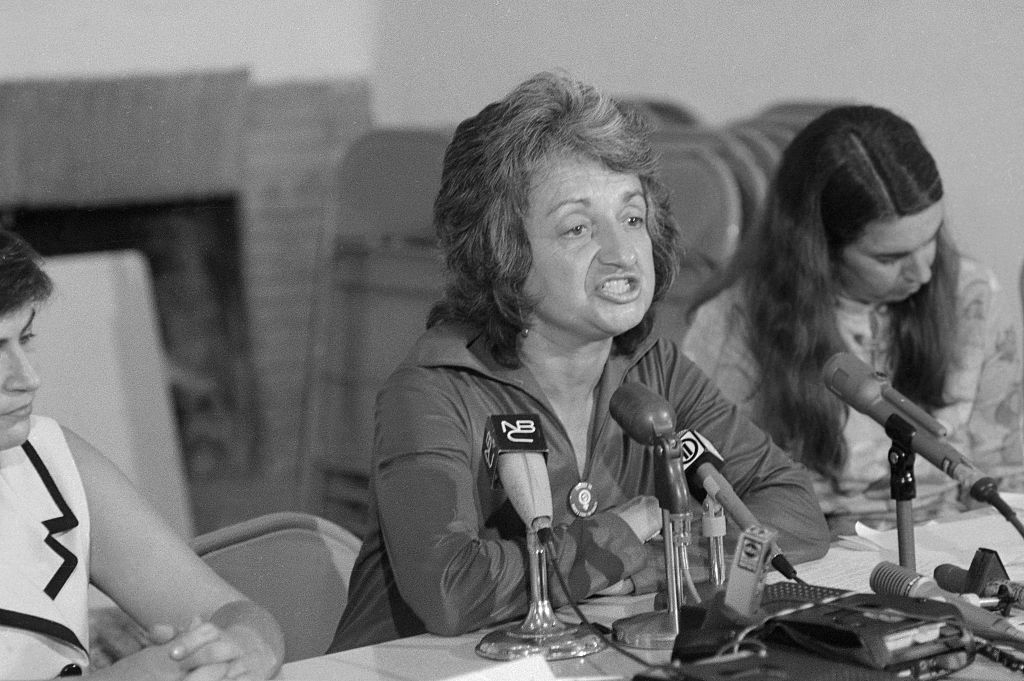
It opened the floodgates of feminism.
Betty Friedan’s The Feminine Mystique, which was published 63 years ago this month, marked the beginning of the modern wave of American feminism. It has contributed perhaps more than any other radical ideology to the dissolution of traditional American culture and social order. This is a good moment to remind ourselves precisely how far out of touch with reality Friedan’s book is, as part of the ongoing effort to reclaim the culture it set out to demolish.
Based on interviews with her former Smith College classmates 15 years after graduating, Friedan’s book describes what she calls “the problem that has no name.” By this she meant a purportedly widespread perception that college-educated women believed their lives were crushingly unfulfilling, a problem that would require a complete re-envisioning of the family and the sexual division of labor to address.
However, among the book’s readers who were eager to accept Friedan’s critical diagnosis, few bothered to look closely enough to see that by her own analysis “the problem that has no name” should have been called “the problem that does not really exist except in the minds of a few discontented radicals like Betty Friedan.” She did not discover a problem—she simply found a way to interpret reality in a way sympathetic to her desires.
Friedan straightforwardly admits in the book that most of the women she interviewed happily dedicated themselves to the home and caring for their children, given that their spouses shouldered the burden of making a living for the family. But in a technique she had doubtless learned from her previous quarter-century of activism for the Communist Left under her maiden name of “Goldstein,” she presumes that these women could not adequately understand their own experiences. They had unwittingly adopted a false consciousness and been brainwashed by the patriarchy, and they therefore could not have been truly fulfilled women.
Friedan did not publish the results of her study as an appendix to the book, but she describes them briefly. Of the 200 women she surveyed, nearly 9 of 10 were full-time housewives. Friedan set out intending to show that these women were fundamentally unhappy with their roles as mothers and homemakers, but her data do not support her desires.
These women averaged almost three children each, more than their mothers had had, a scarcely imaginable outcome if they were strongly opposed to being mothers. Only 1 in 10 of these women considered themselves “martyred” (Friedan’s bizarre term of choice) as mothers. Sixty percent did not find being a homemaker to be “totally fulfilling”—Friedan does not speculate as to how many of their husbands might have said the same thing about the jobs they had.
The other side of this equation, of course, is that 2 in 5 of these women did consider being a homemaker “totally fulfilling.” In Friedan’s view, these were doubtless the ones most deeply in a false consciousness. Nearly 80% of these Smith graduates said they had found ways to participate in the public life of their communities, allowing them to “pursue the goals that education had given them.” This scarcely sounds like a problem requiring the total transformation of American familial and relationship culture in the interest of getting every married woman with children into the workforce.
But that was exactly the idea that emerged following the publication of Friedan’s book.
For Friedan, any woman who practically accepts a functional sexual division of labor is deluded about her life. An antipathy to functionalism has long since become normative in contemporary feminist circles, but it was the mainstream view of the social sciences even in the early 1960s. And it remains unchallenged in its ability to make sense of both human social order and the typical psychological profiles of the two sexes.
Functionalist analysis argues that human societies are systems in which different parts operate in complementary ways toward ends that are productive for the whole society. This is based on innate psychological differences in the sexes, which become still more distinct by acculturation into sexed roles. Friedan sneeringly cites the anthropologist Margaret Mead, aptly summarizing this view with respect to sex:
The sexes are complementary…neither is superior, neither inferior. Each must be judged in terms of its own functions. Together they form a functioning unit. Either alone is in a sense incomplete…. The difference between the two sexes is one of the important conditions upon which we have built the many varieties of human culture that give human beings dignity and nature.
In Mead’s opinion, it was “economical” that sex differences led to “teaching [the two sexes] to walk and dress and act in contrasting ways and to specialize in different kinds of work.”
But for Friedan and the feminist wave she set off, men and women at bottom yearned to be the same. Becoming a mother and taking charge of a home, as she sees it, “evad[es] tests of reality.” “Reality” in this analysis has to do solely with work done outside the boundaries of the family, and indeed, not even all of that work counts. According to Friedan, only the “great human visions of stopping wars, curing sickness, teaching races to live together, and building new and beautiful structures for people to live in” count. It is hard to see how we could include plumbers and administrative secretaries in this definition of meaningful work.
In short, Friedan wants women to give up marriage and motherhood in order to engage in “creative work,” which is the only thing that can conceivably make life worthwhile. She quotes interview subjects who talked about their painting, music, or abilities, labeling them as “mental health educators” or “master teachers,” and argues they were exemplary cases of the work that truly matters. Women should compromise their contributions to family life—or indeed abandon it altogether—to pursue this type of work, she claims.
There is no discussion of how women could make a living in such fields, which are overcrowded and poorly paid. An economy in which everyone pursues only “creative work” would be one in which none of the work that cannot be so classified—but that is nonetheless required for a modern society to function—would get done. In short order, such an economy would collapse. Friedan is equally silent about how we should make sense of all the male labor—the vast majority of it, incidentally—that cannot be defined as “creative.” Are they too being robbed of their humanity by being required to carry out this functionally necessary labor?
Motherhood and homemaking, in Friedan’s bizarre view, can only “create a sense of emptiness, non-existence, nothingness.” There is nothing redeeming about these roles. The level of hyperbole in Friedan’s description of the state of the vast majority of women at the time the book was published shows the extreme radicalism of her argument.
Perhaps the most infamous section of The Feminine Mystique helps us see that radicalism in stark detail:
[H]ousewives are in as much danger as the millions who walked to their own death in the concentration camps—and the millions more who refused to believe that the concentration camps existed…. There is an uncanny, uncomfortable insight into why a woman can so easily lose her sense of self as a housewife in certain psychological observations made of the behavior of prisoners in Nazi concentration camps. [Emphasis added.]
Friedan had the gall to compare women who commit themselves primarily to the essential and infinitely valuable work of raising the next generation to being prisoners of the Nazis. What makes this stupendously offensive claim all the more appalling is that though she was an atheist, she was ethnically Jewish.
In the intervening decades since the publication of The Feminine Mystique, Friedan’s project has had grave consequences for the family, especially for mothers who have accepted her radical claims without even realizing it.
The American Mind presents a range of perspectives. Views are writers’ own and do not necessarily represent those of The Claremont Institute.
The American Mind is a publication of the Claremont Institute, a non-profit 501(c)(3) organization, dedicated to restoring the principles of the American Founding to their rightful, preeminent authority in our national life. Interested in supporting our work? Gifts to the Claremont Institute are tax-deductible.
Suggested reading


Who’s accountable when violence happens?

An English literature professor describes how he came to love teaching Freshman Comp.

Younger generations must have avenues to rise.

Half-truths are no antidote for lies.

Plan B is not just a contraceptive Tic Tac.

