

Both the Left and Right are targeting anonymous users online—and ultimately free speech.
Lindsay Clancy and the Battle of the Sexes
Social media algorithms reward the most extreme positions—at great cost.
Will marriage survive the internet?
It’s a question no one was asking in the 1990s, even as the World Wide Web became part of our everyday lives. Yet here we are more than halfway through the 2020s, and it’s fair to say the digitization of our social lives has drastically unsettled the relations between the sexes. As scholar Patrick T. Brown recently wrote, “At this point, anyone who is arguing that phones didn’t change societal scripts in a meaningful way has the burden of proof.”
Yes, the battle of the sexes is as old as civilization itself. But digital technology has introduced a new and disorienting dynamic. It turns humans into avatars. And avatars don’t fall in love or find God or have children. They exist in your phone, as pixels to be rewarded with likes or screamed at with comments, depending on the situation.
Take, for example, the horrible case of Lindsay Clancy. Though it’s recently become an object of national fixation, I first read about Clancy in 2024, when The New Yorker published a detailed account of events leading up to Clancy’s killing of her three children, Cora, Dawson, and Callan. They were five, three, and eight months old. A postpartum mother myself, I don’t think I finished reading the story. It was too devastating.
After five weeks of testimony, a jury of nine women and three men is deliberating whether Lindsay Clancy is guilty of three counts of first-degree murder or shouldn’t be held criminally responsible because she was not in her right mind when she killed her children. Meanwhile, in a dark twist, Clancy has become a TikTok sensation.
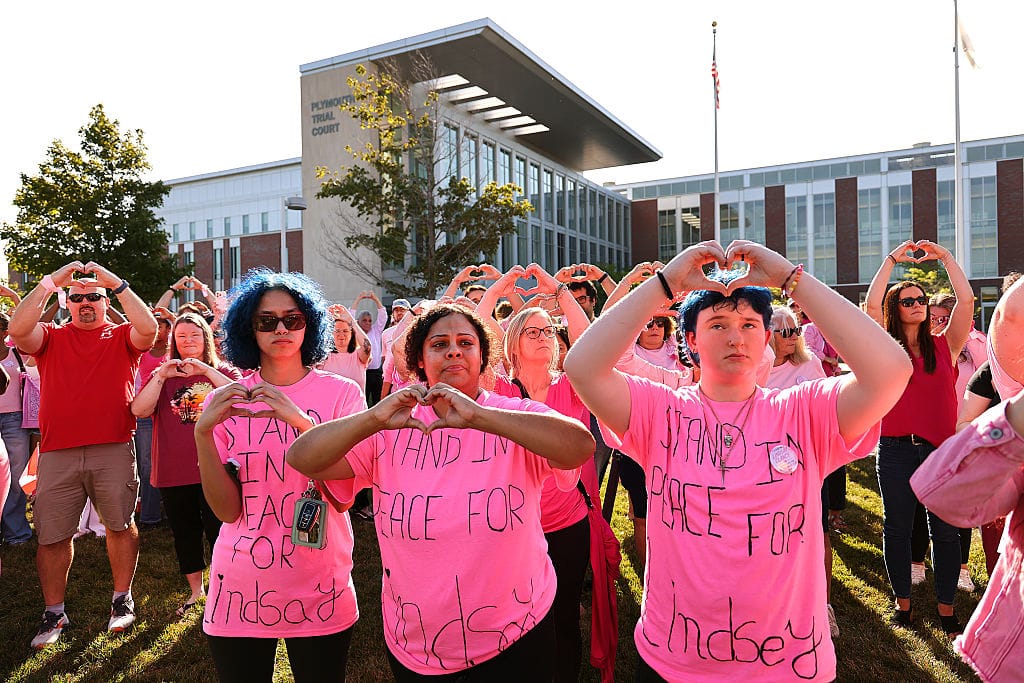
Hundreds of women gathered outside the courthouse wearing pink to support her in August. “Any one of us who have dealt with mental health, anxiety, depression, postpartum—I think we just know that any one of us could be sitting in her chair,” the event’s organizer said.
It’s not too surprising, then, that the grisly case has become a flashpoint in the never-ending battle of the sexes online. “The Lindsay Clancy contagion has shown that the majority of eligible women are no longer fit to be mothers and wives. In fact, it’s utterly dangerous to procreate with these women,” an anonymous poster claiming to be Gen Z wrote on X (his post received more than 1,000 likes). Support for Lindsay Clancy has been floated as a litmus test for a man to use when deciding to date a woman.
One headline announced, “Lindsay Clancy Case Becomes New Relationship ‘Test’ as Men Leave Partners Over Their Views”—even though this claim is based on unverified and/or anonymous posts. Yes, a Reddit thread titled “My [boyfriend] of 4 years baited me into forming an opinion on the Lindsay Clancy case and now we’re no longer together” makes for interesting late-night reading. But a collection of online detritus should not constitute our views on the opposite sex as a whole (nor should an outspoken minority online be mistaken for representing a majority).
And there’s the rub. The internet algorithm rewards posters who make the boldest claims that offend the most people. The more these bad ideas and false claims are ridiculed online, the more visible they become, and the more people they have the potential to influence. The personification of this trend is manosphere influencer Andrew Tate, who has an army of underage male followers and is currently in a Florida jail.
But this feedback loop can be seen among misandrists and misogynists alike. Recent research published in the journal Current Psychology suggests that most individuals overestimate others’ susceptibility to social pressures and underestimate their own. We tend to think that other people shouldn’t doomscroll, but that we can handle it. Without realizing it, we imbibe information designed to confirm our worst biases—whether that’s a belief that all men are secretly abusive or a belief that all women are secretly evil.
There are lots of ways to divide people—race, religion, and political affiliation, to name a few. But the most basic divide is gender. Marriage bridges this divide. But the bridge is crumbling: researchers predict that as much as a third of young people today will never marry. A 2024 analysis of data from 20 developed countries by The Economist found that the “attitudes of young men and women are polarising,” especially in the U.S.
Posts that tell men to avoid marriage lest they unknowingly marry a murderer and podcasts that tell women to avoid marriage because all men are cheaters exemplify the kind of messaging that some young people are bombarded with every day. When womanhood is flattened into Lindsay Clancy and manhood into Andrew Tate, it becomes difficult for men and women to like each other, let alone love each other.
When men and women treat existence as a zero-sum game, everyone loses. Difficult as it is to detach from sensational outliers amid a constant barrage of extreme cases, it’s a matter of existential urgency. The future of the human race depends on us learning to see each other as humans—not as avatars—once again.
The American Mind presents a range of perspectives. Views are writers’ own and do not necessarily represent those of The Claremont Institute.
The American Mind is a publication of the Claremont Institute, a non-profit 501(c)(3) organization, dedicated to restoring the principles of the American Founding to their rightful, preeminent authority in our national life. Interested in supporting our work? Gifts to the Claremont Institute are tax-deductible.
Suggested reading

It’s time to bet on humanity—before things get worse.

South Dakota’s experience with intellectual diversity legislation is a case study for the nation.

I will arise and go now.

Democrats are preparing to win by any means necessary. What’s the Right going to do about it?

