

San Francisco's Democratic government propped up the infamous cult leader Jim Jones.
Havana’s Long Shadow
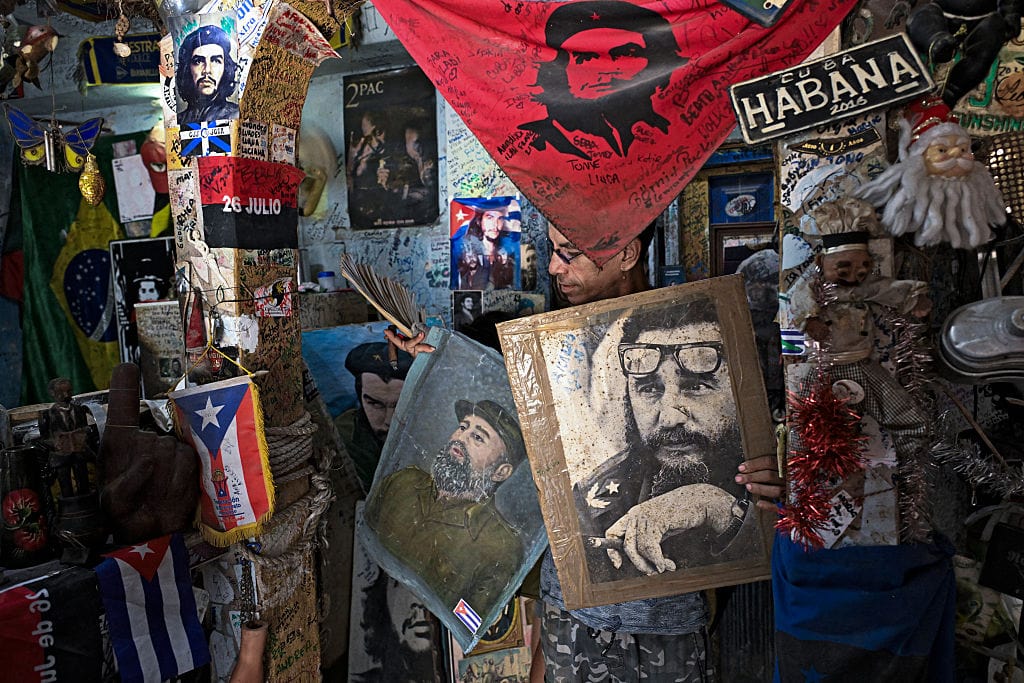
Its influence extends far beyond Cuba.
Thirty-two Cubans died when American forces entered Caracas on January 3, 2026, to capture Nicolás Maduro. Cuba and Venezuela are more than a thousand miles apart. Why were Cubans dying in defense of Maduro? How did a small Caribbean island become so deeply invested in the survival of another country’s dictatorship?
To answer those questions, we have to go back nearly seven decades to a revolution that promised liberation but spent a lifetime exporting authoritarianism and reshaping the politics of an entire hemisphere.
From the moment he seized power in 1959, Fidel Castro knew that the survival of his revolution depended on its spreading throughout South America. In the years that followed, Havana trained Marxist guerrillas across Latin America, dispatched troops to fight Soviet proxy wars in Africa, supported Syria in its war against Israel, and embedded intelligence officers inside allied dictatorships. Today, it’s widely reported that Cuban nationals are fighting alongside Russian forces in Ukraine.
If there is one lesson the Cuban regime has taught us, it is that dictatorships do not always have to become stronger to survive. Sometimes they survive by becoming indispensable to stronger powers. For Cuba, the Soviet Union came first. Then Chávez’s Venezuela. Today, Russia, China, and Iran have each found value in keeping the regime afloat. Cuba has vexed every American president since Eisenhower not because it is economically or militarily powerful, but because it has repeatedly positioned itself as the hemisphere’s most persistent hub of anti-American influence.
That history helps explain why Secretary of State Marco Rubio has made Cuba a central priority of the Trump Administration’s Western Hemisphere strategy. Some dismiss this focus as ideological or personal. They are mistaken. The administration’s Cuba policy is strategically sound because the Cuban Revolution was never content to remain on one island.
Communist Subterfuge
Wherever there has been an opportunity to challenge the United States and its allies, Havana has taken it.
The Cuban regime’s interventions around the world reveal a consistent foreign policy: weaken the United States, strengthen its adversaries, and export the revolution wherever the opportunity presents itself. If there has been a Marxist insurgency to support, an anti-American regime to sustain, or a hostile adversary looking for a willing partner, chances are Cuba has been there.
Cuba’s hostility toward the United States has not been limited to distant battlefields. It has promoted its agenda in cities across America and directly threatened the lives of U.S. citizens on American soil.
Beginning in the 1960s, Cuban intelligence recruited, trained, financed, and equipped Puerto Rican militants who later formed or led terrorist organizations such as the Armed Forces of National Liberation (FALN) and Los Macheteros. These groups carried out bombings, assassinations, robberies, and other terrorist attacks across Puerto Rico and the U.S. mainland, including the 1975 bombing of Fraunces Tavern in New York City.
In 1996, Cuban fighter jets shot down two unarmed civilian aircraft operated by a Miami-based humanitarian organization named Brothers to the Rescue, killing four people, three of them American citizens. Earlier this year, Cuban border guards opened fire on a Florida-registered speedboat off Cuba’s northern coast, killing five Cuban Americans and injuring several more.
The battlefield does not always involve bombs or bullets. Cuba’s intelligence services have repeatedly demonstrated an ability to penetrate the highest levels of the U.S. government.
Victor Manuel Rocha secretly served Havana for decades while rising through the ranks at the U.S. State Department, serving on the National Security Council, and eventually representing the United States as ambassador to Bolivia. Ana Belén Montes, the Defense Intelligence Agency’s leading Cuba analyst, passed classified military information to Havana, exposing undercover American intelligence officers and distorting Washington’s understanding of the regime. Walter Myers and his wife Gwendolyn spent almost three decades working for Cuban intelligence while Walter held sensitive positions at the State Department. Few hostile intelligence services have assembled a roster like that.
Espionage is only one part of Havana’s playbook. For decades, the regime also invested in a quieter campaign to shape opinion and spread its revolutionary ideas inside the United States.
Through academic exchanges and solidarity organizations, conferences, and cultural programs, the regime cultivated activists, intellectuals, and future political leaders who were sympathetic to the revolution. The Venceremos Brigade was created to bring thousands of Americans to Cuba under the banner of solidarity with Castro’s government. Many of those who participated returned to the U.S. convinced they had witnessed a revolutionary success rather than an authoritarian dictatorship. Some eventually entered positions of influence themselves, including Antonio Villaraigosa and Karen Bass—both of whom went on to serve as mayors of Los Angeles.
The State Department’s recent report, Cuba: The Capital of 21st Century Communism, also reveals that Cuba has cultivated relationships with revolutionary organizations, including the Black Panthers and the Weather Underground, offering training, political support, refuge, and direct access to senior Cuban officials. It concludes that these influence efforts have recently been linked to Antifa-affiliated activists, participants in demonstrations following George Floyd’s death, and the recent anti-ICE protests.
American intelligence has also long warned that elements of the Cuban regime facilitated international narcotics trafficking. A 1985 CIA assessment concluded that Havana was not merely turning a blind eye to the drug trade but providing traffickers access to Cuban waters, ports, and airspace, making it easier to move narcotics into the United States while complicating American interdiction efforts.
Viewed together, these activities over the past 67 years reveal a clear pattern: whether through espionage, ideological influence, or criminal networks, Cuba has repeatedly acted as a force multiplier for America’s adversaries.
Cuba’s Real Business
There’s an old saying in Latin America: Dime con quién andas y te diré quién eres—“Tell me who your friends are, and I’ll tell you who you are.”
Today, Cuba stands shoulder to shoulder with many of America’s main adversaries: Russia, China, Iran, Daniel Ortega’s Nicaragua, and, until Maduro’s downfall, Venezuela.
The Cuban regime has survived as long as it has by adapting and changing sponsors. Someone will always be willing to pay for its strategic location. When one patron disappeared, another stepped forward.
Many anti-American regimes have invested handsomely in keeping the Cuban regime afloat. Russia has forgiven billions of dollars in Cuban debt and, together with Iran, supplied Havana with more than 300 attack drones. China has also extended favorable loans and donations to Cuba, financed infrastructure, and poured money into the country’s telecommunications network through companies like Huawei and ZTE. Venezuela and Mexico have kept the lights on in Havana by sending subsidized oil, despite having little room for such generosity, as both struggled with serious economic challenges of their own.
Why?
Certainly not because Cuba is an economic powerhouse. These governments are investing because Cuba gives them something far more valuable than monetary returns: strategic access to the United States.
Britain fought wars over territories that today seem insignificant—Malta, Gibraltar, the Falklands—not because of the land itself, but because of the geographic position those islands occupy.
Cuba is no different. It is the equivalent of an unsinkable aircraft carrier at the crossroads of the Caribbean. If you are Russia, China, Iran, or any other hostile power seeking to collect intelligence on the United States, project influence into the Western Hemisphere, or maintain a foothold only 90 miles from Florida, few places on Earth are more attractive.
That is why the Trump Administration’s Cuba policy is fundamentally about ensuring that America’s principal competitors cannot continue using the island as a platform to project power into the Western Hemisphere.
The Wrong Question
Predictions of Cuba’s collapse have been circulating for decades. Look no further than Andrés Oppenheimer’s 1992 bestseller Castro’s Final Hour. More than 30 years later, the title serves as a reminder of how often outside observers have underestimated the regime’s ability to survive.
The more important question is not what happens if Cuba collapses, but what happens if Cuba succeeds.
What if Russia further expands its intelligence presence? What if China deepens its surveillance infrastructure on the island? What if another million Cubans flee and attempt to come to the United States? What if Havana continues exporting the intelligence, security expertise, and political repression that have helped sustain evil dictatorships across Latin America? These are not hypothetical concerns. They are already happening.
For too long, Washington played damage control with Cuba. Meanwhile, the regime continued doing what it has done for nearly seven decades: exporting instability and inviting America’s adversaries into the Western Hemisphere. Migration is one of Cuba’s most effective tools for doing this. From the Freedom Flights to the Mariel Boatlift to the Balsero exodus, every major upheaval on the island has sent hundreds of thousands of Cubans toward American shores.
The current exodus, however, makes those crises look modest. Since 2021, more than one million Cubans have fled the island, with Customs and Border Protection reporting record-breaking numbers arriving at the southern border. Havana has long understood that migration can be used as a weapon against Washington, and it is willing to turn humanitarian suffering into political pressure. What happens in Havana does not stay in Havana, and our neighbors’ problems have a way of becoming our problems.
That is why Cuba cannot be dismissed as simply another poor island with a struggling economy. It is so much more than that. It is the strategic hub of an authoritarian network stretching across the hemisphere.
Imagine, for a moment, a different Cuba.
A Cuba no longer supplying intelligence officers to Caracas or security advisers to Managua. A Cuba that no longer hosts Russian intelligence platforms or Chinese surveillance infrastructure, or serves as the hemisphere’s main exporter of revolution. A new government in Havana would not solve every problem in the hemisphere overnight. But it would remove the regime that has spent decades working overtime to perpetuate those problems. That is why turning Cuba matters.
Falling Dominoes
Everyone remembers the Monroe Doctrine, but far fewer remember Theodore Roosevelt’s corollary. James Monroe argued that hostile powers should stay out of the Western Hemisphere. Roosevelt recognized something just as important: instability invites those outside powers back in. When disorder takes root close to home, America cannot pretend it is someone else’s problem.
For much of the past three decades, Washington forgot that lesson. As American attention shifted to the Middle East, Europe, and the Indo-Pacific, China financed ports, Russia rebuilt intelligence networks, Iran expanded partnerships, and authoritarian regimes consolidated their grip across Latin America.
America’s adversaries rediscovered the Western Hemisphere long before Washington did.
What many have begun calling the “Donroe Doctrine” is less a new doctrine than a return to an old strategic instinct. The objective is not to dominate Latin America or intervene for intervention’s sake. It is to prevent hostile powers from turning the Western Hemisphere into another arena for great-power competition.
That is where Cuba enters the picture.
Secretary Rubio understands that changing Cuba is about changing the strategic balance of the entire hemisphere.
The Trump Administration’s own assessment reflects that view. In its 2026 report on Cuba, the State Department concluded that the regime remains a significant national security threat through its espionage, ideological influence operations, partnerships with hostile powers, and long history of supporting anti-American actors. The report reflects the Trump Administration’s view that Cuba should be treated not simply as an authoritarian state but as an active strategic challenge in the Western Hemisphere.
That is why Cuba has become such a priority. Turn Cuba, and the strategic map of the hemisphere changes.
Russia loses one of its most valuable intelligence platforms in the Western Hemisphere. China loses one of its closest technological and intelligence partners. Nicaragua loses its most experienced revolutionary mentor. The authoritarian network that stretches throughout Latin America becomes weaker, more isolated, and more vulnerable.
The administration does not simply see another authoritarian government 90 miles from Florida. It sees the operating system that has helped sustain much of the hemisphere’s anti-American architecture since 1959.
Cuba is just the first domino.
The Cuban Endgame
The fact that 32 Cubans died defending Nicolás Maduro in Venezuela tells us that Cuba was never just another small, poor Caribbean dictatorship. It spent nearly seven decades punching far above its weight—exporting revolution around the globe, supporting authoritarian regimes, penetrating American institutions, welcoming hostile powers into the hemisphere, and projecting influence far beyond its shores. It became the connective tissue linking much of the hemisphere’s anti-American architecture.
While American attention drifted halfway across the world to the Middle East, Europe, and the Indo-Pacific, Cuba continued projecting influence throughout the Americas while welcoming America’s adversaries into its own backyard.
Geography, however, never changed.
Nearly two centuries ago, John Quincy Adams recognized that Cuba was too strategically important for any great power to ignore. America’s adversaries understand that today. The Trump Administration has rediscovered that same reality.
America cannot choose its geography. But it can choose whether hostile powers are allowed to exploit that geography.
For 67 years, the Cuban Revolution refused to remain on the island, wreaking havoc throughout the South American continent and presenting serious threats to U.S. national security.
America’s Cuba policy should ensure that the Communist regime meets its end.
The American Mind presents a range of perspectives. Views are writers’ own and do not necessarily represent those of The Claremont Institute.
The American Mind is a publication of the Claremont Institute, a non-profit 501(c)(3) organization, dedicated to restoring the principles of the American Founding to their rightful, preeminent authority in our national life. Interested in supporting our work? Gifts to the Claremont Institute are tax-deductible.
Suggested reading
James Burnham and the managerial revolution.
America’s blindness to the source of our decline is the fundamental problem we face.
Despite hostility from the Biden Administration, the report stands as a guiding light for future generations.

To believe in democracy is to understand that each citizen has a voice.

A national museum should be a source of pride.

