

Conservatives need to be a lot savvier about how they vet judicial candidates.
Calvin Coolidge and the Fourth of July
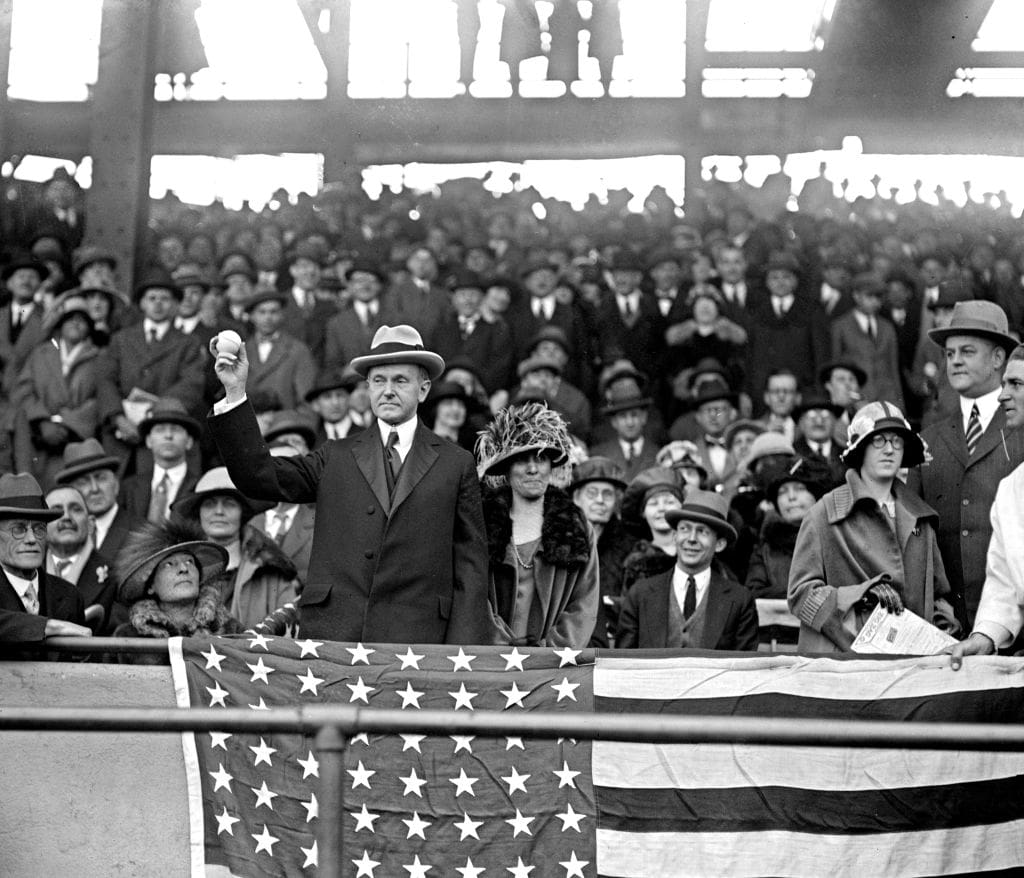
Reverence for great ideas and great men.
Editors’ Note
As we continue to celebrate the 250th anniversary of the American Founding, we will keep publishing reflections on the meaning of the Declaration of Independence, some by Claremont scholars and others by learned friends. In this piece, Claremont Institute Senior Fellow Christopher Flannery highlights Calvin Coolidge’s magnificent speech marking the 150th anniversary of the Declaration of Independence. Read all the entries in our “Declaration at 250” series here.
Celebration of the semiquincentennial will not be complete without remembering the only president of the United States born on the Fourth of July: Calvin Coolidge, our 30th president, who was born on July 4, 1872.
It is charming that Coolidge was born on the date of the American Declaration of Independence that we have been celebrating for 250 years now. It is almost providential when we reflect that he joins John Quincy Adams and Abraham Lincoln as a president who emphatically took all his political bearings from the principles of the Declaration; and he joins Adams and Lincoln as a president who became one of the great expositors of those principles.
Like the 6th and 16th presidents, Coolidge saw all of America’s blessings of liberty flowing essentially from the ideas in the Declaration of Independence. And like his two predecessors, he understood that when we cease to understand and live by these principles, we will cease to enjoy those blessings as a people.
“Silent Cal,” as Coolidge came to be known, fondly and otherwise, was actually quite eloquent. He was a student of Demosthenes and Cicero from his early days. In the evenings of his mature years, he enjoyed translating selections from Cicero’s orations. He regarded his Latin as serviceable for translation but not strong enough for composing. He also enjoyed translating Dante. A foreign diplomat quipped that Silent Cal could be “silent in five languages.” His English prose was known during his day, even among his critics, for its clarity and economy. He loved the poetry of Homer, Shakespeare, and the Bible.
Coolidge was president when the sesquicentennial of the Declaration of Independence came about 100 years ago on July 4, 1926. The speech he gave to commemorate the occasion is the one most remembered for its exposition of the principles of the American Revolution. He delivered the speech at Independence Hall on July 5. He called it “The Inspiration of the Declaration.”
About the significance of the Fourth of July for Americans and the world, he said on that occasion, “It was not because it was proposed to establish a new nation, but because it was proposed to establish a nation on new principles, that July 4, 1776, has come to be regarded as one of the greatest days in history.” The principles themselves were immortal and universal. What was new was proclaiming them as the grounds of the political life of a particular people. As Coolidge stated:
It was the fact that our Declaration of Independence containing these immortal truths was the political action of a duly authorized and constituted representative public body in its sovereign capacity, supported by the force of general opinion and by the armies of Washington already in the field, which makes it the most important civil document in the world.
The passage most frequently quoted from Coolidge’s speech, for good reason, is this:
About the Declaration there is a finality that is exceedingly restful. It is often asserted that the world has made a great deal of progress since 1776, that we have had new thoughts and new experiences which have given us a great advance over the people of that day, and that we may therefore very well discard their conclusions for something more modern. But that reasoning can not be applied to this great charter. If all men are created equal, that is final. If they are endowed with inalienable rights, that is final. If governments derive their just powers from the consent of the governed, that is final. No advance, no progress can be made beyond these propositions. If anyone wishes to deny their truth or their soundness, the only direction in which he can proceed historically is not forward, but backward toward the time when there was no equality, no rights of the individual, no rule of the people. Those who wish to proceed in that direction can not lay claim to progress. They are reactionary.
This passage is so deserving of being requoted and remembered because already in Coolidge’s time—and continuing in our own time—the doctrine had come to prevail among the most authoritative intellectuals that there were no final truths that could be guides to political and moral life. There was just “progress” or “history,” which ultimately came to mean there is just “change.” As a result, eminent progressive historians like Carl Becker could sneer that “To ask whether the natural rights philosophy of the Declaration of Independence is true or false is essentially a meaningless question.”
Progressive historians caricatured Coolidge as being a tool of big business and believing that the accumulation of wealth was the ultimate purpose of America and the ultimate end of life. To the contrary, as Coolidge insisted:
We live in an age of science and of abounding accumulation of material things. These did not create our Declaration. Our Declaration created them. The things of the spirit come first. Unless we cling to that, all our material prosperity, overwhelming though it may appear, will turn to a barren sceptre in our grasp. If we are to maintain the great heritage which has been bequeathed to us, we must be like-minded as the fathers who created it. We must not sink into a pagan materialism. We must cultivate the reverence which they had for the things that are holy.
To introduce yourself to Calvin Coolidge, you can’t do better than to start with his own Autobiography, written with his characteristic clarity and economy soon after he was president. Then, to immunize yourself against the distortions of the progressive historians, you should read the great Tom Silver’s book, Coolidge and the Historians, republished by Hillsdale College Press. As Amity Shlaes (author of the highly acclaimed Coolidge) says of it:
This is the volume that turned America’s eyes to a forgotten president. Through accurate and precise scholarship, Silver showed just how wrong the old evaluation of Coolidge was. In the process, Silver also demonstrated the power of a substantive rebuttal—to change minds, and to change history. Coolidge and the Historians is must reading for anyone interested in Calvin Coolidge.
Coolidge was a humble man—a worthy American hero who well understood and eloquently articulated the importance of heroes in a few fine speeches:
Great men are the ambassadors of Providence sent to reveal to their fellow men their unknown selves…. When the reverence of this nation for its great men dies, the glory of the nation will die with it…. It is only when men begin to worship that they begin to grow. A wholesome regard for the memory of the great men of long ago is the best assurance to a people of a continuation of great men to come.
The American Mind presents a range of perspectives. Views are writers’ own and do not necessarily represent those of The Claremont Institute.
The American Mind is a publication of the Claremont Institute, a non-profit 501(c)(3) organization, dedicated to restoring the principles of the American Founding to their rightful, preeminent authority in our national life. Interested in supporting our work? Gifts to the Claremont Institute are tax-deductible.
Suggested reading

Preserving liberty and engendering civic gratitude.

How the founders resolved the theological-political problem.

One fit for republican government.
A reply to Matthew Continetti's recent critique.

