

The U.S. needs to support domestic drone production.
Bringing the American Way of Life to Space
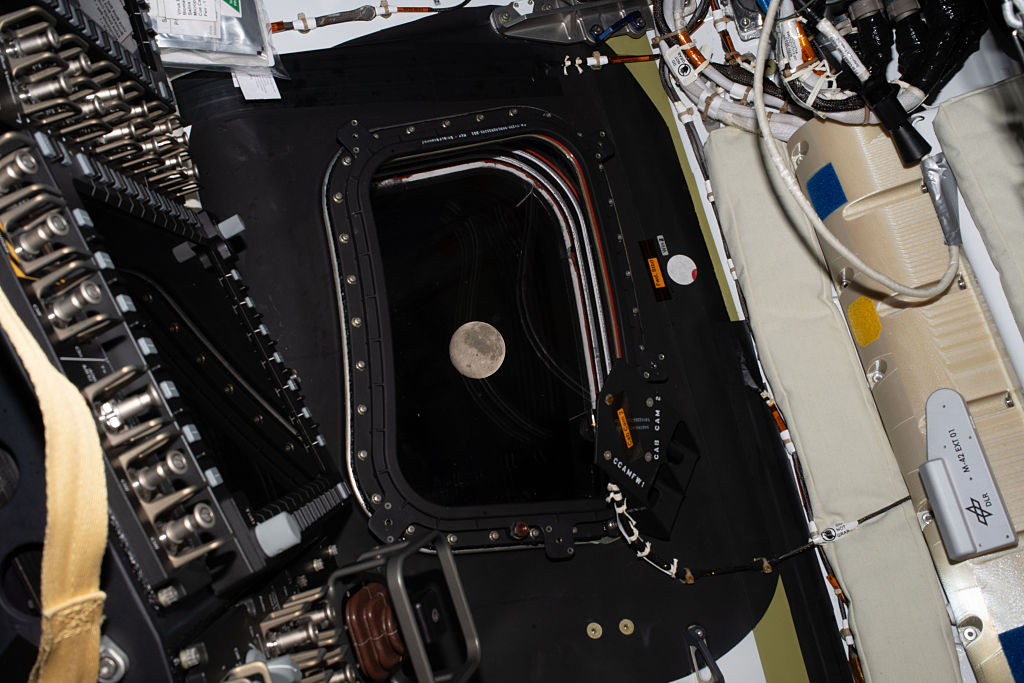
If we don’t design for freedom beyond Earth, we won’t get it.
At this very moment, humanity is venturing beyond the limits of Earth.
NASA’s Artemis II mission to the far side of the moon was a reminder that this is no longer science fiction. Commercial launches are becoming more frequent, private missions are expanding, and durable off-world habitats—once the stuff of far-flung imaginings—are well within reach. What was once a set of hypothetical word problems has become a collection of real-world challenges to solve.
Those of us who believe in America’s ideals, political structure, and folkways have to start thinking now about how to preserve them in outer space. Human nature is not going to change. But the parameters of human life will—and dramatically. The question is how, in this unprecedented scenario, we can make the American way of life one of the things we carry with us. We are taking our humanity to space. How can we take our freedom too?
To meet this challenge, the University of Austin has initiated the Torchlight Summit. Torchlight convenes astronauts, scientists, engineers, classicists, and political theorists to address a question that is too often ignored: What are the political and institutional consequences of life beyond Earth, and how can we shape them before they solidify?
The summit is structured around three core pillars:
- Human Limits: understanding how biology and environment constrain what is possible
- Human Order: analyzing how those constraints reshape political and social organization
- Human Freedom: designing technologies and institutions that can sustain free and adaptive societies in space
Human beings evolved under the specific conditions of Earth: gravity, atmospheric protection, stable day-night cycles, and a planetary biosphere. Spaceflight removes or alters each of these constraints. Microgravity weakens bone and muscle. Radiation damages DNA. Food must be manufactured or tightly controlled. Every system is interdependent; every failure is consequential.
Under these new conditions, the default architecture of survival trends toward centralization. When access to oxygen, water, and thermal control is mediated by tightly coupled systems, authority tends to consolidate around those who control those systems. Redundancy is expensive, independence is difficult, and exit is nearly impossible.
This creates a dangerous dynamic: space habitats risk becoming closed systems not only biologically but politically. On Earth, the development of liberal institutions was inseparable from material circumstances that allowed for decentralization: geographic space, agricultural surplus, distributed resources, and the possibility of exit.
By contrast, the circumstances in space tend to necessitate coordination, resource allocation, and system-level control. Authoritarian and centrally-planned governance models align naturally with these constraints. Classically liberal systems—free speech, limited government, distributed authority—are harder to implement in environments where survival depends on tightly integrated infrastructure.
Without deliberate intervention, the first durable societies beyond Earth risk becoming ruthlessly optimized, highly controlled systems in which dissent is treated as unacceptably destabilizing and autonomy is constrained by design. Yet history offers a warning against this outcome. Centralized systems, even when initially efficient, are prone to failure modes that are difficult to correct once entrenched. They accumulate fragility, suppress feedback, and resist adaptation.
If these dynamics are embedded into the foundational architectures of space settlement, they will be extraordinarily difficult to reverse. This means that freedom in space will not emerge by default. It must be engineered into the systems that sustain life.
If scarce resources impose centralization, then technologies that decentralize and individualize survival become necessities, not luxuries. Redundant life support, modular habitats, distributed resource production, and interoperable systems can create space for autonomy within otherwise constrained environments. Institutional design must follow the same logic.
The early United States did not emerge ex nihilo. It adapted and retained elements of English common law that proved durable in new circumstances, while discarding others. Spacefaring societies will face a similar task. They must decide what to carry forward, what to modify, and what to reject.
The early decisions will matter disproportionately. Initial architectures tend to persist for generations. And there is no default outcome that preserves freedom. If we build only for short-term survival, we will get tightly controlled, brittle systems that are difficult to reform and dangerous to inhabit.
America’s founders understood that the case for freedom is based on universal, enduring truths, but that those truths need to be worked out anew in each new age as history unfolds. We will either think seriously, as they did, about how to keep the ideals of our political project alive in new circumstances—or we will meanly lose the last best hope of earth.
The American Mind presents a range of perspectives. Views are writers’ own and do not necessarily represent those of The Claremont Institute.
The American Mind is a publication of the Claremont Institute, a non-profit 501(c)(3) organization, dedicated to restoring the principles of the American Founding to their rightful, preeminent authority in our national life. Interested in supporting our work? Gifts to the Claremont Institute are tax-deductible.
Suggested reading


The Apollo 8 astronauts worshipped God while circling the moon.

There is a reason why we love to drive.
Italy’s new prime minister has steered a shrewd course.
The Red Planet is an unexplored frontier.

The greatest American film reminds us to give thanks that the cause of freedom remains there, waiting to be joined.

