

When civility goes wrong.
A Realist Case for America’s Acquisition of Greenland
Bequeathing a better country to future generations.
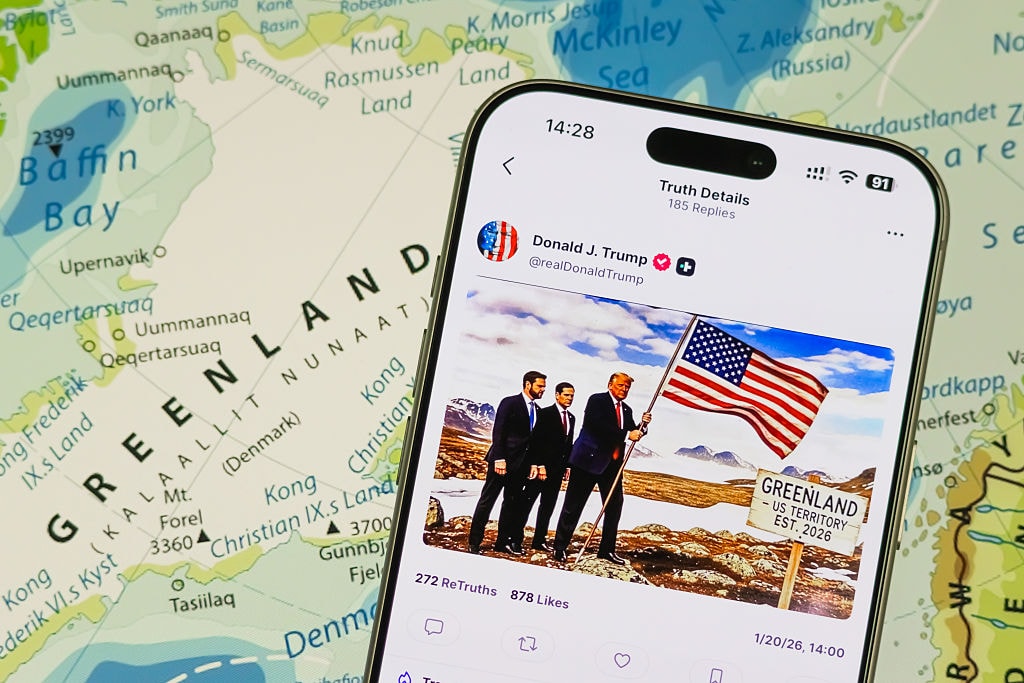
Donald Trump says many things, some of which should be taken literally and some of which should not. When Trump first mentioned the idea of America acquiring Greenland in 2019, many European leaders assumed, or at least hoped, that this plan fell into the latter category. However, as the last few weeks have demonstrated, Trump is quite serious about America obtaining the largest non-continental island in the world. If accomplished, getting Greenland will likely be remembered as the beginning of Europe’s own century of humiliation, as the reality of its status as essentially a vassal of the U.S. becomes undeniable.
Trump’s Greenland plan has garnered opposition domestically as well. While no small part of this disagreement stems from people who would refuse to brush their teeth if Trump told them it was healthy, there are sincere policy disagreements over the issue, notably within the “realist and restraint” coalition that has opposed the failed foreign policy status quo. Sensible realists have put forward proposals that seek to avoid annexation or invasion while still securing American interests via “dollar diplomacy,” as Justin Logan and Sumantra Maitra recently argued in The National Interest.
Trump himself seems to be moving toward such an approach, as he announced on social media that a framework is being established with NATO to address his concerns. He told Fox Business’s Maria Bartiromo that “we will be getting everything we want at no cost,” which would involve perpetual “total access.” This does not sound like annexation, though a perpetual lease like Guantanamo Bay is certainly better than nothing.
In contrast, comments from NATO Secretary General Mark Rutte seem to imply that the deal to which Trump has referred only concerns increased NATO military engagement in the Arctic, and that negotiations will continue between the U.S., Greenland, and Denmark over the island’s future. When asked about Greenland’s sovereignty going forward, Rutte replied that the question had not come up in the meeting, which seems rather hard to believe.
Details of what this framework fully entails are sparse and speculative, and Trump has a track record of announcing deals that have failed to materialize such as the end of the war in Ukraine. Speculation includes U.S. bases being turned into sovereign U.S. territory, changes to a 1951 defense treaty that allows U.S. military bases in Greenland, or Greenland becoming independent and entering into a Compact of Free Association (COFA), similar to the U.S.’s arrangement with several Pacific islands. The framework could grant the United States the responsibility for Greenland’s defense while leaving the country to govern its internal affairs. There is also a realist case for using dollar diplomacy to secure Greenland as a de jure territory of the U.S.
In the classic BBC show Yes, Prime Minister, the lovable yet perpetually conniving cabinet secretary Sir Humphrey Appleby once remarked that “Diplomacy is about surviving until the next century, politics is about surviving until Friday afternoon.” It is on this timescale that one must consider the acquisition of Greenland.
A core tenet of realism is the radically uncertain nature of the future. We cannot foresee with any certainty the capabilities of great powers in 100 years, or what the U.S.’s own power will look like either. This calls for the careful stewardship of strategic assets and vital geographic resources, whose potential usefulness may be needed in a century or more.
Yes, America can easily ensure Greenland’s security now. And Denmark is aligned with the U.S. However, it would be foolish to think that these realities will always be true.
A case in point is the current situation regarding the British-controlled Chagos Islands, which house a strategically important joint U.S.-U.K. military base at Diego Garcia. In a fit of ideological madness, the Labor government is seeking to hand over the islands to Mauritius. If the British leaders who appear to be obsessed with turning their country into Airstrip One can fall so far so fast, we must consider two questions: What is to stop Denmark or an independent Greenland from aligning with a rival power in the future? And what would happen if this occurs when the U.S. is in a period of relative weakness or decline?
A theorized COFA implies that such an association can be ended at any time. Look at how France’s former colonies in West Africa are showing them the door. What would stop a similar scenario from playing out between Greenland/Denmark and the U.S.?
The point is that there is uncertainty about America’s future power potential and its ability to secure Greenland in the absence of full sovereign control. If we do not want to look like the U.K. or Europe in 100 years, we must take prudent action today.
Acquiring Greenland is necessary not only to provide radar coverage of ICBMs when they are exoatmospheric, but it is also a vital point of control in the Arctic Circle and a crucial access point to the North American continent via the Northern Atlantic. None of this will likely change in the next few centuries. But America’s ability to indirectly control Greenland very well may.
As Logan and Maitra argue, dollar diplomacy is a powerful weapon in America’s arsenal. In fact, concerned Danes have argued that it is already being wielded by powerful American businessmen such as Trump ally Ronald Lauder of the Estée Lauder fortune. If Denmark won’t fork the island over, then buying out the inhabitants, or at least their elites (such as they are), is the most prudent option.
The best time for the U.S. to have acquired Greenland was at the end of World War II, when we were already in possession of the island following Denmark being overrun by the Nazis. Instead, when we offered to purchase the island, we gave the Danes the right of refusal, which they exercised (and then we provided them with today’s equivalent of billions of dollars in development aid anyway). There’s a clear historical precedent for America to have kept Greenland at that time. Great Britain forced the reestablished Kingdom of the Netherlands to hand over Cape Colony, which the U.K. had taken from the short-lived French-aligned Dutch state during the Napoleonic Wars, in the London Convention of 1814.
The past is the past, and the next best time to secure Greenland is now. We are fortunate that we can acquire Greenland with wads of cash rather than boatloads of Marines. Doing so will ensure that a vital, strategically important piece of real estate will be at much less risk of falling into hostile control in the decades ahead.
Prudent statesmanship requires not just considering our immediate security needs, but also the needs of our posterity. It is up to us to ensure that future generations will have the best shot to survive the dangerous and anarchic world we will bequeath to them. By peacefully obtaining Greenland, President Trump can establish an American legacy and stockpile an expanded inheritance for future generations of Americans.
The American Mind presents a range of perspectives. Views are writers’ own and do not necessarily represent those of The Claremont Institute.
The American Mind is a publication of the Claremont Institute, a non-profit 501(c)(3) organization, dedicated to restoring the principles of the American Founding to their rightful, preeminent authority in our national life. Interested in supporting our work? Gifts to the Claremont Institute are tax-deductible.
Suggested reading


Embracing Communist China was the U.S.’s greatest strategic failure.

A strategy to beat China in the tech race.

The fight isn’t about the Left versus the Right; it’s the Left versus the West.
The Trump Administration will soon undo the disastrous Biden-Harris agenda.

The Trump Administration is working to prevent it from arriving on America’s shores.

