

The great self-evident truth of the Left.
A Documentary Worthy of America 250
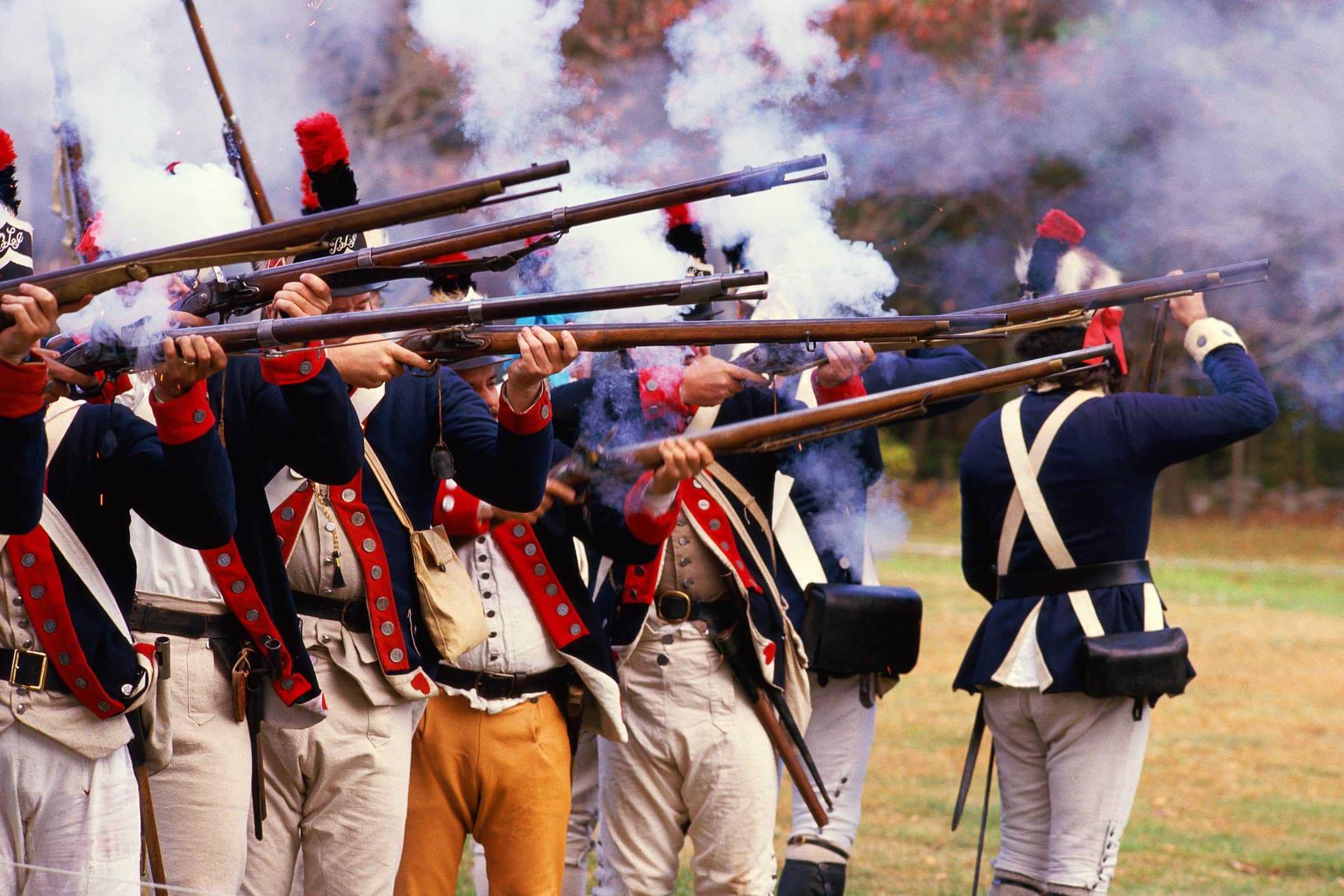
Hillsdale’s Revolutionary America tells a captivating story.
Revolutionary America, Hillsdale College’s new Ken Burns-style documentary on the founding, arrives at a fitting moment: the nation’s 250th anniversary. Though it resembles Burns’s work in its message, soundtrack (very much like the work of Hans Zimmer), maps, and pacing, it is far superior to anything Burns has done.
The documentary is a gorgeous, straightforward, non-ideological approach to a difficult and complex historical subject. While the film never shies away from explaining political philosophy, its main goal is to tell America’s history as a story, inviting the audience to encounter its drama, myth, and wonder.
Narrated by Tom Selleck and featuring an impressive lineup of Hillsdale professors and well-known political commentators, Revolutionary America is broken into two parts. Its first half explores the events leading up to the Battle of Lexington, the Revolution’s opening salvo, on April 19, 1775. The second half considers the move toward independence, George Washington’s masterful leadership of the Continental Army, and the Revolution’s fulfillment through the creation and passage of the Constitution. The documentary builds to a powerful close, with President Arnn observing that the American Revolution never really ended—that every generation must rededicate itself to the principles on which it was fought.
The Revolution was an eruption of eternal truths in time, a moment steadied by Ciceronian first principles, an expression of Judeo-Christian truths of natural law and natural rights. One comes away from the film not only with an increased devotion to and patriotism for the American republic, but also with a deep appreciation of the men who fought for independence: John Adams, Sam Adams, Thomas Jefferson, John Dickinson, and, most especially, George Washington.
Revolutionary America begins, naturally, with the colonial settlement of North America and the policy—or non-policy—of salutary neglect. The colonists were left mostly alone to defend themselves, to govern themselves, and to regulate their own economies.
After the French and Indian War, however, the British government found itself saddled with staggering debt. To pay for it, Parliament—unjustly and unconstitutionally—began to tax the colonists without their consent. The British also began housing peacetime soldiers in colonial homes, and drastically interrupted the very traditional, stable, and beloved common law courts. Naturally, the Americans resented all of this. After the atrocities of the Boston Massacre and the tea monopoly Parliament granted to the East India Company, it was only a short and logical—if somewhat tragic—step to the first shots being fired at Lexington, Massachusetts, on April 19, 1775.
As Michael Knowles wisely and humorously notes, why would anyone, even a massive empire, pick a fight with a heavily armed people who had been born and bred in the wilderness? Yet pick a fight with the Americans they did.
Brilliantly, Revolutionary America lingers over the creation of the Continental Army and the Declaration of Independence, approved on July 2 and adopted on July 4. Then, at a wonderful breakneck speed, the movie details the ups and downs, the victories and the tragedies, of the Revolutionary War. We learn of the brilliance of Washington, remembered more for his restraint than his action, the suffering of the soldiers, and the many campaigns in New England, the middle colonies, and the American South. The movie crescendos with Washington putting a stop to an attempted military coup at Newburgh, New York, the failures of the Articles of Confederation, and the fight over the ratification of the Constitution.
While all of this is not only accurate but excellent, I would like to have seen some mention of the Northwest Ordinance, the document that defined the future of the republic, bridging the natural law and natural rights of the Declaration and the common law tradition carried on in the Constitution. The Northwest Ordinance led, of course, to the rise of Abraham Lincoln, the inspiration for the Republican Party, and the abolition of slavery. This, however, is a minor omission and a minor quibble. The movie already stands, properly and rightly, at 1 hour and 48 minutes. There is little else they could have added.
At its finale, President Arnn challenges the audience to be worthy of the Revolution and to be worthy of God.
We have a unique opportunity, and from it we get a responsibility to establish for all time whether a people can govern themselves from reflection and choice or whether they must ever depend on accident and force for their institutions. America is THE demonstration of that, and it’s ongoing and has to be redemonstrated in every generation…. America is an experiment. It is the most generous and beautiful political experiment in human history. They set up the standard maxim for a free society. Always to be striven for, always to be sought after, never to be wholly attained. The Revolution continues.
Hillsdale has once again given its time, its treasure, and its talent to the republic with Revolutionary America. The film serves as an anamnesis—a remembering of all that matters. We are reminded that we should all be immensely grateful for 1776 and for 1787, as well as for 2026.
The American Mind presents a range of perspectives. Views are writers’ own and do not necessarily represent those of The Claremont Institute.
The American Mind is a publication of the Claremont Institute, a non-profit 501(c)(3) organization, dedicated to restoring the principles of the American Founding to their rightful, preeminent authority in our national life. Interested in supporting our work? Gifts to the Claremont Institute are tax-deductible.
Suggested reading
Too often, experts who are working to "save American democracy" are doing anything but.
Delegitimization of the justice system is a key step toward progressive domination.

Officers are using the “Constitution” to subvert the chain of command.
It’s a product of judicial policymaking untethered to the real meaning of the First Amendment.
A response to recent misrepresentations of our work.

