

The Biden administration has adopted a posture of compliance and appeasement toward Beijing.
How the U.S. Can Restore Its Arsenal
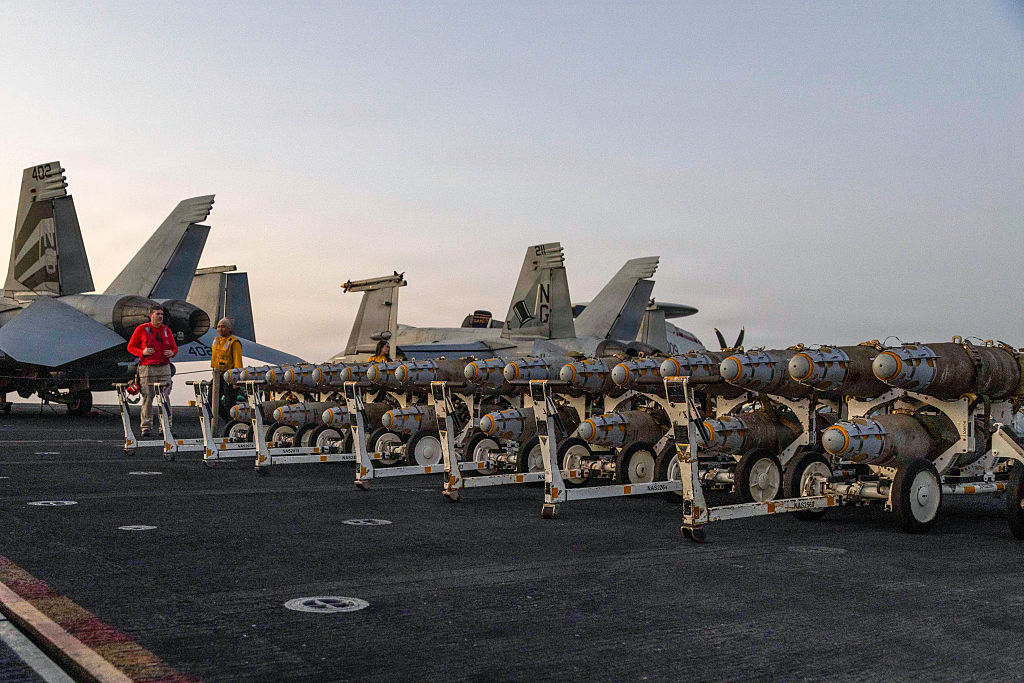
A playbook to address the munitions crisis.
The Trump Administration has done what no previous administration attempted in directly confronting Iran. American and Israeli forces destroyed the Iranian Air Force and Navy, killed the supreme leader and dozens of senior IRGC commanders, struck over 13,000 targets across 26 provinces, and drove Iran’s ballistic missile launch rate down by more than 90%. B-52 Stratofortresses now fly unchallenged in Iranian airspace, carrying out bombing runs with impunity over a country whose integrated air defense system ceased functioning within the campaign’s first week. This pressure culminated in a ceasefire framework brokered through Pakistani mediation, representing the first serious diplomatic movement since the war began.
Though these are historic achievements, they do not resolve the structural question my previous essay raised regarding the alarming state of the U.S. arsenal. Whether Operation Epic Fury ends next week, next month, or next year, and whether it ends through negotiation, stalemate, or escalation, the United States will emerge from it with an arsenal depleted at rates that would have been unimaginable 18 months ago. The question is no longer whether the arsenal is exhausted—the question now is how the U.S. rebuilds it, and whether its political and military leadership addresses the structural failures that produced the deficit or merely writes larger checks to keep funding the existing system.
That question has a finite timeline because China and the United States Indo-Pacific Command (INDOPACOM) are watching. Every interceptor fired in the Gulf is one that cannot be fired in the Taiwan Strait. The choices Congress and the Trump Administration make in the next 12 months will determine whether the United States enters the Pacific contingency with a rebuilt arsenal or with an accounting fiction.
The Numbers Are Clear
Through the first five weeks of combat in Iran, American forces fired approximately 850 Tomahawk cruise missiles, which is roughly 25% of the entire national inventory. To put that into perspective, pre-war production stood at around 60 missiles per year, with each Tomahawk taking up to two years to build because of specialized supply chains, single-source components, and solid rocket motor shortages. Center for Strategic and International Studies (CSIS) analyst Mark Cancian argues that replacing the missiles already expended alone will take two to three years at fully accelerated production rates.
The interceptor math is worse. Bloomberg reported that coalition forces have used at least 2,400 interceptors defending the Gulf states, a number approaching prewar stockpiles. (Iran has launched approximately 1,200 ballistic missiles and 4,000 Shahed drones at Gulf countries.) The Foreign Policy Research Institute found that in the first four days of Epic Fury, U.S. and allied Patriot batteries fired 943 interceptors, equivalent to 18 months of combined production from the Lockheed Martin and Boeing factories that build them. Those factories produce roughly 620 interceptors per year.
The cost estimates have climbed in lockstep with the expenditure data. CSIS estimated that Epic Fury cost $3.7 billion for the first 100 hours. The Pentagon briefed Congress that costs rose to $11.3 billion through the first six days, with CSIS updating its model to $16.5 billion at day 12. The Penn Wharton Budget Model assessed that estimates for the war now range somewhere between $40 billion and $95 billion, with a potential economic impact of up to $210 billion.
Fortunately, the Trump Administration’s Fiscal Year 2027 defense budget responds to this reality directly. The $1.5 trillion total request relies on $350 billion in mandatory funding through reconciliation, with roughly $760 billion dedicated to weapons procurement and modernization. The Pentagon seeks a 150% increase across the services’ primary munitions procurement accounts. The Navy alone is requesting $3 billion for 785 Tomahawk missiles, a 1,200% increase over the 58 authorized the prior year. The budget also dedicates $52.9 billion specifically to critical munitions, scaling procurement of 12 systems through multi-year contracts intended, in the document’s own language, “to encourage new entrants by sending a clear demand signal to expand capacity and future scalable production.”
The budget contains the clearest diagnostic statement any administration has produced in decades:
Over the past 70 years, critical vulnerabilities in industrial production, critical minerals dependence, and national security have begun to negatively impact the readiness of the United States to prevail in a peer or near-peer conflict.
The current posture, the budget document concludes, “is untenable.”
This is the most aggressive munitions procurement request in modern history, paired with an unusually candid Pentagon assessment of why it is necessary. But even all of that is still insufficient. CSIS assessed that FY 2026 production will not fully cover usage to date. The structural problem is that appropriations do not produce weapons—factories, supply chains, and workforces do. Ordering 785 Tomahawks in a budget cycle does not produce 785 Tomahawks if the underlying industrial architecture cannot build them on the timeline the threat demands.
Illusions of War
The most consequential analysis of the Iran War has come from the Foreign Policy Research Institute, which has contended that the war is “creating a strategic illusion where the tactical bombing campaign continues, but America’s readiness for a larger, second-theater contingency quietly bleeds out with every high-end munition fired.”
That framing deserves to become the organizing principle for how policymakers think about the arsenal deficit. It captures the precise asymmetry that tactical success cannot resolve. Every day of continued operations in the Gulf is a day of draining magazines that are sized for a one-theater campaign against a below-peer adversary.
The Pacific threat will not wait for the industrial base to catch up.
The implications for Taiwan contingency planning are severe. CSIS wargames have consistently found that U.S. forces would exhaust critical munitions within eight days of a high-intensity conflict with China. INDOPACOM commander Admiral Samuel Paparo said bluntly, “I was already dissatisfied with the magazine depth,” and called for replenishing stocks “and then some.” Admiral Praparo gave these remarks before the United States fired 850 Tomahawks and 943 Patriots, and consumed at least 30% of the global THAAD stockpile defending Gulf partners.
While the U.S. draws down its arsenal fighting in Iran, China is watching and preparing. AEI’s Critical Threats Project noted that Beijing increased its oil stockpile by 15.8% in the first two months of 2026, and now maintains a strategic reserve of approximately 1.2 billion barrels. PRC officers traveled to the front lines of the Russia-Ukraine War to study operational lessons. They will do the same with Epic Fury.
Xi Jinping has set a 2027 deadline for his military to be ready to seize Taiwan. Whatever the merits of the Trump Administration’s strategic posture toward Taiwan—its 2026 National Defense Strategy does not mention the island nation—the industrial consequences are measurable: every munition consumed defending the Gulf is one that cannot deter China in the Pacific.
This is the real strategic cost of Epic Fury, and it makes a strong case for rebuilding the arsenal now rather than after the war ends.
Looking Below the Primes
The defense industrial base is typically analyzed through its largest prime contractors, but the binding constraints sit in the lower tiers. War on the Rocks published a detailed assessment in January that reframed the problem: supply chains that appear distinct at the program level rely on the same handful of sub-tier suppliers. In the munitions sector, multiple solid rocket motor producers depend on overlapping Tier-2 and Tier-3 sources for energetic materials and propulsion components. A sourcing disruption at one tier stalls multiple prime production schedules simultaneously.
The sub-tier industrial base consists of roughly 3,000 small and medium manufacturers: machine shops, heat treaters, platers, specialty metal processors, precision electronics firms, and specialty chemical producers. These are the companies that produce the components flowing upward into every weapons system. They operate near capacity with aging workforces. RealClearDefense captured the underlying problem:
The workforce that built the legacy of American deterrence is aging out. Much of the institutional memory that underpins prime-level quality and reliability exists in binders, legacy systems, or in [sic] the judgment of individuals who are leaving the factory floor.
Solid rocket motors, which power Tomahawks, PAC-3s, SM-3s, SM-6s, THAAD interceptors, and GMLRS rockets, sit at the center of the bottleneck. The supply chain for propulsion systems is extremely thin, with only a few specialized subcontractors capable of manufacturing them.
The Department of War has used Defense Production Act Title III authorities to address this problem, awarding $32.7 million in September 2025, another $73 million later that year, and additional funds to Systima Technologies, R.E. Darling, X-Bow Systems, and Anduril. Lockheed Martin’s new solid rocket motor (SRM) facility in Camden, Arkansas, will open later in 2026. Ursa Major is pursuing a vertically integrated SRM production model in Youngstown, Ohio.
The FY 2027 budget scales this effort dramatically, requesting $72.3 billion across the Industrial Base Analysis and Sustainment program and DPA Title III to address cross-cutting supply chain risks, including solid rocket motors, critical chemicals, castings and forgings, and microelectronics. The Pentagon calls specifically to “address key sub-tier Solid Rocket Motor suppliers to reduce production costs and increase surge capacity.”
These investments are necessary. But they are also insufficient at the scale of the FY 2027 budget request. Defense procurement has historically sent erratic signals to the sub-tier base: surging during conflict, contracting afterward. While that volatility is manageable for primes that can absorb it across diversified revenue streams, it is an existential risk for smaller suppliers. When demand falls, they lay off workers, mothball equipment, or exit the market. When demand rises again, the capacity is gone.
A machine shop will not invest in new CNC equipment, hire apprentices, or pursue ITAR and AS9100 compliance if it expects the contract to evaporate in three years. The FY 2027 budget’s 150% munitions increase must translate into long-term production agreements that flow down to Tier-2 and Tier-3 suppliers, not just to the primes. Without that signal, the sub-tier base will treat the surge as temporary and refuse to invest, and the arsenal will not be restored on any relevant timeline.
This is the central industrial question the Iran War has raised, and the question that almost no public commentary has adequately addressed: How does the United States convert its appropriations surge into sustained production capacity at the sub-tier level where the binding constraints actually sit?
The LUCAS Proof of Concept
One program utilized in this war offers a partial answer.
The Low-Cost Uncrewed Combat Attack System (LUCAS) saw its first confirmed combat use on February 28, 2026—a drone that CENTCOM commander Admiral Brad Cooper has since called “indispensable.” Entering into combat seven months after its public unveiling, LUCAS costs $35,000 per unit and carries a 500-mile range. It was built by SpektreWorks, a 15-person engineering firm in Phoenix, Arizona, after the U.S. government captured a Shahed-136 drone, reverse-engineered it, and sought a manufacturer to build an improved American version.
The critical structural detail is that the U.S. government owns the LUCAS design, as first reported by Reuters. This means that any qualified manufacturer can produce the system. SpektreWorks currently holds manufacturing contracts, but the design was architected for multi-vendor production from day one. Secretary Hegseth’s Drone Dominance Program extends this model further. In four production phases (called “gauntlets”), 12 vendors will collectively deliver 30,000 one-way attack drones at $5,000 per unit in the first phase, with a target of $2,300 per unit by the final phase.
What makes LUCAS instructive is not just the speed or the cost but the type of company that built it. SpektreWorks is not a prime contractor or a venture-backed mega-unicorn. It is a small manufacturer that participated in a government experimentation program, won a contract through APFIT, and delivered a combat-ready system at a unit cost orders of magnitude below traditional precision munitions. Secretary Hegseth described this process at the December 2025 Reagan National Defense Forum, characterizing the goal as
moving from the prime contractor-dominated, low-competition defense industrial base to a future powered by a dynamic vendor space that accelerates production by combining investment at a commercial pace with the uniquely American ability to scale and scale quickly.
The FY 2027 budget operationalizes that vision through $20.2 billion for the new Office of Strategic Capital, a $1 billion National Security Investment Fund for patient capital investments in the domestic industrial base, and expanded APFIT authorities that make competitive awards ranging from $10 million to $50 million to small businesses and non-traditional contractors.
The venture-backed defense technology sector has produced genuine capability, and firms like Anduril and Shield AI are building the manufacturing infrastructure to produce autonomous systems at scale. But those firms are not the entire answer, and treating them as such repeats the concentration problem that produced the arsenal deficit in the first place.
The LUCAS story is a proof of concept for a different industrial architecture: one in which small and medium manufacturers, operating under accelerated acquisition pathways and shared or government-owned IP frameworks, become a primary source of production capacity rather than a residual layer supporting the primes.
The industrial base cannot be rebuilt through the primes alone. It cannot be rebuilt through venture-backed defense technology firms alone. It has to be rebuilt through restoring the small and medium manufacturing layer that collapsed over the past three decades, and that restoration must be structured to survive the inevitable post-conflict drawdown.
What Restocking the Arsenal Requires
To scale production to the levels the war in Iran and the Pacific contingency demand, domestic small and medium manufacturers will have to own their supply chains, operate under shared-rights or government-owned intellectual property frameworks, and receive sustained demand signals that survive political cycles. They must retain enough commercial incentive to invest in capacity and talent, while the government retains sufficient rights to license production to additional manufacturers during a wartime surge. Neither side owns the IP exclusively; both benefit from scale.
This is not a theoretical concept—it is the model that built the arsenal of democracy in the 1940s. Consolidated Aircraft designed the B-24 Liberator, and Ford Motor Company manufactured over 8,500 of them at Willow Run, a manufacturing plant in Michigan. Thousands of sub-tier shops across the Midwest produced the components that fed both lines. The government structured the production rights so that no single vendor could bottleneck supply. That architecture produced around 18,450 B-24s across multiple factories in only four years.
If Congress and the Department of War want this architecture to function at the scale today’s threat environment demands—for autonomous systems, precision munitions, and interceptors—four structural reforms will need to define the legislative agenda for the FY 2027 NDAA and the forthcoming supplemental.
Shared-Rights IP as the Default for Mass-Producible Systems
The LUCAS model, in which the government owns the design outright, works for reverse-engineered systems, but for original designs, a shared-rights framework is necessary to preserve the commercial incentive to innovate while guaranteeing the government can activate additional production lines during surges. The FY 2026 defense bill approved multi-year procurement for eight critical munitions, including PAC-3, SM-6, THAAD, AMRAAM, and LRASM. Those contracts should include shared-rights provisions that allow the Pentagon to qualify second and third sources during the contract period, with small and medium manufacturers eligible to compete for those secondary production slots. Congress should make this standard policy for any procurement over a threshold quantity.
Sustained Demand Signals to the Sub-Tier Base
The erratic procurement cycles that destroy small manufacturers must be replaced with multi-year production commitments that reach past the primes and into the Tier-2 and Tier-3 shops that produce the actual components. The Defense Production Act Title III investments in solid rocket motors are the right mechanism. But they need to be scaled by an order of magnitude and extended beyond propulsion to machining, castings, forgings, precision electronics, and the specialty chemicals that underpin every modern munition. The sub-tier shops that receive these commitments need to know that the demand will last a decade, not a budget cycle. Without that signal, the capacity will not be built.
Allied Manufacturing as a Strategic Asset
Australia committed $14 billion over a decade to domestic missile and munitions manufacturing. Its Lockheed Martin partnership will produce 4,000 GMLRS rockets annually by 2029, ten times Australia’s own requirement. South Korea’s Hanwha Aerospace is investing $1 billion in a U.S. plant for propellant and modular charge production. Japan ordered 400 Tomahawks and operates SM-3 Block IIA co-production. Lockheed opened PAC-3 co-production programs in Spain, Saudi Arabia, and Poland. The AUKUS ITAR reforms piloted in 2024 should be extended to every treaty ally. Each partnership expands the industrial base without requiring the Pentagon to build government-owned factories.
Depth Across the Cost Spectrum
The FY 2027 budget correctly prioritizes high-end interceptors and precision strike, but Epic Fury demonstrated that the force also needs cheap, autonomous, mass-producible systems at the bottom of the cost ladder. A-10 Warthogs and AH-64 Apaches are flying combat sorties over the Strait of Hormuz and across Iraq because no affordable autonomous system exists at scale to perform the counter-drone, counter-fast-boat, and counter-mine missions those manned platforms are absorbing. The Drone Dominance Program targets this gap. Its success depends on whether the gauntlet model can sustain production contracts that flow to small and medium manufacturers at scale rather than consolidating a handful of firms that recreate the concentration problem the program was designed to solve.
The Timeline That Matters
The Foreign Policy Research Institute’s warning about the strategic illusion of U.S. strength in Iran bears repeating because it frames the real stakes: readiness for a larger emergency fades with every munition fired.
Replacing the 850 Tomahawks expended will take two to three years alone, even with the Navy’s 1,200% procurement increase. Rebuilding the interceptor stockpile to pre-war levels will take even longer. The solid rocket motor supply chain requires new facilities that will not reach full production for years. The sub-tier workforce the entire structure depends on continues to age out. And none of these timelines accommodate a 2027 Taiwan contingency. Meanwhile, the PRC studies this conflict in real time, as it studied Ukraine.
Fortunately, the Trump Administration has recognized the scale of the problem and responded with the most ambitious defense budget in a generation. The FY 2027 request, the Drone Dominance Program, the Defense Production Act Title III investments, the solid rocket motor expansion, the multiyear procurement authorities, and the pending supplemental all push in the right direction. The missing piece is not money—it is the production architecture that converts appropriations into weapons at the pace and cost the threat demands.
Restoring that architecture requires something very different than simply writing larger checks to the primes. It requires creating shared-rights IP frameworks that let multiple manufacturers produce the same system. It requires sustained demand signals that let a 50-employee machine shop in Ohio, Pennsylvania, or Arizona commit to a decade of capital investment. It requires treating allied production capacity as an extension of American industrial power. And it requires the discipline to sustain these investments through the inevitable peacetime drawdowns that have destroyed sub-tier capacity after every conflict in living memory.
The question now is whether American industrial policy can move at the pace the threat environment demands, or whether the FY 2027 budget will become another accounting exercise while the production architecture remains unchanged. The answer will be written on factory floor space, in apprentice pipelines, in IP framework revisions, and in allied co-production agreements—not in appropriations line items.
The 18 months ahead matter more than the 18 days behind us. Congress and the Trump Administration have the moment—but it will not last for long.
The American Mind presents a range of perspectives. Views are writers’ own and do not necessarily represent those of The Claremont Institute.
The American Mind is a publication of the Claremont Institute, a non-profit 501(c)(3) organization, dedicated to restoring the principles of the American Founding to their rightful, preeminent authority in our national life. Interested in supporting our work? Gifts to the Claremont Institute are tax-deductible.
Suggested reading


What it will take to break the deep state.

China is buying American farmland at a brisk pace.

It’ll require political will, statutory reform, and likely a trip to the Supreme Court.

Now is the time to strike a partnership.

A roadmap for the Trump Administration.

