

Overturning Humphrey’s Executor is not enough.
Restoring Our Republican Way of Life
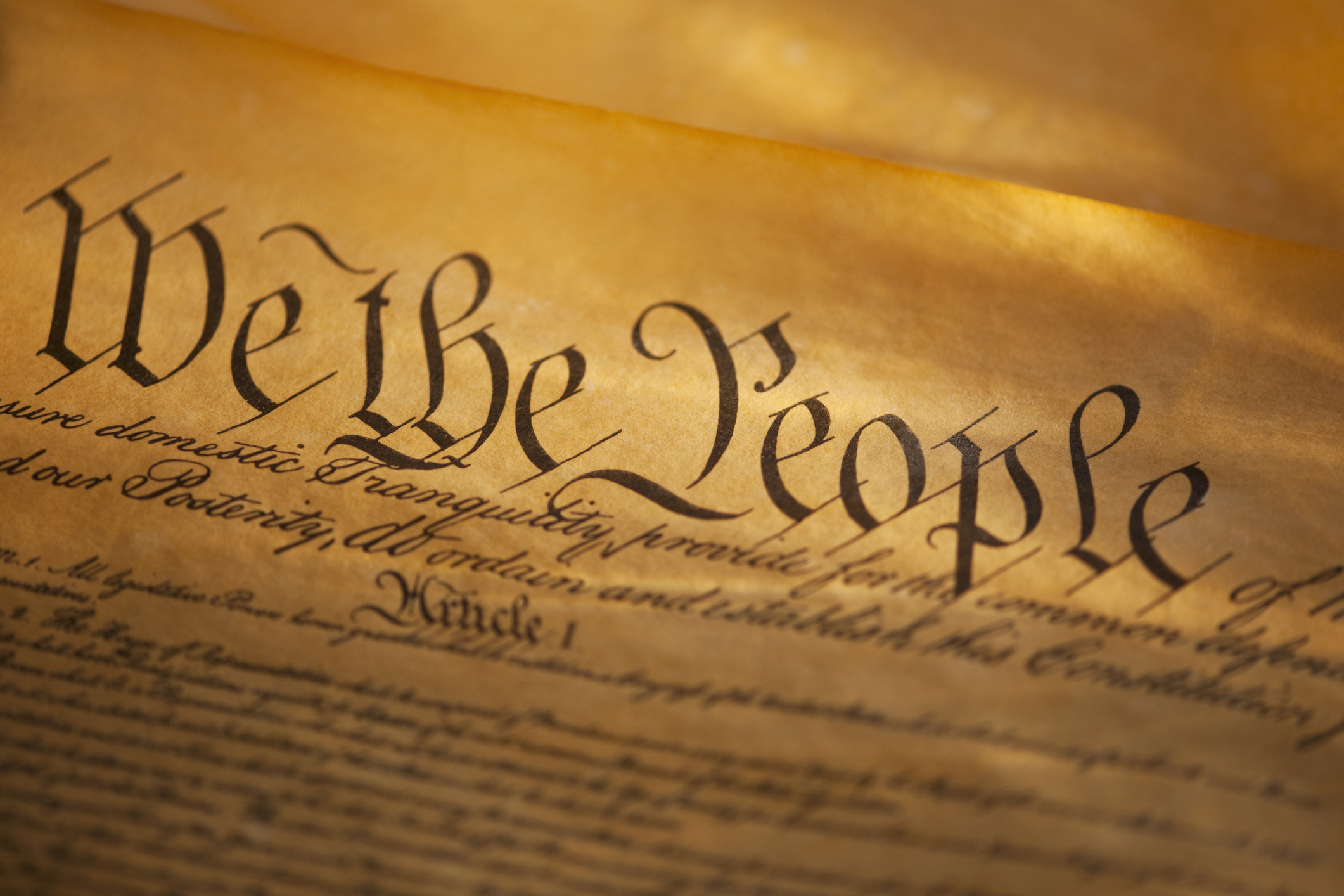
It’s in the hands of the judicial and legislative branches.
Everyone remembers the famous warning Benjamin Franklin reportedly gave Elizabeth Willing Powel as he and his fellow framers left the Constitutional Convention’s final session: they’d created “a republic, if you can keep it.” What’s less understood is that we didn’t.
Ronald J. Pestritto’s new Provocation from the Center for the American Way of Life brings the welcome news that valiant efforts have begun to restore the lost republican framework that those great men designed. But since most Americans believe we still live under the regime forged in Philadelphia, what’s equally valuable in Pestritto’s essay is his lucid reminder of just how we squandered the brilliant contrivance that James Madison shepherded through the Convention: the self-governing republic formed, as Alexander Hamilton wrote, by “reflection and choice” rather than by “accident and force,” arguably the finest achievement of the Western Enlightenment.
Pestritto, graduate dean and professor of politics at Hillsdale College, is perhaps our leading chronicler of the displacement of the framers’ republic by the rise of the administrative state. In this essay, he has fortunately added a few key details to the account he gave us in his previous works, especially America Transformed: The Rise and Legacy of American Progressivism, which I reviewed.
The architects of the administrative state—led by our first professor-president, Woodrow Wilson, and backed by political scientist Frank Goodnow, who served as president of Johns Hopkins—rejected not just the framers’ constitutional machinery but even the fundamental postulate of the American creed: that individuals have inherent rights that governments exist to safeguard and must never infringe. Wilson pooh-poohed that idea as a relic of a bygone historical era. History, he preached, is progressive, and we have moved on from such a crude idea of democracy to a higher concept. “For Wilson,” as Pestritto describes that supposedly advanced notion, “an all-powerful centralized state was merely the logical extension of genuine democratic theory. It gives all power to the people, in their collective capacity, to carry out their will through the exercise of governmental power, unlimited by any undemocratic idea like individual rights.” This idea resembles socialism, Wilson acknowledged, but we might think it smacks more of fascist totalitarianism than democracy, though Pestritto leaves it to the reader to draw his own conclusion.
Against the Constitution itself, as Pestritto recounted in his previous works, the Progressive professors trained the big guns of Darwinism and Hegelianism. Government is a living thing, they argued. Like all life, it has to evolve, always moving toward a higher historical plane as the world grows more complex, with advancing technology, industry, and trade requiring ever more governmental regulation.
In particular, as Pestritto stresses in this essay, the Progressives contended that they had to move beyond the framers’ idea of the separation of powers, which they explicitly designed to limit governmental power and keep it from encroaching on individual liberty. Modern conditions, along with a growing consensus about government that transcended petty political disagreement, required a modern unitary state with unlimited power. This state was to feature administration by objective, apolitical, scientifically trained experts who would replace the self-interested squabbles of unenlightened politicians.
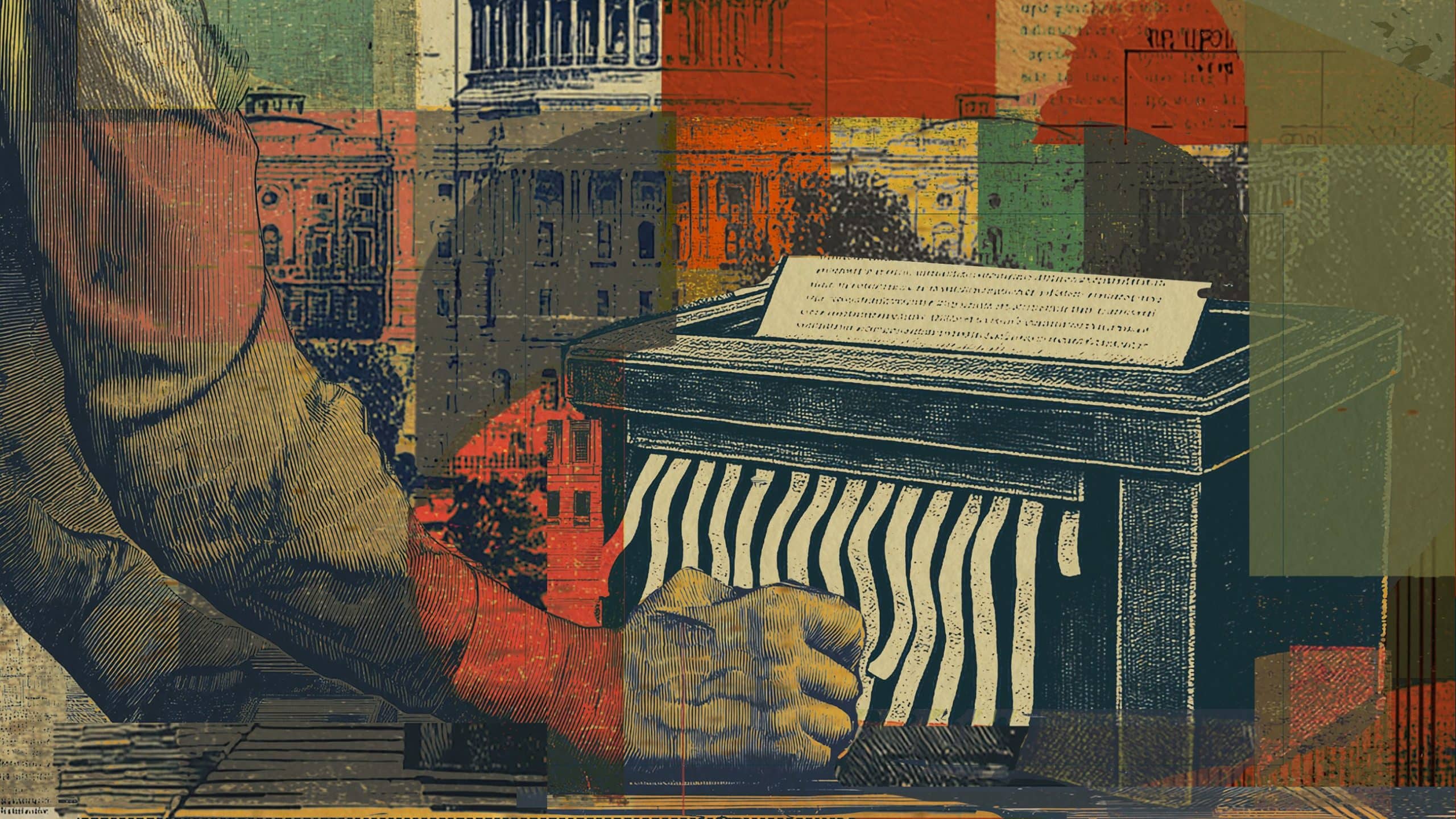
To achieve the necessary efficiency, this new bureaucratic clerisy would make regulations like a legislature, put them into effect like an executive, and adjudicate and punish infractions like a judiciary. Not only did the separation of powers go into the Progressive shredder, but so too did the related doctrine that the legislature can delegate neither its own rule-making powers nor the judicial power, which it does not possess, to a nominally executive-branch administrative agency.
If Wilson and his coadjutors laid the intellectual foundations of the administrative state and brought its first few agencies into being, it fell to Franklin D. Roosevelt and the New Deal to use their model to devour the self-governing republic that America had managed to preserve for a century and a half. Pestritto’s focus on this front is not so much on the particulars of FDR’s construction of “a ‘fourth branch’ of Government for which there is no sanction in the Constitution,” as the president ruefully acknowledged—though in this forgetful age, readers would have profited from a paragraph or two of these details. Instead, the essay recounts, somewhat sketchily, how the federal courts sanctioned this wholly anti-constitutional development, beginning with the Supreme Court’s abandonment of the non-delegation doctrine in the 1930s. The Court has allowed the galaxy of agencies that proliferated from the New Deal onward to mix powers with abandon, even adjudicating infractions of the rules they have concocted by a factitious apparatchik called an “administrative law judge,” a position unmentioned in Article III of the Constitution.
Moreover, after Congress attempted to rein in the agencies with the Administrative Procedures Act, the courts steadily weakened its provisions. By Lyndon Johnson’s presidency, for instance, APA provisions that might have barred some of the rulemaking under the Great Society’s Clean Air Act had become dead letters. The capstone—if it may be called that—of this erosion came in the Supreme Court’s 1984 decision, Chevron v. Natural Resources Defense Council.
That ruling held that any ambiguities or omissions in the law that empowers an agency are to be resolved by the agency itself, usually through yet more expansive rulemaking, rather than by the federal courts that are charged with interpreting the law. This is what’s called “Chevron deference,” whose wildest application came in the Court’s 2013 City of Arlington, Texas v. FCC decision. The Court judged in that case that agencies have the authority to determine the scope of their own jurisdiction, even down to claiming the power to set deadlines for local antenna-siting decisions. Pestritto’s reminder that conservative jurists, including Justices Antonin Scalia and William Rehnquist, endorsed such decisions, influenced by political considerations, will raise the eyebrows of constitutional originalists.
The New Deal Court made the administrative state more bulletproof in a second, even more remarkable way. You would think that agencies established to execute laws passed by Congress would be executive-branch agencies. And since Article II of the Constitution vests the executive power completely in the president, he must be free to fire at will the functionaries hired to help him carry out his duties. Not so, said the Supreme Court in its 1935 Humphrey’s Executor v. U.S. decision, which held that FDR couldn’t sack a Federal Trade Commissioner. To an originalist, the Court’s rationale seems to come from outer space, not from the framers’ document.
The FTC doesn’t exactly belong to the executive branch, the Court reasoned, since its powers are “quasi-legislative” and “quasi-judicial”—powers the justices seemed to think Congress was entitled to delegate. By the same token, Congress has the authority to decree that officials of so-called “independent” agencies can only be fired if they misbehave grossly, not at the president’s will, however much their policies diverge from his. Bad as this is, the Court made it worse in Morrison v. Olson in 1988, ruling that a president can’t fire even a special prosecutor.
An “independent” agency and an “independent” prosecutor—a “fourth branch,” indeed.
Our current Supreme Court, ballasted by originalist justices, has moved laudably to reverse both these trends. A string of decisions has restored much of the president’s removal power over his executive-agency underlings. Free Enterprise Fund v. Public Company Accounting Oversight Board and Seila Law v. Consumer Financial Protection Bureau removed the Rube Goldberg-like layers of protection that Congress gave the administrators of those agencies. In May, the Court allowed the president’s firing of a National Labor Relations Board commissioner, pending further consideration of the merits of the case. The Court’s declaration that since “the Constitution vests the executive power in the President…he may remove without cause executive officers who exercise that power on his behalf” further narrowed the scope of Humphrey’s Executor. The D.C. Circuit Court of Appeals recently formalized that principle, ruling that “Congress may not restrict the President’s ability to remove principal officers who wield substantial executive power.”
Pestritto notes that President Trump has forced the Supreme Court to consider overturning Humphrey’s Executor altogether with the firing of two FTC commissioners in March—officials holding the same positions as those in that egregious precedent nine decades ago. Oral argument in that case, Trump v. Slaughter, took place on December 8 and strongly suggests that the Court will overturn Humphrey’s Executor this summer.
Equally significant are the 2024 rulings in which the Court effectively killed off Chevron deference. Notably, Securities and Exchange Commission v. Jarkesy required the SEC to go to a real court and face a jury trial, rather than its own administrative tribunals, to impose certain fines. Better still, Loper Bright v. Raimondo outlawed Chevron deference as a violation of the Administrative Procedures Act. Echoing Justice Clarence Thomas, Pestritto asserts that it would have been even better if the nine had found the doctrine a violation of the Constitution so that a future Congress couldn’t resuscitate it.
These rulings have significantly undone the earlier Supreme Court decisions that supercharged the power of these agencies. But they leave intact the New Deal Court decisions that supersized federal power, allowing the agencies to assert control over the whole national economy, not just within but also outside of interstate commerce. They also don’t touch the later decisions that let the federal government remold civil society, twisting the Civil Rights Act to let Washington bureaucrats dictate who would fill the ranks of the public schools, the universities, and private employers. Nor do they address the Warren Court decisions that allow the federal government to intrude into local policing and order-keeping matters. All of these decisions bring us a step closer to Madison’s nightmare that the framers’ limited government could be turned into an unlimited one.
Still, what the Court has done so far is excellent, though as Pestritto notes, judicial decree is a far cry from republican self-government. And though the current Supreme Court has staunchly defended the Constitution, the federal district courts have been nipping away at constitutional principles like a swarm of mosquitoes. Better for the Senate to do away with its “blue slip” rule requiring the approval of home-state senators for the appointment of district court judges, he suggests, so that a Republican president can appoint originalists even in red states. But even this won’t prevent the glut of rogue judges like James Boasberg in blue jurisdictions.
What’s badly needed is for a pampered, overfed Congress to wake up from its lethargy and start doing what Article I empowers it to do, as Pestritto notes without further elaboration. For starters, we might urge that it try some checks and balances, as is already happening with the articles of impeachment filed against Judge Boasberg and three other district judges. Some object that these judges aren’t guilty of any impeachable bribery or corruption. But the framers viewed impeachment above all as a safeguard against power-hungry officials claiming prerogatives beyond what the Constitution gives them, the misdemeanor at issue here. And then Congress could fine-tune, trim, or repeal some of its own legislation that gave away so much of its power to agency apparatchiks.
Here Pestritto’s Provocation demands a further Provocation: How exactly should Congress do this? And will it require the Senate to give up the filibuster?
The American Mind presents a range of perspectives. Views are writers’ own and do not necessarily represent those of The Claremont Institute.
The American Mind is a publication of the Claremont Institute, a non-profit 501(c)(3) organization, dedicated to restoring the principles of the American Founding to their rightful, preeminent authority in our national life. Interested in supporting our work? Gifts to the Claremont Institute are tax-deductible.
Also in this feature
Recovering republican government in the 21st century.

Opponents of the administrative state shouldn’t give up on the Founders’ design.
It’ll take more than one administration to end the administrative state.
He’s taking on the modern administrative state.
Our problems are many, the solutions are few.

