

He himself is perfectly capable of unmaking our regime.
The Great Farewell
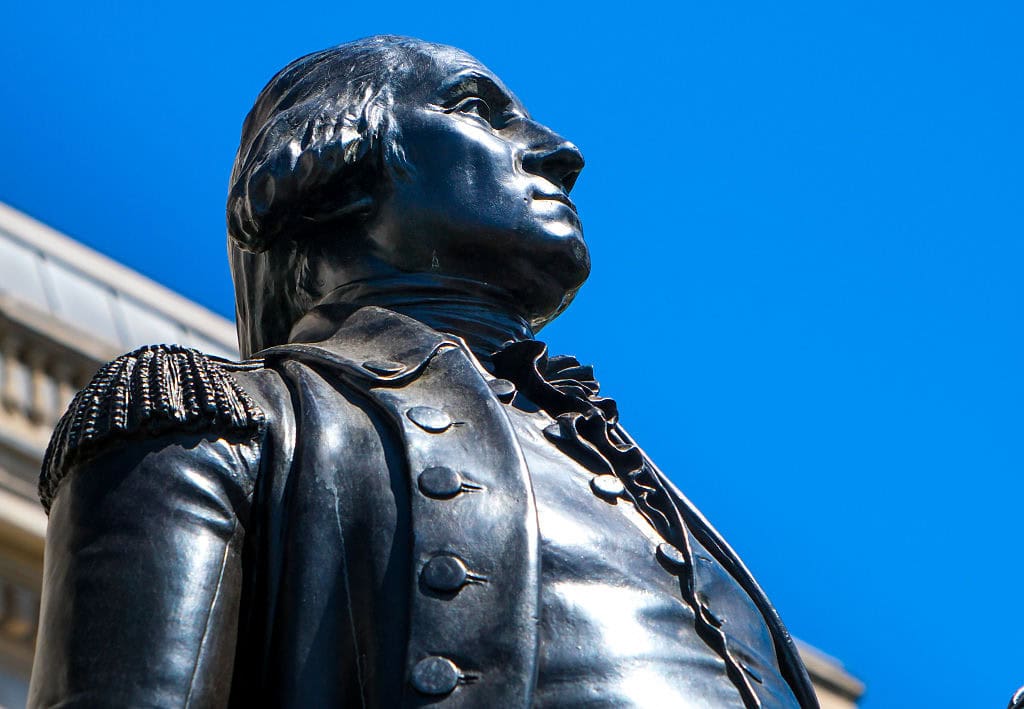
How George Washington’s final presidential address shaped the American mind.
Editors’ Note
The following is an excerpt from Richard Lim’s forthcoming book, Refusing a Crown: How George Washington Changed the World, which will be published by Republic Book Publishers on October 13.
Washington’s Farewell Address is often celebrated as one of the great documents of American history—the political testament of the nation’s founding father. Its authorship, however, has occasioned debate. Some, especially those who viewed Washington as a puppet of closet monarchists, wondered if he was even in charge of his own administration and whatever statements emerged from it.
The record shows that while Washington certainly had assistance during the drafting process, the document was truly his—he dictated what he wanted included and gave the final approval of the text. The tenets espoused reflected beliefs Washington had held for decades—beliefs he hoped could guide the nation from infancy to maturity. The Farewell Address was a worthy capstone to his extraordinary career and a touchstone of American republicanism.
Writing the Farewell Address
In 1792, Washington, considering retiring after a single term, asked Madison to draft a farewell. He shelved that text when, urged by Jefferson and Madison, he stood for reelection that year. In 1796, Washington, resolving to leave office for good at the end of his second term, updated Madison’s 1792 draft to reflect the “considerable changes having taken place both at home & abroad” during his second term.
His relationship with Madison now strained by their political differences, Washington solicited Hamilton’s help with revisions. By May, Washington had sent Hamilton the draft, giving him permission to create a completely new draft. Hamilton decided to do both. By August, he had sent Washington both drafts, his new version incorporating elements from the version Washington gave him. Throughout the process, Hamilton consulted John Jay, then governor of New York.
Ergo, Hamilton, Madison, and Jay, writers of the Federalist Papers that were so crucial to the ratification of the Constitution, could all claim a degree of authorship of the Farewell Address. By early September, Washington was finalizing Hamilton’s draft. He arranged with David C. Claypoole, editor of the American Daily Advertiser, to publish the document on September 19. Since the Advertiser’s reach was limited to Philadelphia and environs, the rest of the nation gradually learned of Washington’s decision as local papers around the country republished the text.
In his roughly six-thousand-word address, Washington started with a unifying theme, acknowledging the one thing virtually all Americans agreed on: the importance of liberty. He asserted that the “love of liberty” was “interwoven…with every ligament of…[the American people’s] hearts.” While Americans might disagree on many things, they could certainly agree that being an American was synonymous with the love of freedom.
The remainder consisted of “some sentiments which are the result of much reflection…” These sentiments echoed many ideas from his 1783 circular—and, as in the circular, reinforced his version of republicanism.
Two Principles: The Universality of Truth and Morality
Washington believed there to be objective and universal moral truths about right and wrong rooted in age-old religious precepts and binding on all people and all nations. He also held that the manner of one’s adherence to those truths determined, in large part, one’s happiness or success. To depart from these truths was to incur negative consequences.
In the Farewell Address, Washington declared, “Of all the dispositions and habits which lead to political prosperity, Religion and morality are indispensable supports” and “virtue or morality is a necessary spring of popular government.” These statements tracked with his assertion in the 1783 circular that America could only prosper by imitating the actions and embracing the principles of “the Divine Author of our blessed Religion,” Jesus Christ. He again linked the nation’s political success, especially given that the people ruled the country, with the citizens’ moral conduct, whose foundation lay in religious principles. He stressed that morality could not be divorced from religion: “…let us with caution indulge the supposition, that morality can be maintained without religion.”
Garry Wills and other modern authors have argued that these lines about religion and morality reflected mere utilitarian notions—that Washington didn’t really believe in religious or moral principles but merely saw them as a tool for maintaining social order. This reading fails to consider other lines in the Address that indicate the existence of a religious and moral design to the universe. Washington asked, “Can it be, that Providence has not connected the permanent felicity of a Nation with its virtue?” The term “Providence” was often used by early American Christians to refer to the Deity, making it likely that Washington here is asserting that God has connected the happiness of a nation with its moral conduct. He believed it was in America’s interest to cultivate a virtuous citizenry.
Washington called for the United States to remain at peace with all the world: “Observe good faith & justice towds all Nations,” he wrote, “cultivate peace & harmony with all.” He reinforced this thought by writing, “Religion & morality enjoin this conduct; and can it be that good policy does not equally enjoin it?” In other words, the practical effect of a peace-driven policy was not the only reason to do it—transcendent moral principles required it. All this echoed Washington’s First Inaugural Address in 1789, in which he declared, “the propitious smiles of Heaven, can never be expected on a nation that disregards the eternal rules of order and right, which Heaven itself has ordained.”
In his original draft, Washington had not referred to religion and morality; Hamilton may have added those lines. If so, Washington may have decided to go with that language out of concern that republicanism was being infected with anti-religious hostility, which Washington might have been referring to when he declared, “Whatever may be conceded to the influence of refined education on minds of peculiar structure—reason & experience both forbid us to expect that National morality can prevail in exclusion of religious principle.” Washington apparently feared that well-educated “minds of peculiar structure” could take republicanism into a more secular direction.
The Need to Restrain Human Nature At Home and Abroad
Washington had an unblinking view of human nature, believing man to be a selfish, fallen creature who, given power, would use that power to satisfy personal ambition as Caesar had, rather than for the good of others. He wrote, “love of power, and proneness to abuse it…predominates in the human heart,” predictably leading to the destruction of liberty. In 1786, he had written to John Jay, “We have probably had too good an opinion of human nature in forming our confederation.… We must take human nature as we find it. Perfection falls not to the share of mortals.” This view was contested by Enlightenment-era contemporaries of Washington such as philosopher Jean-Jacques Rousseau, who believed in the utopian notion that man’s nature was inherently good and perfectible. Rousseau uttered the tongue-in-cheek mot juste, “Men are wicked, yes, but man is good.”
The French Revolution was fueled in large part by thinkers like Rousseau and their faith in man’s perfectibility. Jefferson staunchly supported that rebellion, even as it devolved into violence and anarchy. Recall that in 1793 he said, “rather than…[the French Revolution] should have failed, I would have seen half the earth desolated. Were there but an Adam and an Eve left in every country, and left free, it would be better than as it now is.”
Washington shared no such visions, instead blending morality and realism to argue that man was entitled to freedom but, because of his fallen nature, had to be checked at multiple levels. He saw government as the means to curb that nature by keeping the people from disobeying the law, as well as keeping majorities from abusing minorities, and vice versa. Government also needed to serve as a check on itself, which is why the Constitution established checks and balances. In the address, Washington wrote, “The necessity of reciprocal checks in the exercise of political power; by dividing and distributing it into different depositories…has been evinced by experiments ancient & modern; some of them in our country & under our own eyes.” Of these constraints, he asserted, “To preserve them must be as necessary as to institute them.”
Washington called on the American people to accept a certain level of government power according to the Constitution as a restraint on their excesses. He urged every citizen to obey the law and the overall authority of the federal government. He emphasized the legitimacy of the new government, calling it “the offspring of our own choice uninfluenced and unawed, adopted upon full investigation and mature deliberation, completely free in its principles” and therefore deserving of “a just claim to your confidence and your support.” Echoing Romans 13, Washington held that even a government born of rebellion, if legitimate, was entitled to submission by its citizens. He wrote, “The very idea of the power and the right of the People to establish Government presupposes the duty of every Individual to obey the established Government,” and argued, “the Constitution which at any time exists, ’till changed by an explicit and authentic act of the whole People, is sacredly obligatory upon all.”
Believing America’s federal government to be legitimate, he maintained that measures imposing reasonable taxes were among the laws citizens had an obligation to accept. In his Farewell Address, Washington said, “towards the payment of debts there must be Revenue—that to have Revenue there must be taxes.” He explained “that no taxes can be devised which are not more or less inconvenient & unpleasant,” but that the people needed to cultivate “a spirit of acquiescence in the measures for obtaining Revenue which the public exigencies may at any time dictate.” He regarded the Whiskey Rebellion as a violation of this principle. One could argue about the wisdom of the excise tax, but destruction of property and violent resistance of the government was not justified.
Much is made of Washington’s warning in his Farewell Address about political parties. In an era of disillusionment with the political establishment, this message resonates. Washington believed parties undermined the checks that protected all Americans, promoting selfish interests. He wrote, “This spirit [of party], unfortunately, is inseperable from our nature, having its root in the strongest passions of the human Mind”—a passion toward individual advantage over others.
He grasped that parties were inevitable and could even be “useful checks upon the Administration of the Government…” but warned, that they “put in the place of the delegated will of the Nation, the will of a…small but artful and enterprizing minority,” and that parties would be the “potent engines…[for] cunning, ambitious and unprincipled men…to usurp for themselves the reins of government.” In other words, parties would cater to people’s personal ambitions, giving them an incentive to demand protection of their own rights at the expense of others. The only answer to the problem of partisanship, according to Washington, was “to discourage and restrain it.”
Washington was not arguing that people did not have the right to seek their own advantage, or that Americans weren’t free to associate with parties. He did, however, fear Americans prioritizing their own immediate interests at the expense of the nation as a whole—something that could lead to harm for everyone. Just as kings were expected to check factions in parliament and govern with the whole kingdom in mind, President Washington warned against factions in the new republic that would undermine the nation’s interest as a whole. It’s why Washington advised his countrymen that “The name of AMERICAN…must always exalt the just pride of Patriotism, more than any appellation derived from local discriminations.”
Washington wrote in a preliminary draft of the Farewell Address of his desire “That the several departments of Government may be preserved in their utmost Constitutional purity, without any attempt of the one to encroach on the rights or priviledges of another—that the Genl & state governmts may move in their propr Orbits.” The people and their leaders would be checked by all three layers of government—local, state, and federal. Americans suspicious of a strong federal government wondered why these checks could not exist solely at the state or local level.
The main reason for Washington was that during the Revolution and under the Articles of Confederation, states had often acted against the interest of the country at large. Only the federal government, Washington believed, could defend Americans’ rights and enforce policies applying across the entire nation. Instead of states imposing tariffs on each other, hampering commerce, as had happened under the Articles, a federal government could enforce a domestic free trade zone.
Washington supported a strong national government, not only as a means of checking American citizens and public officials, but also enemies abroad, railing against the “insidious wiles of foreign influence” brought to bear by other nations seeking to seduce and “mislead” the American people into making the United States a mere “satellite.”
Washington believed that only the federal government could concentrate the resources of the people to defend against external threats. He wrote, “All the parts [of the Union] combined cannot fail to find in the united mass of means & efforts greater strength, greater resource, proportionably greater security from external danger.” In his initial draft, he made this point clear: “That our Union may be as lasting as time. for While we are encircled in one band we shall possess the strength of a Giant and there will be none who can make us affraid—Divide, & we shall become weak; a prey to foreign Intriegues and internal discord.”
Washington believed that preventively expending money and resources to deter enemies was an investment in peace and freedom: “…timely disbursements to prepare for danger frequently prevent much greater disbursements to repel it—avoiding likewise the accumulation of debt.” This had been his argument since the days of the Revolution. Had America somehow been able to amass and direct the money ahead of time to create a professional army, it might have won the war sooner and at far less expense.
Washington said a strong union would check state interests and prevent internecine conflicts, writing that the union would provide “an exemption from those broils and Wars between themselves, which so frequently afflict neighbouring countries, not tied together by the same government; which their own rivalships alone would be sufficient to produce.” Americans could look to Europe, a continent of nation-states constantly warring with one another, nursing long-standing rivalries, and shifting among intrigue-ridden alliances—a pattern that would continue into the twentieth century. He had written in his 1783 circular that without a firm union, the states would “become the sport of European Politicks, which may play one State against another, to prevent their growing importance and to serve their own interested purposes.” He worried especially about the states on America’s western frontier, whose remoteness from the rest of the country would incline their residents to ally with whatever European empires they did business with. In 1784, Washington had written, “The Western settlers—I speak now from my own observations—stand as it were upon a pivet; the touch of a feather would almost incline them any way…”
Amity among the states would prevent the need for individual states to form standing military forces, which republican theorists had long considered threats to freedom. Washington wrote, “Hence likewise they [the states] will avoid the necessity of those overgrown military establishments, which under any form of Government are inauspicious to liberty, and which are to be regarded as particularly hostile to Republican Liberty.”
Washington and fellow Founders saw in ancient history antecedents for their situation, specifically the Greek city-states and their confederations of the third and fourth centuries BCE, organized to guarantee security. One such confederation was the Achaean League, an early example of federalism, in which the need for collective action was balanced with each city-state’s desire to maintain its autonomy. These leagues failed to prevent defeats, first at the hands of a centralized monarchy in Macedonia and later at the hands of a rising empire centered in Rome. James Madison wrote in Federalist 18, “Had Greece, says a judicious observer on her fate, been united by a stricter confederation, and persevered in her union, she would never have worn the chains of Macedon; and might have proved a barrier to the vast projects of Rome.”
For Washington, union was indispensable for the establishment of cohesive policies, solidification of the national defense, and therefore freedom. He wrote, “your Union ought to be considered as a main prop of your liberty, and that the love of the one ought to endear to you the preservation of the other.” An effective national government would check the untoward impulses of the nation’s citizens, leaders, and adversaries. And where government failed, individual morality would check the conduct of the people themselves. Washington wrote, “Respect for its [the Constitution’s] authority, compliance with its Laws, acquiescence in its measures, are duties enjoined by the fundamental maxims of true Liberty.”
The American Mind presents a range of perspectives. Views are writers’ own and do not necessarily represent those of The Claremont Institute.
The American Mind is a publication of the Claremont Institute, a non-profit 501(c)(3) organization, dedicated to restoring the principles of the American Founding to their rightful, preeminent authority in our national life. Interested in supporting our work? Gifts to the Claremont Institute are tax-deductible.
Suggested reading

Undoing a corrupt eminent domain case doesn’t justify society-wide wealth redistribution.
The cure for what ails America.

The Ninth Circuit flouts the canons of legal reasoning and common sense.
They comply with both the law and the Constitution.
A response to recent misrepresentations of our work.

