

America increasingly resembles a failed state.
Battle Over the Demos
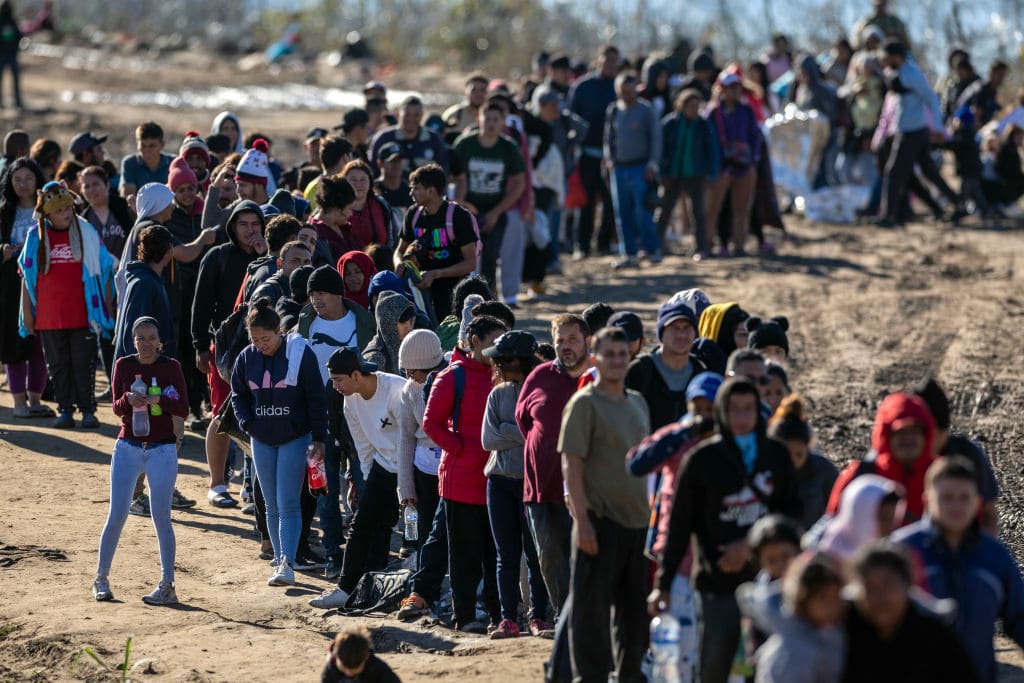
American politics is no longer a contest over how we govern, but over who decides.
The most consequential domestic policy development of the 2020s is neither COVID-19 nor Donald Trump’s reelection. It is Joe Biden’s decision to import ten million foreigners into the United States in violation of standing federal law. Many of the defining political fights of this decade stem from that choice: government shutdowns over border enforcement, states unilaterally redefining the meaning of citizenship, the growing willingness of the restrictionist wing of the Republican Party to defy its own business class, major fraud investigations in Minneapolis and New York, and the unraveling of consensus over whether federal law binds the states.
These are battles in a larger fight over who constitutes the American people, one that escalated with President Biden’s decision to actively facilitate the mass importation of illegal aliens into this country by land, air, and sea.
American politics is no longer primarily a contest over how we govern ourselves. It is a contest over who we are and who decides.
None of this is merely rhetorical. The federal government has shut down six times since 2018—and immigration has been central to nearly every one of them. The government shut down over border wall funding in 2018 and benefits for “Dreamers” in 2019. Two partial shutdowns concerning immigration enforcement occurred in 2026, the second shutdown being the longest in American history at 76 days.
When the U.S. cannot keep the federal government open, it’s usually due to disagreement not over fiscal policy, but over a foundational question—who belongs to the political community. And that’s the kind of disagreement that does not get resolved simply by winning the next election, as the backlash to immigration enforcement in Minneapolis made jarringly clear.
There are two Greek words to help us frame the moment. The ancients distinguished kratos—meaning power, authority, and the mechanics of rule—from demos—the people in whom that authority resides. Most Americans likely recognize these terms because together they form the root of the word “democracy.” For most of American history, our major political disagreements have been kratos arguments—debates over the accumulation of power in the federal government and how to exercise it for the common good.
Over the first quarter of this century, as our political differences hardened, the Left endeavored to convince, and succeeded in convincing, many of our fellow countrymen that the kratos as it exists is flawed and, more alarming, illegitimate.
Recognizing they do not have the breadth of public support to have their views made law, the Left decided to expand the political terrain. They argued that the Electoral College is racist and should be abolished, that proportional representation in the Senate is an antiquated relic, and that the Supreme Court remains useful only if packed. At the same time, they came up with a more insidious innovation: the Left realized they could change the answer to the question of who we are through the mass importation of illegal aliens.
The demos is the grounds on which we now contest our politics.
Defying the People
Recall what has happened since the 2024 election. The country spoke through the most legitimate instrument it has, and the answer was decisive: mass deportation and the restoration of federal immigration law. Yet the Left decided to defy that answer.
California expanded benefits to illegal aliens in the weeks after President Trump’s decisive victory. Illinois passed new sanctuary protections. New York City reaffirmed its municipal voting policy (before it was struck down) and expanded state-funded health coverage to those here illegally.
The left-wing government contractor apparatus, built to execute the Biden Administration’s mass importation policy, sought to obscure records and coach illegal aliens in how to evade the law, often with support from state and local funding streams. And when federal law enforcement began the hard and rough work of restoring law and order in the interior, the Left’s response was not simply protest. It was the single most extreme anti-federal resistance operation in living memory: coordinated, sustained physical resistance directed at federal law enforcement, designed to prevent them from carrying out the laws the American people explicitly called for in 2024.
Mere protesters do not stalk federal law enforcement officers through airports, feed their license plate data to sources in a local police department, threaten their families on Facebook, or smash windows at their hotels. American history offers few examples of localities resisting federal authority on that scale, and those episodes belong to some of our nation’s darkest chapters.
States and cities now reject the single definition of citizenship on which our union depends. The country voted decisively on the demos question. Yet a substantial part refuses to accept the result—not by contesting the count, but by denying the legitimacy of border enforcement and mass deportation altogether, along with the work of the legislative and executive branches to carry out the American people’s wishes on immigration.
The Left is contesting the very political order that produced a second Trump Administration committed to restoring sanity on immigration. This can be difficult to see because the current political moment allows the Left, along with establishment Republicans, to cloak its rejection of immigration enforcement in principle as concern over specific enforcement tactics. But the tactics are the pretext; the real objection is to enforcement itself.
This asymmetry cannot hold for long.
A Restoration, Not an Insurgency
Much of the commentary among advocates of immigration restriction and mass deportation invokes the restrictionist turn of America 100 years ago. That precedent, however, is inadequate to the moment. The 1924 Johnson-Reed legislation and the following decades-long political consensus worked because the country still had a kratos container capable of holding a demos dispute.
Both political parties generally accepted federal supremacy over immigration. Both generally accepted that citizenship was a single, uniform, federally defined status. The argument was about whom the country admitted. What was not contested was who would adjudicate it and who had a say.
Now attempts to enforce the law are met by sanctuary jurisdictions and street-level resistance. Deep blue states are unilaterally changing the demos itself through issuing IDs, extending benefits, and granting municipal voting rights to illegal aliens. They no longer accept the federal definition of who counts as a member of the political community. Since the container is gone, the resolution cannot look like 1924.
Many in the political class presume that these policy disagreements will resolve as others have historically done—through legislation, the courts, and the slow grinding of consensus toward a workable center. That assumption is wrong.
You cannot half-recognize the ten million people the Biden Administration admitted in contravention of the law. You cannot merely half-restore the demos.
This is why the issue will not subside.
The administration that came in on the back of that reaction has been treated by its critics as a populist insurgency against governing norms. That description misreads the moment. The positions the Trump Administration is implementing were, until about a decade ago, the consensus of both parties: that the border is enforced, that deportation is a routine function of law rather than an atrocity, that citizenship is the only path to receive public benefits and the franchise, and that identification documents certify something real.
The Trump Administration is not the insurgency—it is the restoration.
The Left’s chosen terrain and the ferocity of its fight are the tell. Deportation, sanctuary jurisdictions, the status of those flown in under the Biden-era mass parole programs, the benefits for non-citizens, the IDs the government will honor: each of these, examined closely, is part of a much larger campaign to transform the demos in pursuit of permanent political dominion.
The Trump Administration stands in the breach. This is not a policy disagreement that can be resolved through compromise. It is an existential conflict over who counts as a member of the national citizenry. In an era when every political dispute is described as existential, few deserve that label more than one in which a portion of the country contests the very composition of the people themselves.
Every Issue Is Now a Proxy
There can be no return to the pre-Biden status quo. Housing, healthcare, schools, and crime are increasingly being seen through the lens of immigration, particularly the crushing fiscal weight of carrying millions of non-citizens in the markets and on the books. This is an essential question of political membership: to whom the benefits and responsibilities of that membership apply. Americans witness illegal aliens receive preferential or subsidized mortgage loan access and free emergency room visits, all while operating under a double standard that lets them flout the law at every turn.
Every domestic political debate has become a proxy for the crucial question of who is part of the American people.
Many establishment Republicans still argue that mass deportation is unworkable, that the American people will never bear the high costs of enforcement it requires, and that the country can eventually return to the old consensus. But they are mistaken.
The Left’s radicalization on immigration prevents the old consensus from re-emerging. There is no going back. They have no compunction about flouting immigration law, importing millions in a stunningly short window, and even fighting in the streets for their preferred outcome.
The Left is deliberately rejecting a uniform definition of citizenship. If they win, American citizenship will not erode but splinter irreversibly, a danger more immediate than any downstream effects on the census or future demographic trends. Every path to recovering the traditional understanding of American citizenship—to Make America Great Again—will require citizens themselves to shoulder real burdens and make real sacrifices.
It is our generation’s calling to confront this problem, whether we want to or not.
The American Mind presents a range of perspectives. Views are writers’ own and do not necessarily represent those of The Claremont Institute.
The American Mind is a publication of the Claremont Institute, a non-profit 501(c)(3) organization, dedicated to restoring the principles of the American Founding to their rightful, preeminent authority in our national life. Interested in supporting our work? Gifts to the Claremont Institute are tax-deductible.
Suggested reading

Ilhan Omar’s bizarre speech must be understood in the broadest sense of “constituency.”

The H-1B visa program undermines our nation.

The administration has racked up countless victories.

Britain’s two-tier system of justice is costing innocent lives.

A country is more than just a group of self-interested individuals.

