
Living the Declaration: The Next 250 Years
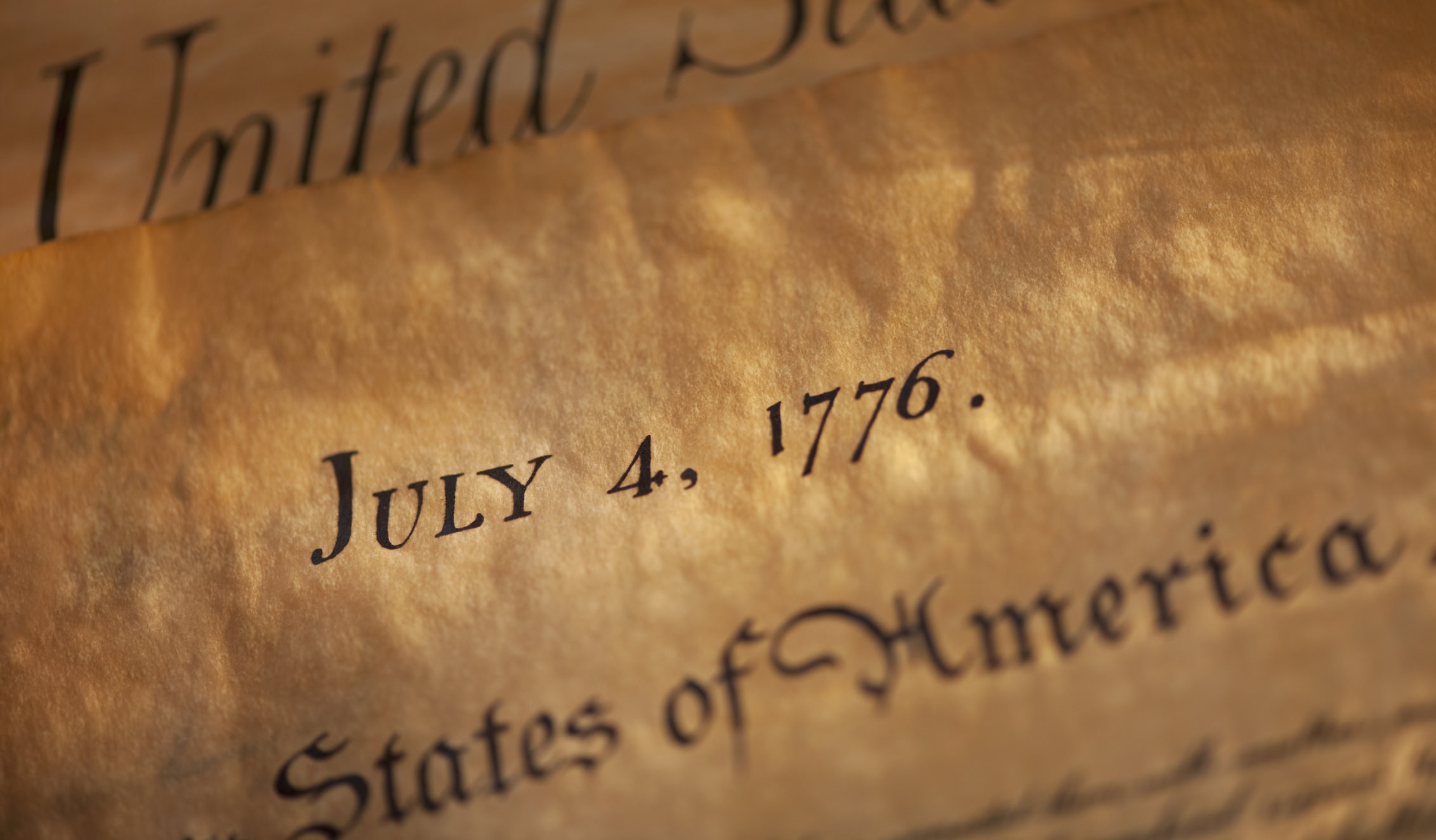
What should bind Americans together?
The following is an excerpt from Divided Over the Declaration: How an Enduring Debate Sustains the Vision of America, which is available now from Diversion Books.
Since the 1970s and for a variety of different reasons, the Declaration has been marginalized as a touchstone in national discourse. There are plenty of politicians and political movements in the last two generations that included a throwaway citation of the Declaration in a speech or manifesto. But this is far from the American people—even 10 or 15 or 20 percent— taking the Declaration seriously as a touchstone for deliberation. No 12-step ideological project for taking the Declaration seriously will elevate it to the prominent position it should hold today. Still, as America enters its next 250 years, it is worth considering what nonideological, nonpartisan steps will help in this effort. For Americans to get right with the Declaration, they must take it seriously for (1) its ideas, (2) the disposition it inspires, and (3) the skill set it requires.
Taking the Declaration’s Principles Seriously Today
First, taking the Declaration seriously means taking its principles seriously. As a set of ideas, the Declaration is critical for every citizen to know. It takes about ten minutes to read it. At just over 1,300 words, it is not too heavy a lift. After you finish this book, read the document in its entirety if you have never done so or if you have not read it recently. The Declaration’s preamble (second paragraph) is important, but it is vital to understand the document’s whole argument. Instead of pitting equality and liberty against each other, the Declaration reveals them to be complementary. All human beings are equal in possession of the natural rights of life, liberty, and the pursuit of happiness. Government’s job is to secure those rights. If government fails to secure the rights, it is unjust. If it persists in failing to protect citizen rights, revolution may be justified.
The history of America is the history of a protracted, almost always contentious debate about the Declaration and its principles. From its inception, it has been the subject of ceaseless debate, much of it serious. America’s Declaration demands that it be debated. Its own insistence on freedom carved out room for this deliberation. After all, the Declaration started with “a decent respect to the opinions of mankind.” Debating these ideas is an essential part of taking the Declaration seriously. And debating them seriously is not just about citing the Declaration.
To think and reason worthy of the Declaration’s promise is to start with the dignity of each individual alongside the “safety and happiness” of the community. It is to affirm the equality of all human beings—and that each by nature of their humanity has rights of which the government may not deprive them. It is to affirm the consent of the governed, a principle that flows from the principles of liberty and equality. What if public policy debates using the Declaration as a touchstone became more common? This would mean taking the moral dimension of politics and policy more seriously. Instead of seeing political things as a zero-sum scrum, we should consider the principles at stake. Instead of seeing the other side as an existential threat to democracy, we should consider them fellow Americans just as interested in our common destiny and listen to them.
Declaration-Inspired Disposition
Second, taking the Declaration seriously means taking seriously the sentiment, or disposition, it inspires. Speaking in Chicago just after Independence Day in 1858, Abraham Lincoln reflected on why Americans celebrate July Fourth. He stated that the celebration was about the growth of the country and the good that Americans have done. But it was not just about shared history. It was not about the generations who made America but rather about those who believe in its principles.
About half of Americans at the time, Lincoln noted, were not descended from old stock America. Rather, they were immigrants from Europe, without any bloodlines going back to the founding. Still, despite this lack of familial connection, when they encounter the “moral sentiment” in the Declaration—“We hold these truths to be self-evident, that all men are created equal”—they recognize that it is “the father of all moral principles in them.” Belief, not bloodlines, matters most. “That is the electric cord,” Lincoln said, “in that Declaration that links the hearts of patriotic and liberty-loving men together, that will link those patriotic hearts as long as the love of freedom exists in the minds of men throughout the world.”
Lincoln spoke about this sentiment in the context of children, or what today is called civics. What he urged, for children and Americans of every age, is the inculcation of the sentiments of the Declaration. This is not to be confused with sentimentalism, which is excessive feelings of sadness or nostalgia. Lincoln encouraged the opposite of sentimentality. For him, the sentiment, or love, of the Declaration’s principles is grounded in knowledge of them. Sentiment is like disposition: it is informed by sound reason and habit. One important disposition befitting a citizen is informed patriotism. It comes from the knowledge and love of what Frederick Douglass called the “saving principles.” Patriotism defined by love of the saving principles is a mean between the extremes of excessive love, which can stray into nationalism, or insufficient love, which can lead to resentment. A genuine love of the saving principles leads to gratitude. This gratitude should be given to the Creator, to those who have fought for our principles, and to one’s “fellow citizens.”
The Declaration itself counsels a particular disposition. The shift it demarcates is from subjects to citizens. Citizens are capable of self- government. Subjects are not; they are servile. A disposition for self-government is about individual virtue and what it takes to uphold the common good. The Declaration mentions or refers to a number of civic and moral virtues: justice, prudence, patience, moderation, firmness, humility, magnanimity, and honor. These civic virtues make room for respectful dialogue and deliberation in a common endeavor.
The people and their representatives are able to govern themselves judiciously. The importance of public and private integrity is implied in the principles of the Declaration. Principled courage was on full display in the crafting of the Declaration and the winning of the American Revolution. Mutual respect and civic friendship flow from the Declaration’s philosophy, although each is a hard-won quality. Empathy is born out of mutual respect and civic friendship. Resilience is a hallmark of putting the Declaration’s principles to work. Patience flows from resilience. In the 19th and 20th centuries, the long struggles for suffrage and civil rights exemplified resilience and patience, as well as the complementary virtues around moral urgency.
As the historic moments around the Declaration in this book have revealed, the line between rashness and courage or between moral laxity and patience is often blurrier than at first we think. Patience is a virtue, but too much of it can become a vice.
Moral and civic virtues are acquired more than they are taught. The acquisition of virtue takes time; it must become habitual. Virtue is a disposition or habit. Parents are responsible to help their children habituate themselves to moral and civic virtue. Adults must start this process early alongside their kids. Families, schools, houses of worship, and voluntary civic organizations cultivate virtue through education and daily practice. In his 1858 Chicago speech, Lincoln showed that the message of Stephen A. Douglas to which he responded was exactly the wrong history and civics lesson for young people. Referring to Douglas’s support of Dred Scott and his care-not approach to the morality of slavery, Lincoln contended that, “if taught to our children, and repeated to them,” will “tend to rub out the sentiment of liberty in the country, and to transform this Government into a government of some other form.”
Weak civic education matters deeply because of disposition. Civic knowledge and disposition determine the destiny of a country. Weak civics can undo the disposition that Americans need to uphold the Declaration and its principles. Strong civics builds this disposition daily. In 2025, a national survey revealed that nearly three out of four Americans believe the Declaration is relevant to their lives. Taking the Declaration seriously means creating strong civics that attaches young people to its principles. This is the task in a constitutional democracy where self-governance is required.
The story of the Declaration is a story about civic learning and engagement. Each moment around the Declaration in this book featured it. Each story included individuals whose lives changed forever because of a civic spark, which in turn enabled them to change forever the lives of others. For some the civic spark came early. For others it came later in life. For some it came in the classroom. For others it started at home. For Lincoln and Frederick Douglass, it came in the Columbian Orator and other publications they read.
Civics must start with the Declaration and embolden Americans at every stage of their lives. In Lincoln’s January 1838 speech to the Young Men’s Lyceum in Springfield, Illinois, he talked about civic learning in the aftermath of the November 1837 lynching, in Alton, Illinois, of the antislavery newspaper printer Elijah Lovejoy. Lincoln lamented the “mobocratic spirit” that led to Lovejoy’s murder. He urged fidelity to the principles of the Declaration and obedience to the laws and the Constitution. The acquisition of this disposition must start young, Lincoln held: “Let reverence for the laws, be breathed by every American mother, to the lisping babe, that prattles on her lap—let it be taught in schools, in seminaries, and in colleges;—let it be written in Primmers, spelling books, and in Almanacs.”
Taking the Declaration seriously as a sentiment, or disposition, ultimately leads one to the core things about what it means to be human. It spurs reflection on human nature itself. This is not an abstract reflection. The Declaration’s argument is that a prince, King George III, became a tyrant. As the grievances mount, the Declaration indicts the king for arrogating to himself legislative, executive, and judicial powers that he did not have. Its implication is that no human or single entity can exercise all these powers without becoming tyrannical; the prince became a tyrant. A Declaration disposition is a disposition against tyranny. It is a disposition for liberty and equality for all. It is skeptical of centralized power because governments tend to be greedy for it.
Governments are made up of people. And while people are rapacious for power, they also are capable of self-government. The Declaration warns against excessive faith in government but urges belief in people’s capacity for self-government. The Declaration points the way to self-governance as the highest calling for each American and our existence as “one people.” Its confidence in self-government is remarkably optimistic without being naïve. This confidence has had the effect of emboldening Americans to act as individuals and groups. It creates vast space for civil society, which has been the engine of American progress.
What if the legacy of America’s 250th birthday is the reinvention of civics based on Declaration principles? The bicentennial sparked significant interest in local history. The success of the semiquincentennial should be judged based on what it can do for civics. Strong civics draws on history and helps young people acquire moral and civic virtues; it teaches the roles of civil society and government. It equips Americans for the lifelong practice of the pursuit of happiness that leads to principled, productive citizenship.
The Declaration’s Skill Set
Third, taking the Declaration seriously means acquiring a skill set to put its principles into practice. The Declaration of Independence includes abstract ideas, but it was and is a practical instrument. Ultimately, it demands the skills of citizenship. Its preambulatory principles mean nothing if they are not put into practice. Strong civics is about gaining the lifelong disposition or practice of the pursuit of happiness. This means knowing oneself, acquiring the moral and civic virtues and disposition required of citizenship, and equipping oneself with the requisite skills. America’s ability to thrive in the next 250 years will depend on each young person securing the civic skill set needed for success. Contrary to conventional wisdom, this skill set is not mainly about technical knowledge including media literacy or prowess around artificial intelligence.
Those skills are of secondary importance, even in the 21st century and the age of AI. The most important skills needed by young people include their ability to relentlessly pursue the truth and to cultivate virtue. These skills follow logically from the “Declaration disposition” discussed above. To take the Declaration seriously is to recognize that the civic skill set is about putting its principles into practice.
Experiential learning is the way to do this. Experiential learning that builds on a strong knowledge base is the best, proven way for young people to gain skills. A 2025 report on experiential learning published by the Council on Civic Strength surveyed the most effective strategies. The report emphasized community engagement, collaboration, and the development of a problem-solving framework. Effective communication, perspective taking, and managing civil disagreement all build on a problem-solving toolkit. Young people also should learn how to run meetings, structure meeting agendas, and work through conflicts to compromise.
All of this should be done with the recognition that civil society is the main engine of American progress. As the Declaration moments in this book have revealed, action based on the corrective mechanism of the Declaration almost always started with the American art of association. From enslaved persons’ petitions based on the Declaration principles to the burned-over district activity around suffrage that led to the Seneca Falls Declaration of 1848 to the thousands of organized abolitionist chapters that hastened slavery’s demise, the Declaration story is about citizen activity that overcame divisions, forged compromises, and corrected course.
The truth is that Americans today are not as divided as they think they are, especially about core matters including Declaration principles. Sophisticated polling reveals much broader agreement about American principles than surface-level polarization and politicization studies show.
For instance, 91% of Republicans and 95% of Democrats agree with the statement, “Throughout our history, Americans have made incredible achievements and ugly errors.” However, Democrats believe that only 41% of Republicans will agree with the statement (a 50-percentage point misperception gap), while Republicans believe that only 55% of Democrats will agree (a 40-percentage point misperception gap).
Take another example: While 92% of Democrats agree with the statement, “All students should learn about how the Declaration of Independence and the Constitution advanced freedom and equality,” Republicans believe that only 45% of Democrats will agree with the statement. This is a misperception gap of 47 percentage points. On the topic of learning from history, 93% of Republicans agree with the statement, “Americans have a responsibility to learn from our past and fix our mistakes,” but Democrats believe Republicans will agree at a rate of 35%. This is a misperception gap of 58 percentage points. The misperception gaps of one party’s members versus the others are massive—often 50 percentage points versus the reality. Given the perceptions of “you” and “yours” that this survey reveals, it is not surprising that 71% of Americans perceive the country to be deeply divided on the topic of U.S. history.
It appears that Americans overestimate how far apart they are not just about history but on other related topics, as well. Private opinion polling reveals what Todd Rose has argued are “collective illusions.” When people speak with a survey taker, they often feel a compulsion to conform to conventional wisdom.
For instance, in surveys about polarization, those answering the questions feel like they should say that Americans are deeply divided about everything. The constant swirl of talk about division, polarization, politicization, and even a cold civil war is all around Americans, leading most to believe that Americans are hopelessly divided. When the survey instrument and the means of collecting the surveys shift, and individuals can be more honest in their answers, the responses are noteworthy.
For example, Populace research reveals that when it comes to the relationship of character and status, Americans “overwhelmingly” emphasize character but believe that society prioritizes status, or owning luxury items, being famous, or attending an elite college. This is seen in other areas of significance to civics, including community involvement and the achievement of the American dream. Americans are not nearly as involved in their communities as they want to be, private opinion surveys reveal. About two-thirds of Americans believe that the American dream is possible for them to achieve, but less than half think that other Americans believe it is possible. In other words, there are misperception gaps today across many facets of American life, including what we think is possible in the future. “You” and “yours” are shouted the loudest, but “our” and “ours” is stronger.
In 1999, the New Jersey state legislature set off a strident battle over the Declaration. Conservative members of the State Assembly introduced a bill that would have required every third- through 12th-grade public school student in the state to daily recite a 55-word excerpt from the Declaration’s preamble, including “all men are created equal and endowed by their Creator with certain unalienable rights, among them life, liberty, and the pursuit of happiness.” Opponents claimed that the legislation was an effort to smuggle God into public schools. Proponents said that it inculcated “safe values.” In the end, the proposed bill, and similar efforts mounted as recently as 2022, failed to gain enough votes to become law.
America in the 21st century has seen many similar battles over history and civics. Whether about DEI, books in public school libraries, state standards, the role of the national government, or curriculum in local schools, these are vital conversations to have, and there is a robust, productive debate that happens every day. But often these debates give off more heat than light. The reality is that outside of the extremes on both sides, there is broader agreement about civics and history education than at first meets the eye. For example, there is broad cross-partisan agreement around what educators call “viewpoint diversity,” or the teaching of multiple perspectives. Overall, 84% of Americans say “it is important to evaluate different arguments about a topic,” and 79% of Americans say “it is important for students to debate topics from opposite points of view.”
Today, the evidence is clear that Americans have significant gaps in their knowledge about the Declaration and related core areas of civics and history. According to a 2025 survey of Americans, a majority, 53%, do not know why the United States declared independence. Another survey revealed that about 70% of the American people can name the three branches of government. It should be the case that 100% of Americans are able to name the three branches. It should also be the case that they can see that the separation of powers flows from the Declaration’s argument and the structure of the U.S. Constitution. Americans should learn and know why separating the powers is important for the promotion of liberty and equality for all. Ideally, they should be able to discuss the “why” not in the abstract but in the here and now. And they should be able to reasonably debate and disagree about policies related to the separation of powers and the system of checks and balances.
Civics and history education should not be partisan politics by other means, and the American people know this. Today, we the people are less divided about the Declaration than we think. We need strong civics and history education not to eliminate disagreement but to manage it better. Strong civics and history education that takes the Declaration seriously is not easy. It does not happen automatically.
Every day in the United States approximately 200 World War II veterans die. Over 16 million Americans served in World War II. Some 45,000 veterans are alive. Soon there will be none. In 1818, America faced a similar situation related to Revolutionary War veterans. In that year, 35 years after the war’s end, there were fewer than two thousand living veterans out of a total of more than 250,000 who fought.
With this situation in mind, Baltimore newspaper editor Hezekiah Niles wrote John Adams a letter asking him about the American Revolution. Adams sent a long, thoughtful answer that he summarized as follows: “This radical change in the Principles, Opinions Sentiments and Affection of the People, was the real American Revolution.” Having been “effected before the War commenced,” the American Revolution accomplished the nearly impossible task of bringing the colonies together, “to unite them in the Same Principles in Theory and the Same System of Action.”
Americans forget how radical the Revolution and Declaration were. Radical means “root.” The Declaration’s radicalism did not seek to remake human nature, but it did set in motion a uniquely American understanding of what “fellow citizen” means. Continuing that work is our task today, so that “you” and “yours” is a less frequent response to our fellow citizens than “our” and “ours.”
“We all know Abraham Lincoln by heart,” Frederick Douglass said in an 1883 speech celebrating the anniversary of emancipation in the District of Columbia. By this, Douglass meant that Americans knew Lincoln’s words but also that they took his words to heart. Successful, strong civics and history education can do the same thing for the Declaration, its story, and our “saving principles.” Americans today need to know the Declaration by heart so that its “saving principles” animate our next 250 years.

The American Mind presents a range of perspectives. Views are writers’ own and do not necessarily represent those of The Claremont Institute.
The American Mind is a publication of the Claremont Institute, a non-profit 501(c)(3) organization, dedicated to restoring the principles of the American Founding to their rightful, preeminent authority in our national life. Interested in supporting our work? Gifts to the Claremont Institute are tax-deductible.

It’s time to reassert the authority of we the people.

Populism can be broad enough to include the bourgeois virtues of the golf course.
Recovering the world-changing triumph of America.

How Americans are a revolutionary people.
Hillsdale’s Revolutionary America tells a captivating story.

