

A response to Christopher Flannery.
Bringing the Declaration to the People
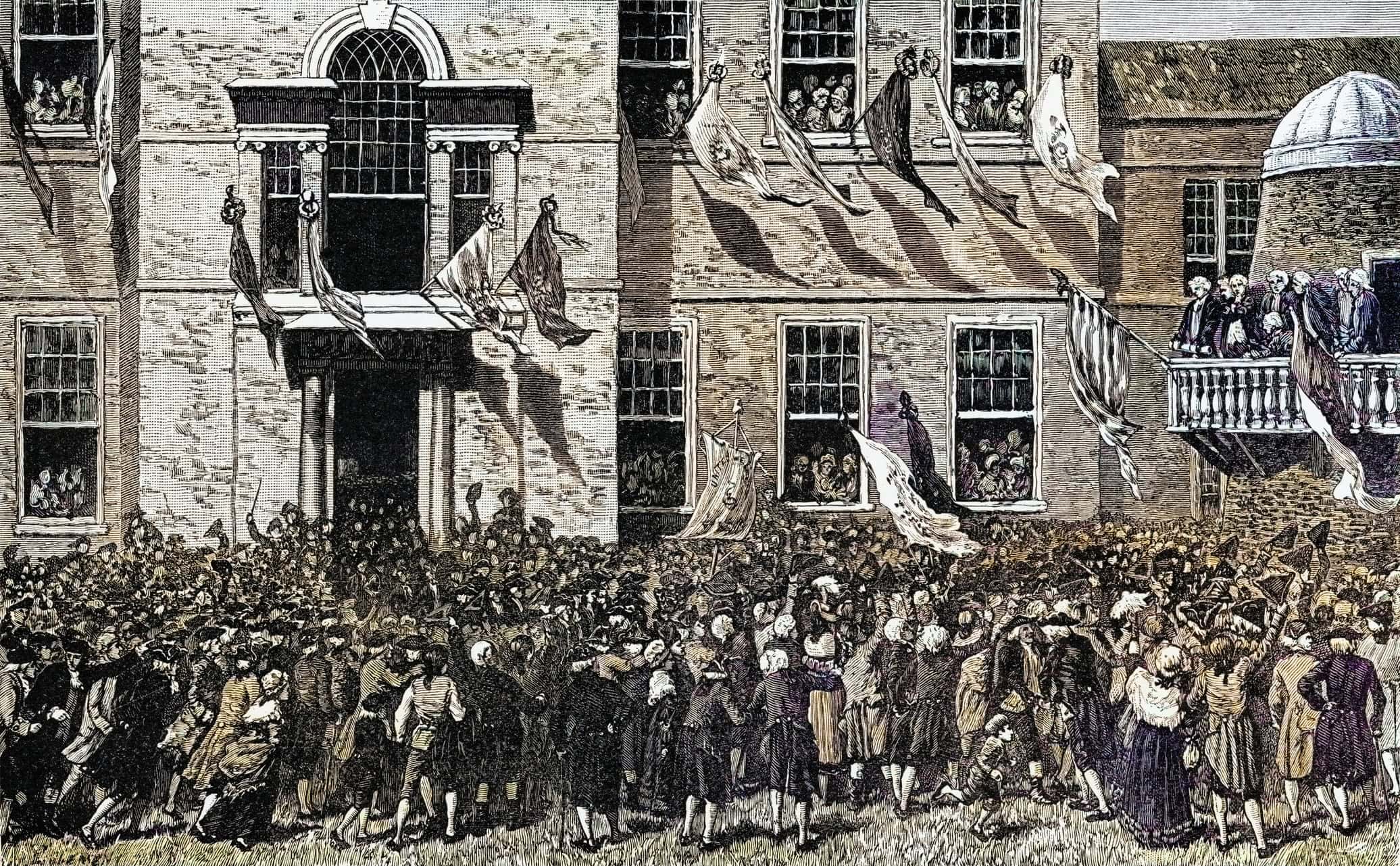
Letting the world know of American independence.
Editors’ Note
The following is an excerpt from Michael Auslin’s forthcoming book, National Treasure: How the Declaration of Independence Made America, which will be published on May 5 from Simon & Schuster.
On his way to the State House on the morning of July 4, 1776, Thomas Jefferson would have walked along High (now Market) Street, Philadelphia’s main thoroughfare. Four blocks down, past the open markets, on the southeast corner of Second Street was the printing shop of John Dunlap, an Irish immigrant and publisher of the Pennsylvania Packet, a weekly newspaper reporting on the proceedings of the Continental Congress. In his shop at No. 48 High Street, Dunlap, then only twenty-nine, was about to play a key role in the first hours of American Independence.
Though Congress had adopted the Declaration in the name of the “good People” of the colonies, John Adams would later claim that only one-third of these good people had supported war with Great Britain, while another third had opposed it and a middle third remained undecided. Americans needed to know that the colonies were now a new nation fighting for its existence, and they needed to be inspired to choose the right side. As soon as the delegates voted on the statement, they ordered “That the declaration be authenticated and printed” and “That the committee appointed to prepare the declaration superintend & correct the press.” After that, the record goes silent, and the questions begin.
Soon after the vote on July 4, John Dunlap was given the most important printing job in American history. Since the drafting committee was charged with overseeing the printing, Thomas Jefferson likely recommended Dunlap, who had printed his Summary View of the Rights of British America two years previously. Given that Philadelphia’s most famous printer, the seventy-one-year-old Benjamin Franklin, was ill with gout, it is likely that Jefferson himself carried the approved copy of the Declaration the few blocks to Dunlap. He would most likely have arrived in the early afternoon, staying through the night to make sure that his words—harshly (to his mind) edited by Congress—were accurately typeset. Yet in his copious notes, Jefferson makes no mention of Dunlap or of the printing.
It is at this moment that one of the great mysteries of the Declaration began.
Given the need to print the Declaration as quickly as possible, it is unlikely that Charles Thomson took the time to rewrite the 1,320-word document as approved. Nor did Thomson write out the approved text into his Rough Journal on the Fourth, leaving instead a blank space to insert a printed copy later. In other words, Congress kept no official version of the Declaration’s text. It would have to rely on what came back from the printer.
If no clean copy was written out, Dunlap likely received the “fair copy” of the draft in Jefferson’s hand, with lines crossed out and Congress’s many edits written in. Someone intimately familiar with the changes made to the fair copy would have had to guide the printer as he deciphered the marked-up document for typesetting. Again, that person most likely would have been Jefferson himself. Whatever the truth, the piece of paper authenticated by Hancock, attested by Thomson, and carried to Dunlap would have to be considered the official Declaration of Independence. And yet, almost inconceivably, this founding document of the United States disappeared from history the moment it left the State House.
One explanation for the disappearance is that Dunlap most likely did what many printers would do to save time on an urgent job. He would have cut up whatever official copy was brought him into sections and given them to different typesetters in his shop, a common practice in the printing process. If this is what happened, no one, not even Jefferson, thought to save the strips and restore the document once it had been typeset.
Like all printers, Dunlap would have first run off a “proof copy,” to check the typesetting against the handwritten document. Someone from the committee, likely Jefferson, would have checked to make sure he got it right. As it turns out, whoever looked over the proof copy found some mistakes.
We know this because one printed Dunlap copy is different from all other surviving ones. It is now held by the Historical Society of Pennsylvania and is most likely Dunlap’s proof sheet. Only part of this proof survived, but even so, we can see at least some of what was wrong with it. It contains multiple quotation marks around various phrases, like those Jefferson inserted in his surviving handwritten rough draft and in other documents he wrote. These quotation marks were probably used by Jefferson as guides for when the draft declaration was to be read aloud. He likely copied them from his rough draft onto the fair copy he presented to Congress, and from there, it went to the printer. However, Jefferson—or whoever looked over Dunlap’s proof—realized these marks should be taken out of the printed document.
The proofreader also caught a more serious mistake, most likely made by Dunlap. In line 13, the proof includes the phrase “institute a new government.” All other copies of the Declaration, including the famous en grossed copy, omit the a. Inserting a single a may seem inconsequential, but it wasn’t to Congress. What likely seemed grammatically correct to the typesetter was a potentially explosive error. The colonies had agreed to break from England as independent states, so their official proclamation could not refer to a unitary government. To assert otherwise could have wrecked the new nation before it got off the ground, given the fear smaller colonies had of domination by the larger ones. What later became known as the “errant a” was quickly removed.
Working hastily throughout the evening and night, Dunlap and his assistants printed up what were known as “broadsides,” single sheets of paper, generally 191⁄2 by 151⁄2 inches, on the shop’s wooden presses. The broadsides were printed on several different types of high-quality cotton-fiber paper, many of which bore Dutch watermarks and some of which, ironically, included a crown and the initials “GR,” Latin for King George and apparently made for the English market. At the top of the broadside, either Jefferson or Dunlap had decided to include the line “In Congress, July 4, 1776.” The inclusion of this simple date would cause centuries of misunderstanding about when the Americans actually decided to separate from Great Britain. Then followed the title Congress likely approved: “A DECLARATION By the REPRESENTATIVES of the UNITED STATES OF AMERICA, In GENERAL CONGRESS assembled.” Note that the document did not include the words unanimous or thirteen, since on July 4, the New York delegation had not yet been authorized to support Independence.
Without the officially approved copy from Congress, we don’t know how much license Dunlap took with orthography, especially the frequent and unsystematic capitalization of nouns. For example, in Jefferson’s rough draft, the famous triumvirate of “life, liberty, and the pursuit of happiness,” is not capitalized, but it is in both John Adams’s handwritten copy of the draft and the Dunlap broadside. Did Congress change Jefferson’s draft? Did Adams pop by the print shop and instruct Dunlap to do so? Or was it a personal choice of Dunlap’s? As was later quipped by the historian Carl Becker, the capitalization and punctuation in the Declaration followed “neither previous copies, nor reason, nor the custom of any age known to man.”
Something else was noticeable about the Dunlap broadside: the only names it contained were those of John Hancock, who “Signed by Order and in Behalf of the Congress,” and Charles Thomson. The rest of the men who voted to adopt the Declaration kept themselves anonymous. Neither ordinary Americans, nor the British, nor the rest of the world knew who had approved this audacious act. The Declaration was thus partially cloaked in the secrecy that marked all Congress’s proceedings. It was, after all, treasonous, and perhaps discretion was the better part of “sacred honor.”
Dunlap worked through the night and into the following morning. No record remains of how many copies he printed, though we know he ran off at least two batches, based on tiny stylistic differences between copies. In the rush, some were printed slightly askew, and some were folded before they were fully dry, leaving offset impressions. Perhaps unhappy with the haste of his work, Dunlap at some point reset the type and printed a single copy of the Declaration on durable animal parchment. This unique version is now held by the American Philosophical Society in Philadelphia, America’s first learned society, founded by Benjamin Franklin in 1743, among whose members were fifteen of the Signers.
Only twenty-six copies of Dunlap’s broadsides would survive the ravages of time, making it one of the most sought-after artifacts in American history. By early morning on July 5, Dunlap had a batch ready for Congress. As soon as he received a copy, Charles Thomson affixed it with wax wafers in the space in the Rough Journal he had set aside the previous day.
It was now time to let the world know about American Independence.
***
On July 5 and 6, John Hancock and Charles Thomson dispatched express riders with copies of the Dunlap broadside, following Congress’s order to send the Declaration to the state assemblies and local committees of safety, as well as to the Continental Army. Outside a few major cities, most roads were little more than tracks through the wilderness or rutted paths, sinking wagons in impassable mud pits or saturating travelers in dust. Only a few scattered stage lines operated, and a letter from Boston to Philadelphia would take the better part of a month.
Even as the riders started upon these abysmal roads, Heinrich Miller’s widely read Pennsylvanischer Staatsbote, catering to the seventy thousand Germans concentrated in the fertile western part of Pennsylvania, became the first newspaper in the colonies to report that a Declaration of Independence had been adopted. Four days later, on July 9, the Staatsbote published a German translation of the Dunlap broadside.
The first unofficial printing of the Declaration appeared on July 6 in a Philadelphia newspaper. Surprisingly, it was not John Dunlap’s own Pennsylvania Packet that brought the Declaration to the public, but his rival Benjamin Towne’s Pennsylvania Evening Post. Towne’s printing press was just a block from Dunlap’s shop, at High and Front Streets, near the popular London Coffee House. No one knows how Towne got his hands on a copy of the Declaration. A spy in Dunlap’s shop may have spirited a copy out or passed it surreptitiously in the coffeehouse. The news quickly made its way to other newspaper publishers up and down the seaboard. By the end of July, the Declaration had been reprinted in thirty newspapers, from New Hampshire down to Virginia. Americans farther south would have had to wait for the express riders to learn that they lived in a new country.
As word of Independence spread, the new state assemblies printed their own official broadsides. Those north of Philadelphia were printed in New York, Massachusetts, and New Hampshire; none appear to have been published in the South. Some of these reprintings included State resolutions approving Congress’s action while others told readers when the Declaration was to be read in public. Still others, addressed to local reverends, were intended to be read in church. In the public square and from the pulpit, Americans were learning about Independence.
***
At noon on Monday, July 8, John Adams took a break from his duties and stepped outside the State House. A “great Crowd of People” was gathered in front of a viewing platform set up by the American Philosophical Society in 1769 to measure the Transit of Venus, the first great scientific endeavor undertaken in the colonies. From the platform, Colonel John Nixon, sheriff of Philadelphia, gave the first public reading of the Declaration. Adams described the festive atmosphere in a letter to Samuel Chase, saying that the reading was followed by “Three Cheers…The Battalions paraded on the common and gave Us the Feu de Joy” (a rifle salute). After the ceremony, Adams told Chase, “The Bells rung all day, and almost all night.”
As Nixon finished reading the Signers’ rousing pledge, a group of men rushed into the State House, took down the King’s Arms, carried them outside to the common, placed them on a pile of wooden casks, and burned them. What seemed a spontaneous act of patriotism was a carefully choreographed action by eight members of the Pennsylvania Association, a volunteer military group. According to the Philadelphia druggist Christopher Marshall, who kept a detailed diary during those days, the plot was hatched on July 6 by members of the American Philosophical Society, of which Marshall was one. Designed to spark fervor among the listeners at the reading, it appears to have been the first instance of political theater after Independence.
One would have expected Thomas Jefferson to be keenly interested in this first public reception of the Declaration, but he made no mention of the reading in his notes. Nor did Adams indicate that he was joined by Jefferson at the ceremony. It was an odd absence for someone so proud of his handiwork. Yet up and down the colonies, the Declaration was treated as a collective document, like the hundreds of resolutions passed in local committees over the past years. None of the accounts of the day, or the succeeding ones, include any mention of who, if anyone, was the primary author of the audacious document.
The next day, one of Hancock’s express riders reached New York City, where George Washington was encamped with his troops, preparing for a British attack. Hancock had sent the broadside with a note requesting that Washington “have it proclaimed at the Head of the Army in the way, you shall think most proper.”
Washington was quick to write back:
I perceive that Congress have been employed in deliberating on measures of the most Interesting nature. It is certain that It is not with us to determine in many Instances what consequences will flow from our Counsels, but yet It behoves us to adopt such, as under the smiles of a Gracious & All kind Providence will be most likely to promote our happiness; I trust the late decisive part they have taken is calculated for that end, and will secure us that freedom and those privileges which have been and are refused us, contrary to the voice of nature and the British Constitution.
Washington understood the symbolic importance of this charter of freedom and hoped it would give material and moral support to his Continental Army. Just a week earlier, he had written to Hancock asking for flint, telling him that “an agreable spirit and willingness for Action seem to animate and pervade the whole of our Troops.” Yet at almost the same time, John Adams described the army as “an Object of Wretchedness…Disgraced, defeated, discontented, dispirited, diseased, naked, undisciplined, eaten up with Vermin…”
Washington immediately ordered the Declaration “to be read with an audible voice” to the various brigades of the army throughout the country, reporting to Hancock that he hoped it would “serve as a free incentive to every officer, and soldier, to act with Fidelity and Courage.” At his headquarters on Manhattan, where City Hall now stands, the reading took place at 6 p.m. that very day. The General sat on horseback at the head of the troops drawn up in ranks and later told Hancock that “the measure seemed to have their hearty assent.” The cheers may well have been heard by British troops encamped on nearby Staten Island.
That hearty assent soon turned into a mini-riot, as some of Washington’s troops converged on the large equestrian statue of George III raised only six years earlier at the southern tip of Manhattan. John Adams had described it in his diary while on a visit to New York as “very large, of solid lead gilded with gold, standing on a pedestal of marble, very high.” A colonial officer, Colonel Seymour, related its fate: the statue “was, by the sons of freedom, laid prostrate in the dirt” and melted down, the lead used for “bullets, to assimilate with the brain of our infatuated adversaries.” Washington issued orders acknowledging the troops’ “Zeal in the public cause,” but fearing “riot and want of order,” he directed that “in future these things shall be avoided by the Soldiery, and left to be executed by proper authority.”
Washington’s men stopped toppling statues, but the General had less success controlling the citizens of New York. On July 18, when the Declaration was formally published by the New York State Convention, the British Arms over the seat of Justice in the Court House were taken down, torn to pieces, and burned. Those carved into the Court House pediment were likewise thrown down and smashed, while pictures of George III were burned to the cheers of the crowd. The Declaration released passions that American officials welcomed as proof of patriotism but also feared.
In Boston, cradle of the Revolution, the Declaration was read to a large crowd from the balcony of the State House on that same day. Abigail Adams had come in from the farm for the proclamation, and it was her turn to describe the festivities in a letter to her husband: “three cheers…bells rang, the privateers fired, the forts and batteries, the cannon were discharged, the platoons followed, and every face appeared joyful…Thus ends royall Authority in this State.” As most Loyalists had left Boston with the British troops the previous March, passionate Patriots threw down the King’s Arms and “every sign with a resemblance of it,” and burned them in bonfires.
The farther from Philadelphia, the longer it took for the news to spread. While some newspapers were reprinting the Declaration, most people learned the news of Independence from the official readings. The Declaration was proclaimed in Williamsburg, Virginia, on July 25, and in Charleston, South Carolina, in the beginning of August. The southern most State, Georgia, was the last to receive notice. On August 10, nearly five weeks after Independence, a crowd in Savannah finally heard the Declaration read in public.
On July 16, James Bowdoin, president of the Massachusetts Provincial Congress, was in Watertown, about twenty miles west of Boston, meeting with delegates from the St. John’s and Mi’kmaq Indian Tribes of Nova Scotia. Long chafing under British control and resenting their expansion into tribal lands in Canada, the tribes were ripe for an alliance. Bowdoin had just received a copy of the Dunlap broadside, which he read and translated for the assembled Indians, emphasizing that the Americans had overthrown British rule and could help them do the same.
After hearing the Declaration, the Mi’kmaq leader, Ambrose Bear, said, “We like it well.” He agreed to provide six hundred warriors to campaign with the Americans in Nova Scotia and defend the border of Maine. A week later, the parties signed the Treaty of Watertown, which directly quoted part of the Declaration’s text, including the right to contract alliances. The Indian tribes were most interested in protecting themselves from reprisals and reclaiming their lands. Had they known that Washington had sent an expedition to destroy dozens of Iroquoian towns allied with the British along the northwest border of the colonies, their calculations may well have been different.
A few months later, in November, the British defeated the Americans at the Battle of Fort Cumberland in Nova Scotia, ending the American threat to Canada. British pressure led the tribe to break its alliance in 1779 and sign a new treaty with the English. Trying to maintain a middle ground, the tribe continued to send ceremonial wampum belts to Congress as a sign of friendship, but no longer was there talk of a new partnership.
***
On July 28, 1776, Vice Admiral Lord Richard Howe, commander of British naval forces and brother of General William Howe, sent a copy of the text of the Declaration to London. It arrived by mid-August and appeared in The London Chronicle on August 17. That same month, The Gentleman’s Magazine also printed the Declaration, calling it a “desperate measure” and blithely dismissing Jefferson’s charges by stating “whether those grievances were real or imaginary…we will not presume to decide.” The British responses to the rebels was not long in coming. In the autumn John Lind, a London barrister, published An Answer to the Declaration of the American Congress, casting the conflict as an affront to national honor. The Americans had not just rebelled against the King, charged Lind: “the Declaration of the American Congress is an insult offered to everyone who bears the name of Briton.” Among the more popular English critiques was James MacPherson’s The Rights of Great Britain As serted against the Claims of America: Being an Answer to the Declaration of the General Congress, which went through eight editions in 1776 alone. MacPherson dismissed the Declaration as a mere “paper” in which “the facts are either wilfully or ignorantly misrepresented.”
If anyone in England could be said to truly understand the Declaration, it was Thomas Hutchinson, who had been at the center of the colony’s politics for over three decades and had served as lieutenant governor from 1758 until he was named governor in 1771. An avowed Loyalist, despised for his support of the Stamp Act, Hutchinson had acted as the unofficial leader of the Massachusetts exiles in London since his flight in June of 1774. In Strictures upon the Declaration of the Congress in Philadelphia, Hutchinson mocked the Declaration’s claim that taxation without representation had driven the rebels to separation. If that issue had not appealed, he wrote, “other pretences would have been found for exception to the authority of Parliament.” Yet Hutchinson wrote as a man without any country, as unwanted in England as he was in Massachusetts. “We americans are plenty here and very cheap,” he lamented. He would die in 1780 before setting foot back in his homeland.
On October 31, in a speech at the opening the House of Peers, King George commented publicly on the rebels’ action for the first time. “They have…presumed to set up their rebellious Confederacies for Independent States,” he declared. “If their Treason be suffered to take Root, much Mischief must grow from it, to the Safety of my loyal Colonies, to the Commerce of my Kingdoms, and indeed to the present System of all Europe.” Beyond this, the King was silent. As his biographer Andrew Roberts notes, George likely never read the Declaration and never referred to it in his extensive correspondence.
Domestic political opposition to King George’s government translated into muted support for the Americans. The Virginian diplomat William Lee, younger brother of Richard Henry Lee, who had lived in London for nearly twenty years and had been appointed a political agent of the Continental Congress, wrote from London on September 10 that the op position party Whigs “do not say much, but rather seem to think the step a wise one…and what was an inevitable consequence of the measures taken by the British Ministry.” Another Whig, Edmund Burke, had long advocated for the colonists’ rights as Englishmen, including in his famous 1775 “Speech on Conciliation with America.” Burke was not sympathetic to the Declaration, however, just as he could not approve of outright revolution, lamenting the loss of “a large and noble part of our Empire.” As Burke understood, the Americans had not just created a country, they had thrust Britain into a new era.
From National Treasure: How the Declaration of Independence Made America by Michael Auslin. Copyright © 2026. Reprinted by permission of Avid Reader Press, an Imprint of Simon & Schuster, Inc.
The American Mind presents a range of perspectives. Views are writers’ own and do not necessarily represent those of The Claremont Institute.
The American Mind is a publication of the Claremont Institute, a non-profit 501(c)(3) organization, dedicated to restoring the principles of the American Founding to their rightful, preeminent authority in our national life. Interested in supporting our work? Gifts to the Claremont Institute are tax-deductible.
Suggested reading
Thomas Jefferson and John Adams celebrate their last Fourth of July.
Misuse is no reason to reject the Declaration’s principles altogether.
Those who speak plainly about our regime’s decay are not the ones responsible for it.
Soviet history-writing comes to the National Park Service.

A sure guide to understand America.

